Azerbaijan’s growing engagement with China reflects a strategic and pragmatic approach to Eurasian connectivity, according to Nurbolat Nyshanbayev, a professor at Turan University.
His remarks come as Azerbaijan’s Foreign Minister Jehun Bayramov visits China for high-level talks with Chinese Foreign Minister Wang Yi, amid intensifying focus on Euro-Asian trade routes, logistics and regional cooperation.
According to Nyshanbayev, Azerbaijan–China relations have evolved significantly in recent years, particularly following the pandemic, as Beijing has expanded its outreach toward Western markets.
He stressed Azerbaijan’s central role in enabling east–west trade flows, pointing to the country’s strategic geography in the South Caucasus.
“If we look at the map, without Azerbaijan and the Chinese relations, the goods from the east to the west will not move freely,” Nyshanbayev noted. “Azerbaijan as a South Caucasus nation is very important, providing a secure and transparent logistical hub from China to Europe.”
According to the expert, Azerbaijan has established itself as a key transit hub linking China and Central Asia with Türkiye and European markets, a role that has gained importance amid disruptions to traditional trade routes.
“The latest geopolitical changes in Russia, Ukraine, also in the Middle East, we have seen the international trade route is now interrupting,” he said, adding that maritime routes for Chinese exports to Europe have become increasingly problematic.
In this context, Nyshanbayev said overland corridors through Central Asia, the Caspian Sea, Azerbaijan, Türkiye and Georgia offer one of the most efficient and reliable alternatives.
“That’s one of the efficient, one of the trustworthy roads for Chinese exports,” he said, describing Azerbaijan–China cooperation as “realistic, basic, pragmatic steps, which create a win-win situation for all the parts.”
Strategic framework and regional cooperation
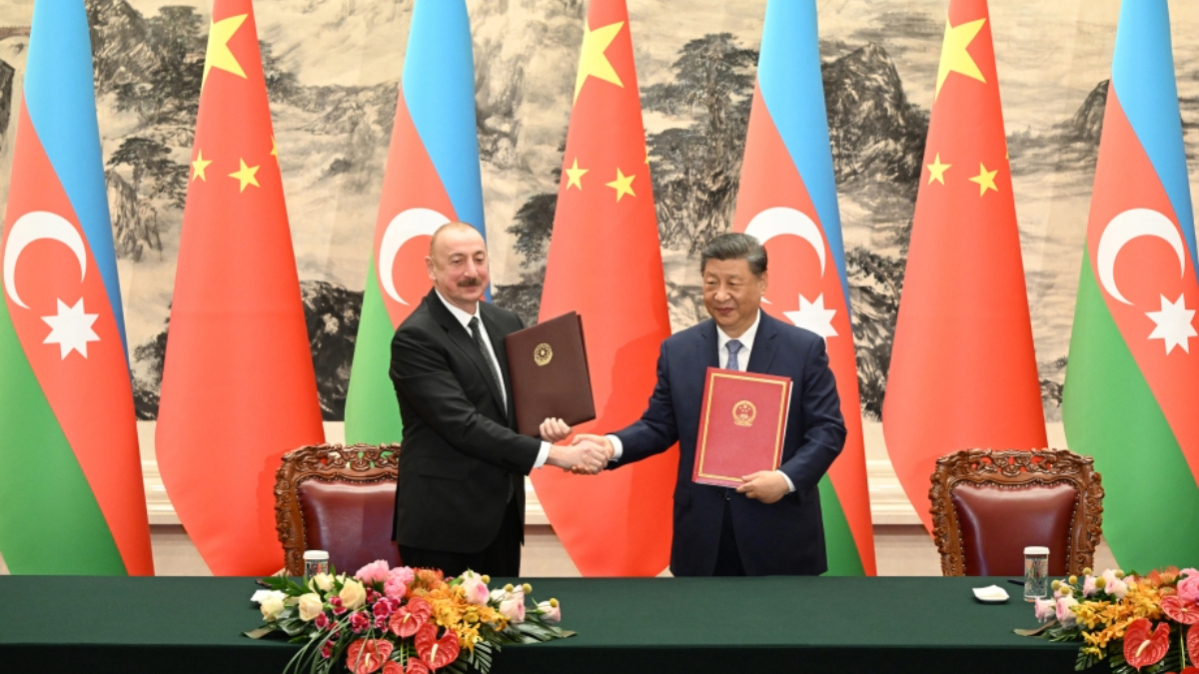
The cooperation has been reinforced by the 'Joint Statement on the Establishment of a Comprehensive Strategic Partnership between the Republic of Azerbaijan and the People’s Republic of China', signed in Beijing on 23 April 2025, during President Ilham Aliyev's state visit to China.
The agreement has laid the institutional groundwork for deeper cooperation under the Belt and Road framework.
Nyshanbayev also linked the partnership to China’s broader Belt and Road vision, calling trade routes a strategic pillar of Beijing’s foreign policy.
Turning to Central Asia, he noted that Azerbaijan’s relations with the region have reached a new level, reinforced by China’s expanding role.
“There are way more values uniting Azerbaijan and Central Asia than separating them,” he said, pointing to shared interests in logistics, economic cooperation, education and culture.
Nyshanbayev added that Azerbaijan is increasingly viewed by landlocked Central Asian countries as a gateway to Europe.
Asked whether the China visit reinforces Azerbaijan’s broader foreign policy vision, he said both countries share a pragmatic and cooperative outlook.
“There are more things to unite them than to disintegrate them,” he said. “It’s strategically important to remove all the barriers and to create concrete steps for the common projects.”












What is your opinion on this topic?
Leave the first comment