Turkish President Recep Tayyip Erdoğan has told Masoud Pezeshkian, his Iranian counterpart, that violations of Turkish airspace by Iran could not be justified “for any reason whatsoever.”
In a phone conversation late Monday, Erdoğan also warned Pezeshkian that Iranian strikes on other regional countries “benefit no one.”
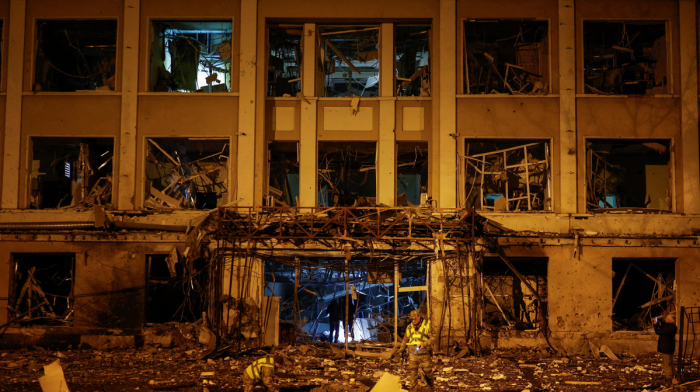
The two leaders spoke shortly after a second ballistic missile was intercepted by NATO air defences over the eastern Mediterranean before falling to earth in Türkiye’s east-central Malatya Province.
It was the second ballistic missile fired towards Türkiye in the past week.
Tehran, meanwhile, said its forces had not fired any munitions at Türkiye.
In his call with Pezeshkian, Erdoğan also voiced Türkiye’s objection to what he described as “unlawful interventions” against Iran, noting that Ankara was pursuing intensive diplomacy aimed at ending the ongoing war between Iran, Israel and the U.S.
According to Erdoğan, Turkish officials have recently spoken with more than a dozen regional and international leaders in the hope of “finding a way out of the crisis”, now in its second week.
Pezeshkian, for his part, told his Turkish counterpart that Tehran planned to launch an investigation into allegations that its forces had launched a ballistic missile towards Turkish territory.
According to official Iranian statements, Pezeshkian also asserted that Israel and the U.S. were attempting to create tensions between Iran and its neighbours, including Türkiye.
In a statement on Tuesday, the Turkish Defence Ministry said that “necessary measures” were being taken to “secure our borders and airspace” and that Ankara was coordinating closely with its NATO allies.
According to the ministry, these measures include the deployment of a Patriot air-defence system in Türkiye’s Malatya Province.
Missed opportunity
In a related development, Ömer Çelik, a spokesman for Türkiye’s ruling AK Party, said the regional war would not have occurred if Ankara had been given the chance to mediate between the belligerents.
In televised remarks on Monday, Çelik also said the initial U.S.–Israeli attack on Iran - which triggered the war - lacked any legal basis, adding that the consequences of a U.S. ground invasion would be “horrific”.
According to the party spokesman, Ankara does not expect any radical changes to Iranian policy under Iran’s newly elected supreme leader, Mojtaba Khamenei.










What is your opinion on this topic?
Leave the first comment