The AnewZ Opinion section provides a platform for independent voices to share expert perspectives on global and regional issues. The views expressed are solely those of the authors and do not represent the official position of AnewZ
For decades, the European Union positioned itself as one of the world’s most vocal champions of open markets and rules-based trade. Brussels urged governments across the developing world to liberalise, limit industrial subsidies and respect the commitments of the World Trade Organization.
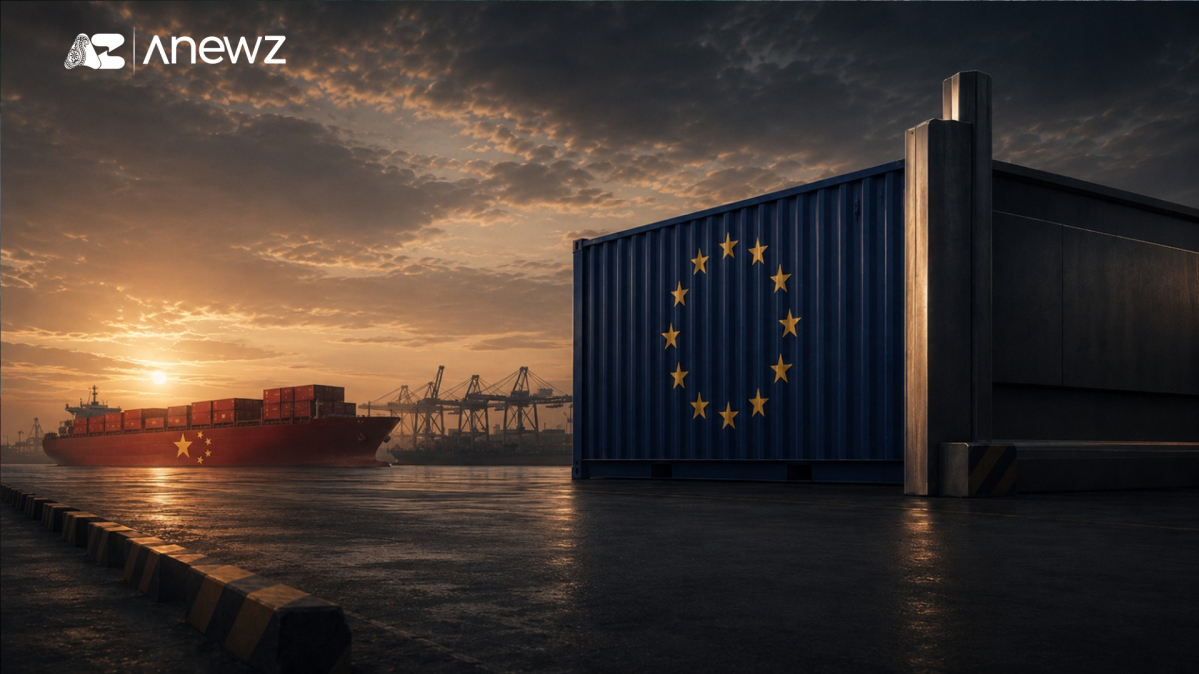
That posture is becoming increasingly difficult to sustain. The EU’s recent wave of trade restrictions, directed largely, though not exclusively, at Chinese goods, raises uncomfortable questions not only for Beijing but for anyone who believed the multilateral trading system was more than a convenience for the already powerful.
The measures are broad in scope. Brussels has adopted definitive five-year countervailing duties on battery electric vehicles from China, with additional duties of up to 35.3 per cent depending on the producer.
It has also moved towards a tighter steel import framework, replacing existing safeguards with tariff-free quotas and a 50 per cent duty on imports above those quotas. In chemicals, the EU has imposed high anti-dumping duties, including a 122.8 per cent duty on phosphorous acid from China.
Alongside these conventional instruments, the EU has deployed its Foreign Subsidies Regulation with growing force. The European Commission has used it to investigate Chinese companies in areas such as security screening equipment and wind turbines.
New proposals, including the Industrial Accelerator Act, would also introduce tighter conditions for foreign investment in strategic sectors, including a 49 per cent ownership cap in certain cases and requirements linked to technology transfer, local capacity and value-chain integration.
These tools are written in neutral legal language. In practice, they will be viewed most closely through the lens of Chinese investment and Chinese industrial strength.
One does not need to be sympathetic to Beijing to notice the widening gap between the EU’s stated principles and its current practice.
Industrial anxiety dressed as security policy
The intellectual justification for these measures moves between two registers: economic security and fair competition. Both deserve to be taken seriously. But neither is free from political convenience.
The security framing has become particularly elastic. Grid components, inverters, turbines and other industrial technologies are increasingly discussed through the language of cybersecurity, supply-chain vulnerability and strategic dependence.
Some of these risks are real. Critical infrastructure should not be treated like ordinary consumer trade. But once the concept of risk is stretched too far, it can justify almost any exclusion. That is what makes it useful to policymakers - and dangerous to the credibility of the rules they claim to defend.
The fair competition argument is more honest, at least in its underlying motivation. European manufacturers of electric vehicles, solar panels, batteries and other green industrial goods are struggling to keep pace with Chinese competitors on cost, technology and scale. That is a real industrial challenge. It would be unrealistic to expect European governments to absorb the consequences without a response.
But there is a meaningful difference between a considered industrial strategy and a defensive wall. A serious strategy would invest in research, reskill workers, build genuine supply-chain resilience and accelerate Europe’s own manufacturing base.
A defensive wall protects inefficient producers, passes costs on to consumers and downstream industries, and delays the harder work of competitiveness. What Brussels is currently building often looks closer to the second path than the first.
The Foreign Subsidies Regulation deserves particular attention because it represents something genuinely new. It gives the European Commission authority to scrutinise foreign financial contributions received by companies active in the EU market.
Brussels argues that this is necessary to address distortions caused by foreign subsidies and to preserve a level playing field. China, however, has objected strongly, especially in the Nuctech case, where Beijing described the EU investigation as unlawful extraterritorial jurisdiction and ordered domestic entities not to cooperate.
Whatever one makes of Beijing’s legal argument, the underlying dynamic is larger than one company. Major economies are increasingly asserting regulatory reach beyond their own borders. The precedents established now, between sophisticated economies, will shape what other governments consider acceptable practice in the years ahead.
When de-risking becomes something else
The phrase “de-risking” entered European policy discourse as a deliberate softening of the harder “decoupling” language favoured in Washington. The idea was to distinguish prudent diversification from an ideological effort to sever economic ties with China. At the time, it was a reasonable distinction.
Supply chains heavily concentrated in a single country do carry real vulnerabilities, as the pandemic years and subsequent geopolitical shocks demonstrated.
Some diversification is sound policy. The EU’s Critical Raw Materials Act, for example, sets a 2030 benchmark that no more than 65 per cent of the bloc’s annual consumption of any strategic raw material, at any relevant stage of processing, should come from a single third country.
Yet the gap between de-risking and active economic confrontation is narrowing. Measures designed for resilience can become tools for exclusion when they are applied too broadly or too selectively.
The expansion of restrictive thinking from energy and raw materials into e-commerce, chemicals, healthcare and industrial machinery suggests an ambition that goes beyond shielding genuinely critical infrastructure from legitimate security risks.
There is also a demonstration effect to consider. When major economies treat security-based trade restrictions as a routine instrument of commercial competition, they lower the bar for everyone.
The managed-trade architecture being assembled in Brussels today may be cited as precedent long after the political pressures that produced it have faded. That is a legacy worth considering carefully.
A question of costs and credibility
None of this is to suggest that the EU has no legitimate grievances. State subsidies distort markets. Overcapacity in key sectors has real consequences for trading partners. European firms cannot be expected to compete indefinitely against producers backed by state finance, cheap credit or policy support that is not available on equal terms.
These are genuine issues. They deserve serious engagement through multilateral institutions and transparent legal processes. The problem begins when powerful economies find it more convenient to act unilaterally whenever existing rules do not deliver the outcomes they prefer.
The honest account of what is happening in Brussels is that Europe faces a painful economic adjustment. Its green industrial transition is proving harder and costlier than expected. Domestic political pressures are intense. Growth is weak. Inflation has left voters anxious. Strategic dependence on China has become a central political concern.
In that context, trade barriers offer politicians a visible response. The costs are diffuse, spread across consumers and downstream manufacturers. The benefits are concentrated among specific industries and constituencies. This is a familiar political economy. Europe is not unique in succumbing to it.
What is distinctive is the scale of the gap between rhetoric and reality. The EU continues to speak the language of open markets, multilateral rules and level playing fields while constructing an increasingly elaborate framework of managed trade.
That contradiction matters for Europe’s credibility as a rule-setter and norm-builder. It also matters for businesses - European and otherwise - that organised their investments around the assumption that access to the single market would be governed by transparent and consistently applied rules rather than shifting political calculations.
The wall being built in Brussels may keep some things out. But walls also shape the space inside them. European consumers, climate goals dependent on affordable clean-energy components and manufacturers relying on competitively priced inputs will all feel the effects.
The more important question is whether Europe can address its legitimate industrial anxieties without abandoning the principles it has long asked others to uphold. At this moment, the answer remains unclear. That uncertainty itself is worth taking seriously.
Read more:













What is your opinion on this topic?
Leave the first comment