The AnewZ Opinion section provides a platform for independent voices to share expert perspectives on global and regional issues. The views expressed are solely those of the authors and do not represent the official position of AnewZ
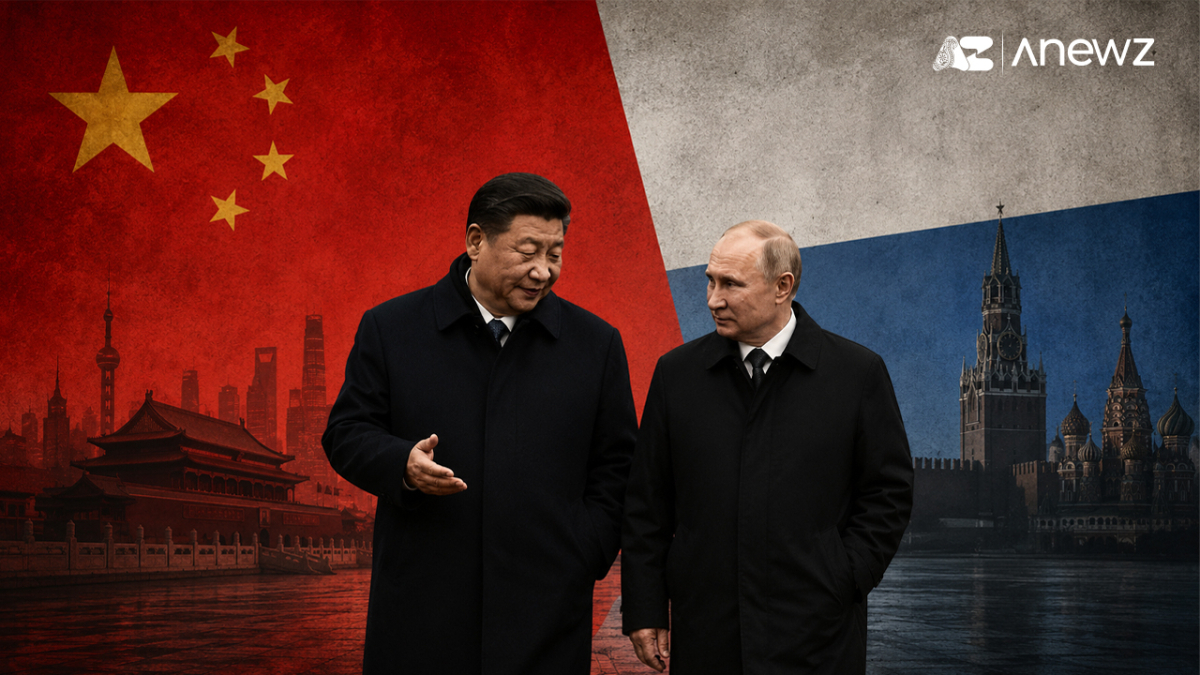
Russian President Vladimir Putin’s latest visit to Beijing appeared to be more than a routine state meeting between two strategic partners.
Coming only days after Donald Trump’s highly-publicised trip to China, the summit between Putin and Chinese President Xi Jinping became a carefully-choreographed geopolitical message to the world: Western dominance is increasingly contested, and the international order is becoming more fragmented and multipolar.
The symbolism surrounding the visit mattered almost as much as the agreements themselves. Chinese state protocol, tea diplomacy imagery, discussions on energy corridors, and repeated emphasis on sovereignty and opposition to hegemonic pressure all pointed toward a deeper strategic narrative. Once again, Moscow and Beijing tried to show that their cooperation is no longer based only on temporary converging interests. Increasingly, they are attempting to reshape the architecture of global power.
Yet beneath the carefully-staged displays of friendship lie asymmetries, hidden tensions, and pragmatic calculations. Putin arrived in Beijing seeking strategic reassurance, economic leverage, and stronger energy commitments. Xi, meanwhile, appeared intent on projecting China as the calm and indispensable centre of a changing world system, one capable of engaging both Washington and Moscow from a position of growing confidence.
Tea chat diplomacy: symbolism beyond ceremony
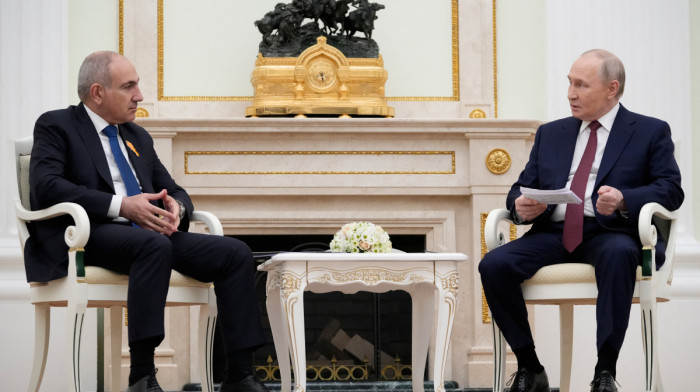
One of the most discussed aspects of the visit was the now-famous tea chat between Xi and Putin. Chinese diplomacy places immense importance on symbolism, and Xi’s decision to host Putin in a more intimate and informal tea setting was widely interpreted as a deliberate signal of political closeness. Several news agencies described the meeting as one between old friends, consciously contrasting it with the more formal atmosphere surrounding Trump’s earlier Beijing visit.
In Chinese political culture, tea diplomacy is not merely aesthetic theatre. Informal settings are often used to convey trust, strategic comfort, and personal rapport. Xi has reserved such formats for leaders he sees as politically significant or strategically valuable. By extending this gesture to Putin again, Beijing signalled that despite international pressure over Ukraine and growing Western sanctions, Russia remains an important partner in China’s broader geopolitical vision.
However, the tea chat symbolism also revealed an interesting hierarchy. While Russian media portrayed the meeting as evidence of a near-equal partnership, the choreography also reinforced China’s central position. Putin appeared less as the co-architect of a new order and more as a critical, but increasingly dependent, partner within China’s expanding geopolitical orbit.
This subtle imbalance is important. China’s economy is far larger than Russia’s, and Beijing possesses greater flexibility in global trade, finance, technology, and human capital. The relationship may be strategically close, but it is not symmetrical. Tea diplomacy therefore becomes a carefully balanced performance. It emphasises fraternity, while quietly acknowledging China’s dominant position.
Energy, pipelines, and the new Eurasian geometry
Energy cooperation remained one of the core issues of the summit. Russia continues to push for expanded gas exports to China, particularly through the long-discussed Power of Siberia 2 pipeline project. Moscow sees the project not merely as an economic necessity, but as a geopolitical lifeline after the collapse of much of its European energy market following the Ukraine war.
Yet despite optimistic rhetoric and numerous signed agreements, no major breakthrough on the pipeline emerged from the visit.
For Russia, the urgency is clear. European diversification away from Russian energy has structurally weakened Moscow’s traditional export model. China therefore represents not just an alternative market, but potentially the central pillar of Russia’s future energy strategy. Putin arrived in Beijing hoping that instability in the Middle East and concerns over maritime energy routes would push China toward faster commitments.
China, however, appears in no rush
Beijing understands that Russia’s bargaining position has weakened under sanctions and geopolitical isolation. This gives China significant leverage in pricing negotiations, infrastructure financing, and long-term contractual conditions. In many ways, China benefits from keeping negotiations unresolved while continuing to receive discounted Russian energy exports.
This dynamic illustrates one of the central paradoxes of the China-Russia partnership. Politically, the relationship appears stronger than ever. Economically, the balance increasingly favours Beijing.
Still, the broader Eurasian implications remain profound. Even without final pipeline agreements, the long-term strategic trajectory is clear. Russia is gradually reorienting its economic geography eastward, while China is deepening continental energy security mechanisms that reduce dependence on vulnerable maritime chokepoints such as the Strait of Malacca and the Strait of Hormuz.
In this sense, pipelines are not simply commercial infrastructure. They remain geopolitical arteries of a new Eurasian order.
Sovereignty, hegemony, and the language of multipolarity
Perhaps the most important dimension of the visit was ideological rather than economic. Both leaders repeatedly framed their partnership around themes of sovereignty, civilisational independence, and opposition to hegemonic interference.
This language reflects the emergence of a shared Sino-Russian worldview, one that mainly rejects the post-Cold War assumption of a Western-led liberal international order.
For Moscow, this rhetoric is partly defensive. Russia increasingly portrays itself as a victim of Western expansionism, sanctions, and geopolitical containment. China’s motivations are more structural. Beijing sees the existing global order as overly shaped by American military power, financial dominance, and alliance systems that ultimately constrain China’s rise.
The convergence between Moscow and Beijing therefore rests less on ideology in the classical sense and more on shared opposition to Western universality claims.
Importantly, both countries now use the term multipolarity not simply as a descriptive concept, but as an active political project. This explains why the summit discussions extended beyond bilateral ties into broader issues such as nuclear security, artificial intelligence, sanctions, Middle East instability, and NATO expansion. The partnership is no longer narrowly transactional. It increasingly seeks to shape global norms themselves.
Yet there are contradictions here as well. China remains deeply integrated into global capitalism and still benefits enormously from existing international structures. Beijing wants reform of the system, not necessarily its collapse. Russia, by contrast, has become far more revisionist and confrontational after years of sanctions and war.
Thus, while both countries speak the language of multipolarity, they ultimately appear to envision different versions of it.
Between partnership and dependency
Putin’s visit to Beijing ultimately highlighted something larger than bilateral diplomacy: the return of classical great power politics. The world is increasingly moving away from the relatively unipolar moment that followed the Cold War. Instead, a more fluid and unstable geometry is emerging, one in which alliances are flexible, economic interdependence coexists with strategic rivalry, and major powers seek autonomy rather than simple integration.
A central question emerging from the visit is whether the China-Russia relationship remains a genuine strategic partnership, or whether it is evolving into a more hierarchical arrangement.
From the Kremlin’s perspective, the partnership is existentially important. China provides a massive export market, access to technology and trade channels, diplomatic cover at the United Nations, and symbolic proof that Russia is not internationally isolated.
For China, however, Russia represents something different: a useful strategic partner, an energy supplier, and a geopolitical counterweight to the United States, but not necessarily an equal.
Asymmetry could become more visible over time
Russian officials continue to speak about unprecedented trust and equal partnership. Yet economically and technologically, Russia’s dependence on China has increased sharply since 2022. Chinese firms have gradually filled gaps left by departing Western companies, while Chinese payment systems and trade channels have become increasingly important for Russia’s sanctioned economy.
At the same time, Beijing remains cautious. China has avoided openly violating major Western sanctions in ways that could threaten its own access to global markets. It supports Russia strategically, but carefully calibrates that support to avoid direct confrontation with the West. In this regard, the latest Trump-Xi talks were a clear example of China’s position.
These balancing acts reflect China’s broader geopolitical maturity and its historically well-known pragmatism. Unlike Moscow, Beijing is attempting to reshape the international order while still operating within many of its existing structures.
One thing, however, is increasingly clear: the age in which the West alone defined the rules of global power is steadily fading, and both Moscow and Beijing intend to accelerate that transition. Whether this new order becomes stable or deeply conflictual remains uncertain.















What is your opinion on this topic?
Leave the first comment