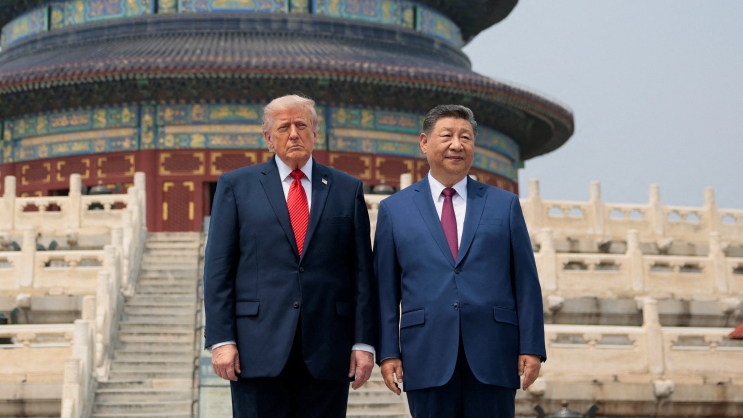
U.S. President Donald Trump’s meeting with President Xi Jinping in Beijing comes as China enters a period of strategic consolidation aimed at building a parallel international system to Washington’s, a China specialist has said.
Tugrul Keskin told AnewZ’s Nadia Gyane on Thursday (14 May) that the world was witnessing a new chapter in international affairs, in which the two superpowers were both competitors and partners.
“For China, the next 25 years will likely be understood as a period of strategic consolidation,” he said. “Beijing's long-term objective is not necessarily to replace the United States as a global hegemon in the classical imperial sense, but rather to construct a parallel international system.”
Keskin said Beijing wanted Chinese technological standards, financial institutions, trade corridors and diplomatic networks to become the norm globally.
He pointed to China’s Belt and Road Initiative - a global infrastructure and development strategy - the expansion of the BRICS group of developing countries, and alternative payment systems as examples of Beijing extending its international influence.
Deep economic interdependence
“Unlike the United States-Soviet Union confrontation of the 20th century, the relationship between Washington and Beijing is characterized by deep structural interdependence,” Keskin said.
“Their economies remain interconnected through global supply chains, semiconductor production, artificial intelligence development, finance, higher education networks, logistics systems and consumer markets,” he added.
Taiwan remains key flashpoint
Keskin said Taiwan remained the greatest threat to relations between the two superpowers, but added that both Beijing and Washington understood that conflict over the issue would have “catastrophic consequences” for the global economy.
China and Taiwan split following the Chinese Civil War in 1949. Taiwan has its own elected government, but Beijing claims the island as part of its territory and has not ruled out the use of force to take control of it.
The U.S. is bound by a 1979 law to provide Taiwan with the means to defend itself, a policy China opposes.
After Xi and Trump met at the start of the summit, the Chinese leader said Taiwan was the most important issue in U.S.-China relations and warned it could create a “very dangerous situation” if mismanaged.












What is your opinion on this topic?
Leave the first comment