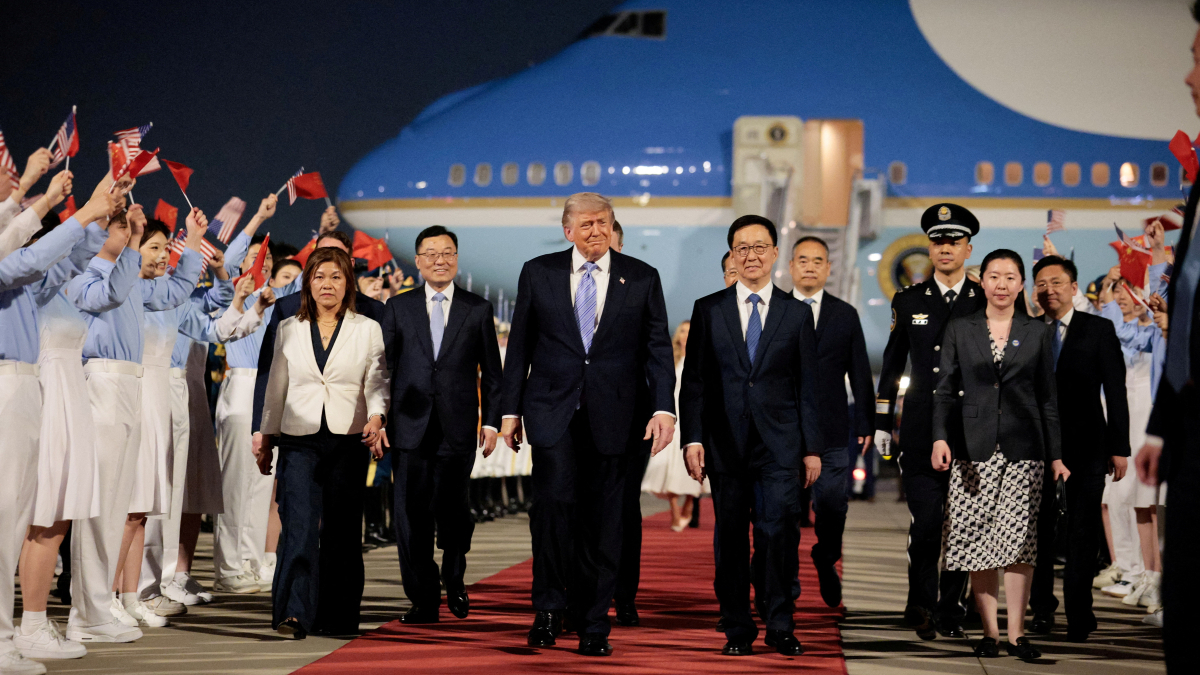
U.S. President Donald Trump’s three-day summit with Chinese leader Xi Jinping in Beijing, beginning on Wednesday (13 May), comes as rivalry between the two superpowers reaches new heights, a China analyst has said.
Andrew Leung, a Hong Kong-based China specialist, told AnewZ’s Bakhtiyar Khasanov that tensions between the two countries had escalated because of American tariffs and sanctions, as well as the Iran war.
“[The meeting] comes at a time when the relationship between the United States and China, the mutual rivalry for global influence, has reached a new height, coming as it has in the wake of a series of American tariffs and sanctions,” Leung said.
He also pointed to disagreements over advanced chips needed for generative AI and cutting-edge military hardware, as well as divisions over the Iran war, as major sources of tension between the two countries.
Leung added that while China was more insulated than many countries from energy disruption caused by the U.S.-Iran conflict, upheaval in the global economy triggered by the war posed a major challenge for Beijing.
“China is more insulated from the rest because 40% of its domestic electricity supply is now accounted for renewably. And some of the external oil supply is supplied by Russia, accounting for some 18%,” he said.
“But nevertheless, it upends the world economy on which China's international trade depends, because China is more dependent on international trade than the United States.”
Taiwan expected to feature prominently
Taiwan is also expected to be a key issue during the meeting between the two leaders.
China and Taiwan split following the Chinese civil war in 1949. Taiwan has its own elected government, but Beijing claims the island as part of its territory and has not ruled out the use of force to take control of it.
The U.S. is bound by a 1979 law to provide Taiwan with the means to defend itself, and Xi is expected to raise objections to Washington’s arms sales to the island during his talks with Trump.
Leung said Beijing was seeking a “more robust stance” from Trump on the issue.











What is your opinion on this topic?
Leave the first comment