By the time American shoppers began noticing higher prices on everything from trainers to televisions, the world's two largest economies were already deep in a trade war that left the world wondering how it would end.
Today (13 May), U.S. President Donald Trump, begins a two-day visit to China, saying he is seeking to "open up" the country. Few rivalries in modern history have reshaped the global economic order as quickly or as dramatically as the tariff war between the two countries.
What began as a dispute over steel and soybeans has grown into a full-scale contest over semiconductors, rare minerals, supply chains and, ultimately, which country will set the rules of the 21st century.
Tariffs, essentially taxes on imported goods, have become the weapon of choice, blunt and far-reaching, felt by ordinary people on both sides of the Pacific.
Round One: How it all began (2018–2020)
The modern trade war began in 2018, under President Donald Trump's first term in office. The White House accused China of stealing intellectual property, flooding global markets with cheap goods and running an unfair trade surplus with the United States. In response, Washington imposed sweeping import taxes, known as tariffs, on hundreds of billions of dollars' worth of Chinese goods, from electronics to furniture.
China did not back down. It retaliated with its own tariffs on American products, particularly hitting U.S. farmers hard by targeting soybeans, pork and wheat. A tit-for-tat cycle of escalation followed, unsettling global markets and supply chains.
A partial truce, known as the Phase One deal, was signed in January 2020, with China agreeing to buy more American goods. But the deeper structural tensions were never resolved. The underlying argument, about who controls the technologies and industries of the future, was simply put on hold.
Round Two: The escalation of 2025
When Trump returned to the White House in January 2025, the trade war reignited, this time with far greater intensity. The administration invoked emergency economic powers to impose sweeping new tariffs, citing China's role in the flow of fentanyl into the United States and longstanding complaints about trade imbalances.
According to the Peterson Institute for International Economics (PIIE), average U.S. tariffs on Chinese goods peaked at 127.2% in early May 2025, before being partially rolled back. China's retaliatory tariffs on American products peaked at 147.6% in mid-April, a level that, as China's Finance Ministry put it at the time, had become "a joke in the history of world economy."
Diplomatic pressure eventually brought both sides to the table. On 12 May 2025, Washington and Beijing agreed to a 90-day pause, dramatically cutting tariffs from the triple-digit peaks. The pause was extended in August, and by November 2025, following a face-to-face meeting between President Trump and Chinese President Xi Jinping at the APEC summit in South Korea, a one-year truce was agreed, lasting through November 2026.
Where the U.S. has the upper hand
- Washington's strongest card is market access. The United States remains the world's largest consumer market, and for Chinese manufacturers, losing American customers is a serious blow.
- The U.S. also leads the world in advanced technology, particularly in designing cutting-edge computer chips, artificial intelligence systems and cloud computing infrastructure.
- Additionally, the dollar's status as the world's reserve currency gives Washington broad financial leverage.
Where China has the upper hand
- China dominates rare earths, controlling about 70% of global extraction and 90% of processing, giving it outsized leverage over critical technologies from electric vehicles to military hardware.
- The United States remains heavily dependent on China, relying on it for refined rare earths despite being the world’s second‑largest producer, including materials vital for defence and green energy.
- Heavy rare earths pose a particular risk, with U.S. officials warning of near‑total dependence on China for elements used in permanent magnets found in systems such as F‑35 fighter jets; Beijing tightened export controls in April 2025.
- China’s manufacturing scale cushions trade pressure, with exports redirected to new markets and a record trade surplus of nearly $1.2 trillion in 2025 despite ongoing U.S. tariffs.
Economic damage so far
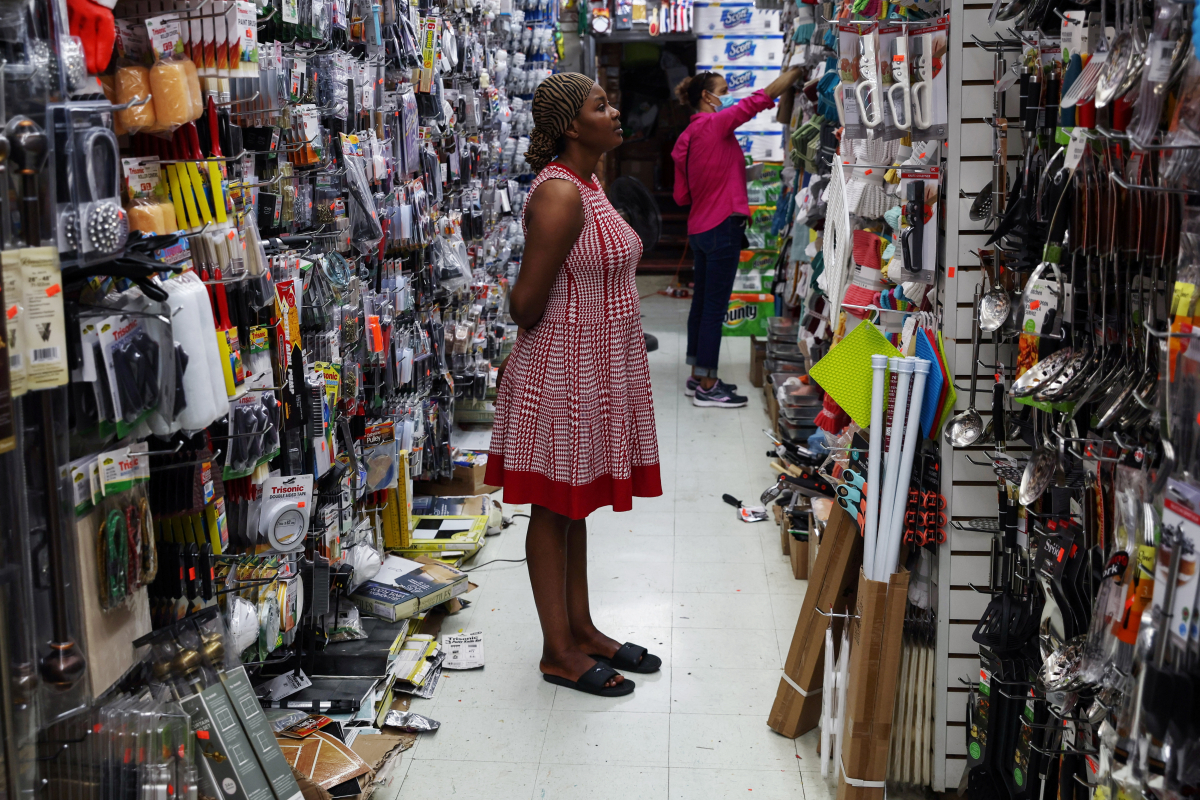
For ordinary Americans, the most visible impact has been higher prices. The RSM Economics research group estimated that the U.S. Federal Reserve's preferred inflation measure could rise by 0.4 percentage points as a direct result of tariffs, squeezing household budgets at a time when many Americans were already struggling with the cost of living.
According to the U.S.-China Business Council, the first round of tariffs in 2018 cost around 245,000 American jobs. With the scope of the 2025 tariffs significantly larger, economists expect the job losses this time to be considerably greater.
For China, the impact has been cushioned by diversification and state support. S&P Global notes that China's GDP growth, while slowing, remained broadly in line with government targets through 2025, though domestic consumption remains fragile and the property crisis continues to drag.
S&P Global concludes bluntly: "There are no real winners in this trade war. Countries facing new tariffs, including the United States, experience declines in real exports and GDP."
An uneasy peace
The one-year truce agreed in November 2025 offers temporary relief. Tariffs on both sides have been pulled back from their extreme peaks. China has agreed to buy American soybeans and agricultural products, and has suspended, though not cancelled, its most aggressive rare earth export controls through to late 2026.
Meanwhile, the United States has been racing to reduce its dependence on Chinese minerals, signing deals with Australia worth $8.5 billion (£6.7bn), as well as agreements with Japan, Malaysia and Ukraine.
In March 2026, the U.S. Trade Representative launched new investigations into Chinese trade practices, signalling that further tariff action could follow once the truce expires.
The contest over who controls the technologies, resources and manufacturing capacity of the future is far from over. What began with a tariff notice has become one of the defining economic struggles of our era and the world is watching to see who blinks first.















What is your opinion on this topic?
Leave the first comment