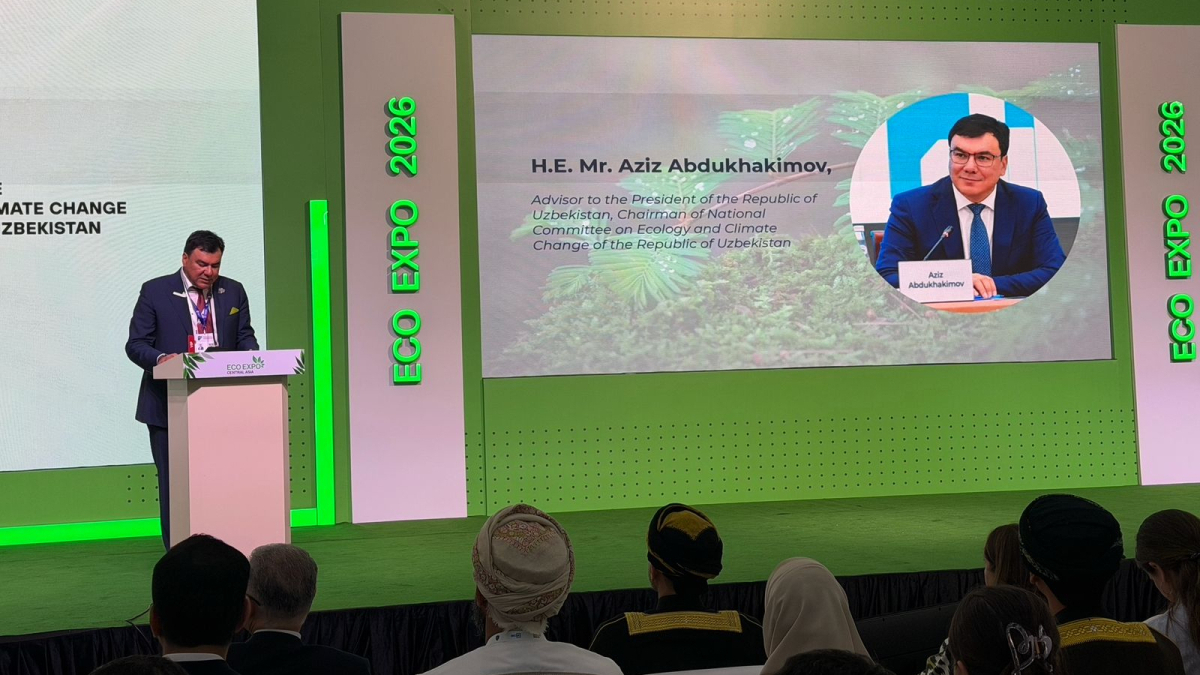
International organisations, investors, environmental experts and business representatives gathered in Samarkand for the opening of Eco Expo Central Asia 2026, one of the region's largest environmental events focused on green growth, climate resilience and sustainable development.
The exhibition is expected to attract around 10,000 local and international participants and features more than 68 pavilions showcasing environmental technologies, green products and sustainability initiatives. Organised by the National Committee on Ecology and Climate Change of Uzbekistan and Business Congress Management (BCM), the event serves as a platform for strengthening international cooperation and attracting investment into the green economy.
From exhibition to action
While the exhibition presents environmental innovations from around the world, much of the focus is on practical solutions to regional challenges, particularly water management, climate adaptation and ecosystem restoration.
One of the key developments on the opening day was the signing of a Concept for Integrated Water Resources Management in the Lower Amu Darya Basin during a side event dedicated to the future of the Aral Sea region. The document was signed by the National Committee on Ecology and Climate Change, the Ministry of Water Resources and the Ministry of Agriculture.
The initiative aims to improve water-use efficiency, strengthen environmental sustainability and promote cooperation between sectors facing increasing climate pressures across the Aral Sea basin.
The issue remains one of Central Asia's most pressing environmental challenges, with experts highlighting the need for coordinated action to address water scarcity, land degradation and biodiversity loss.
International partnerships in focus
Several side events highlighted growing international cooperation on climate and environmental issues.
An Uzbekistan–Japan forum on climate resilience showcased joint scientific projects focused on water-saving technologies, sustainable agriculture, and the development of green and blue hydrogen solutions. Researchers from both countries discussed innovative approaches to tackling salinisation and improving water management in the Aral Sea region.
Another session marked the launch of a new national biosafety initiative designed to support Uzbekistan's implementation of the Cartagena Protocol on Biosafety, with financial support from the Global Environment Facility.
Experts also discussed the results of the FAO-GEF regional CACILM2 programme, which has helped place more than 2.8 million hectares of degraded land under sustainable management across Central Asia and Türkiye.
Recognition of environmental progress
The exhibition also hosted the launch of the Fourth Environmental Performance Review of Uzbekistan, prepared under the United Nations Economic Commission for Europe (UNECE).
According to the review, Uzbekistan has implemented, partially implemented, or is currently implementing 77 per cent of the recommendations issued under the previous assessment. The report highlights progress in environmental governance, renewable energy development, biodiversity conservation and ecological monitoring systems.
The new review contains 45 recommendations intended to help shape the country's environmental policy priorities through to 2030.
Looking ahead
More than 50 forums, presentations and dialogue platforms are scheduled throughout Eco Expo Central Asia 2026, covering topics ranging from renewable energy and waste management to climate adaptation and sustainable water use.
As environmental pressures continue to intensify across Central Asia, organisers say the exhibition is intended not only to showcase innovations but also to accelerate partnerships, investments and policy solutions capable of delivering long-term environmental and economic benefits for the region.














What is your opinion on this topic?
Leave the first comment