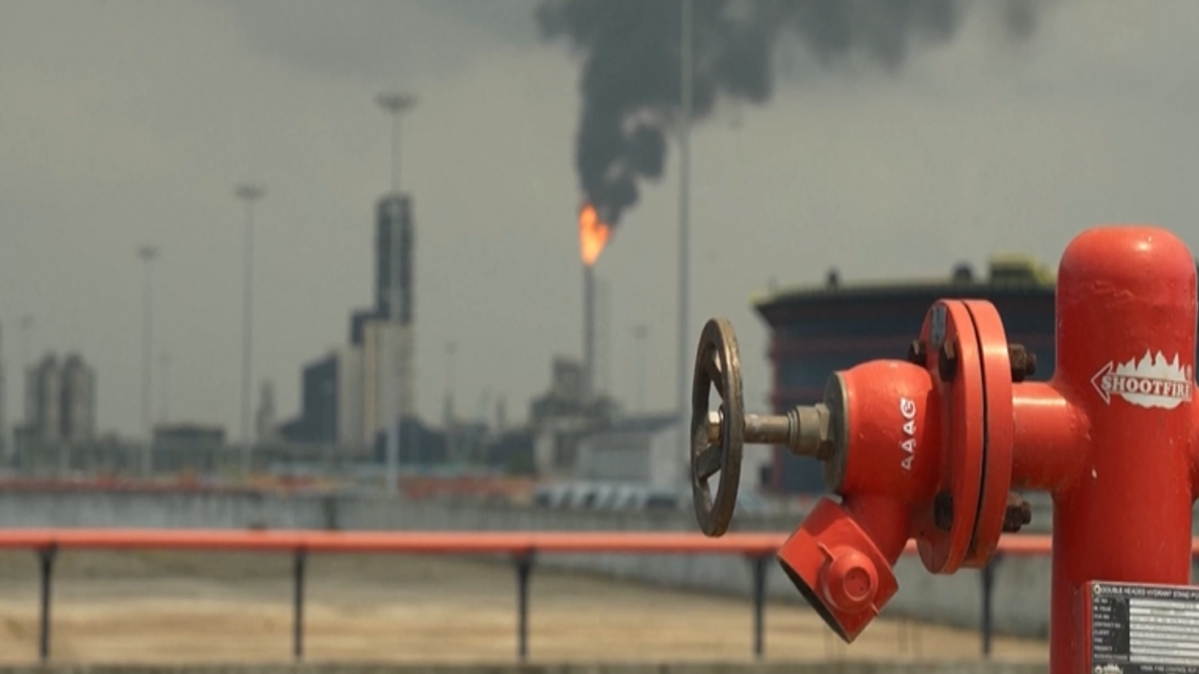
Tehran and Yerevan are drawing up plans to turn Armenia into a transit corridor for Iranian gas, alongside a four-country power grid, a second border bridge, an oil refinery and a new hydroelectric scheme.
Energy security specialist John Roberts said the initiative is less about challenging international sanctions than about Armenia maintaining stable relations with an important neighbour.
Iran and Armenia agreed last month to set up a joint working group on energy, with Iran's Oil Minister, Mohsen Paknejad, proposing to move beyond the two countries' long-standing gas-for-electricity barter arrangement towards a model in which Armenia would host Iranian gas exports bound for other markets, according to the Tehran Times.
The same round of talks, held in Tehran between Paknejad, Armenia's Energy Minister Abbas Aliabadi and Armenia's Minister of Territorial Administration and Infrastructure, Davit Khudatyan, also covered the construction of a refinery to process Iranian crude in Armenia, according to Armenian news agency ARKA.
A blueprint with old roots
None of this is entirely new.
According to ARKA, Iran's ambassador to Yerevan has said a refinery would let Armenia process Iranian crude for both domestic use and export, and linked the idea to closer ties between Iran's Aras free economic zone and Armenia's Meghri free economic zone.
Armenpress has separately confirmed that Armenia is working with Iranian partners on a second bridge across their shared border.
A four-country electricity corridor linking Iran, Armenia, Georgia and Russia was first agreed on paper back in 2015, but according to the Central Asia-Caucasus Institute's CACI Analyst and the geopolitical research group SpecialEurasia, that scheme was never implemented.
Even a more modest project, a third Iran-Armenia power transmission line, has been stalled for more than twelve years, according to the Tehran Times.
Sanctions flexibility, not sanctions evasion
Roberts told AnewZ the proposals should not be viewed as an attempt to circumvent international sanctions on Iran.
"There's always been a certain amount of flexibility and practicality regarding Iran's neighbours when it comes to them having to continue to have economic and trade relations with Iran," he said.
He pointed to Türkiye, which has "still got a major gas supply agreement with Iran, and there is still a considerable amount of cross-border trade between the two countries", referring to Ankara's pipeline import agreement with Tehran, signed in 2001 for up to 9.6 billion cubic metres of gas annually. The agreement expired in July, according to the Center on Global Energy Policy at Columbia University's School of International and Public Affairs.
"There is no reason to suppose that some kind of Iranian deal with Armenia should necessarily run seriously foul of sanctions," Roberts said, "so long as it does not involve the supply or the use of technology that would seem to benefit Iran."
He added that this could prove more difficult for cross-border schemes such as the planned Meghri hydroelectric project, where equipment transfers are more likely to draw scrutiny than the trade in gas or refined products.
Stability over commercial gain
Asked what Armenia stands to gain, Roberts argued the calculation is more political than commercial. "The most important gain that Armenia can look for is simply to have good relations with a key neighbour to the south, namely Iran," he said.
He noted that the border has generally held steady.
"The Iran-Armenia border has always been relatively peaceful, so there is no particular reason to need for any great strengthening," he said. "The issue is always to avoid further problems, further tensions between Armenia and Iran, whose relations have not always been particularly good," a dynamic sharpened, he said, by the fact that "Armenia is more dependent on Iran than vice versa."
The Nakhchivan factor
Roberts also pointed to a narrower, practical benefit buried in the wider package: reconnecting Armenia's own territory via Iranian-adjacent routes.
"Armenia is a contiguous country, but even so, a route through Nakhchivan between one part of Armenia and another would be practically helpful," he said, referring to the old Soviet-era railway that ran from Yerevan through Nakhchivan before it was severed.
The railway, which linked Armenia with Azerbaijan's Nakhchivan exclave and Iran's rail network via Julfa, was closed in the early 1990s following the outbreak of the First Garabagh War, according to Radio Free Europe/Radio Liberty and the Carnegie Endowment for International Peace.
Taken together, Roberts's account suggests the corridor plans are best understood not as a sanctions workaround or a rival to the U.S. backed Zangezur transit route through southern Armenia, but as an insurance policy, a way for Yerevan to keep a difficult but important relationship on an even keel.
















What is your opinion on this topic?
Leave the first comment