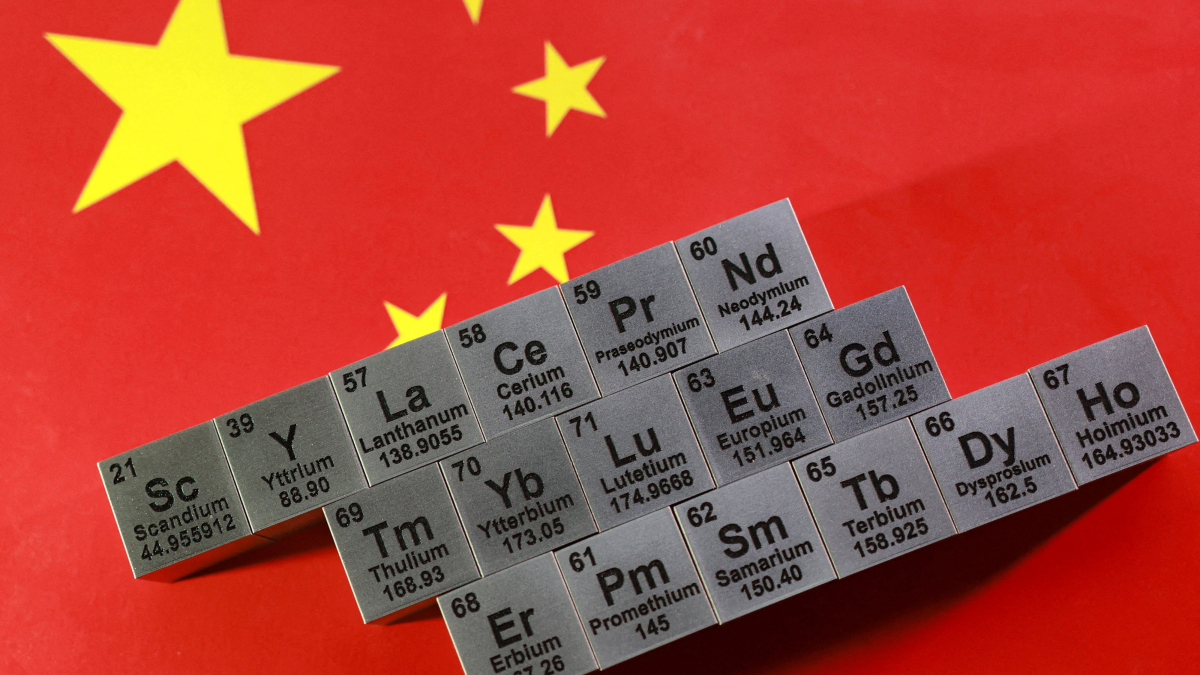
China already dominates the global rare earth supply chain. Now, scientists have discovered new deposits in northeastern China that could prove cheaper and cleaner to extract than those mined elsewhere in the country.
Unexpected discovery in northeastern China
Scientists from the Chinese Academy of Sciences have identified a new type of rare earth formation in the frigid northeastern provinces of Heilongjiang and Jilin - a discovery that could challenge long-held assumptions about how rare earth deposits are distributed across China.
To understand why this matters, it helps to know more about rare earths and why the world cares so much about them. Rare earth elements are a group of 17 minerals with names such as neodymium, dysprosium and cerium that are essential to many of the technologies defining modern life. Electric vehicle motors rely on them. Wind turbines require them. Smartphones, precision-guided weapons, MRI machines and advanced semiconductors also depend on them.
Rare earths are not especially scarce in the ground, but they are extraordinarily difficult to find in concentrations worth mining. As a result, whoever controls the supply chain for these elements holds significant influence over the industries that rely on them.
China’s dominance of the rare earth market
China already holds that influence. The country currently mines more than 60 per cent of the world’s rare earths and refines close to 90 per cent of global supply. That means even ore extracted elsewhere often ends up being processed in China.
This dominance has long worried Western governments, particularly as demand for rare earths has surged alongside the global push towards electric vehicles and clean energy technologies.
Why the new deposits matter
What makes the northeastern discovery especially important is not just where the deposits are located, but what they are made of. Unlike the clay-heavy deposits found in southern China, which require chemical leaching to release the rare earth elements, the northern formations consist of loose sand and gravel shaped over millennia by natural freeze-thaw cycles.
That difference could make extraction more efficient, less costly and significantly less damaging to the environment.
Traditional rare earth mining through chemical leaching is environmentally harmful. It is expensive, produces large quantities of toxic waste and typically leaves around a quarter of the rare earth content unrecovered in the ground.
The newly identified northern deposits, by contrast, contain rare earths in separate mineral particles such as monazite and xenotime, forms that lend themselves to cleaner and more straightforward extraction methods.
Challenging long-held geological assumptions
The discovery could potentially rewrite what geologists have long described as the “heavy in the south, light in the north” pattern of rare earth distribution in China - a rule of thumb that has shaped the country’s mining strategy for decades.
Heavy rare earth elements, which are scarcer and especially important for defence systems and advanced electronics, were previously thought to be concentrated mainly in southern China. Finding them in significant quantities in the north could open an entirely new geography for extraction.
Geopolitical implications
The timing is significant. The discovery comes as the U.S. and other Western countries are scrambling to reduce their dependence on Chinese rare earth supplies by investing in new mines in Australia, Canada and the American West.
Beijing recently agreed to address American concerns over shortages of critical mineral supplies as part of wider U.S.-China trade discussions, underlining that rare earths are not just a geological issue, but also a geopolitical one.
For now, the full scale of the northeastern deposits is still being assessed. However, the early findings point to something potentially transformative: a country that already dominates the global rare earth supply chain may have discovered reserves that are even larger and more accessible than previously thought.




















What is your opinion on this topic?
Leave the first comment