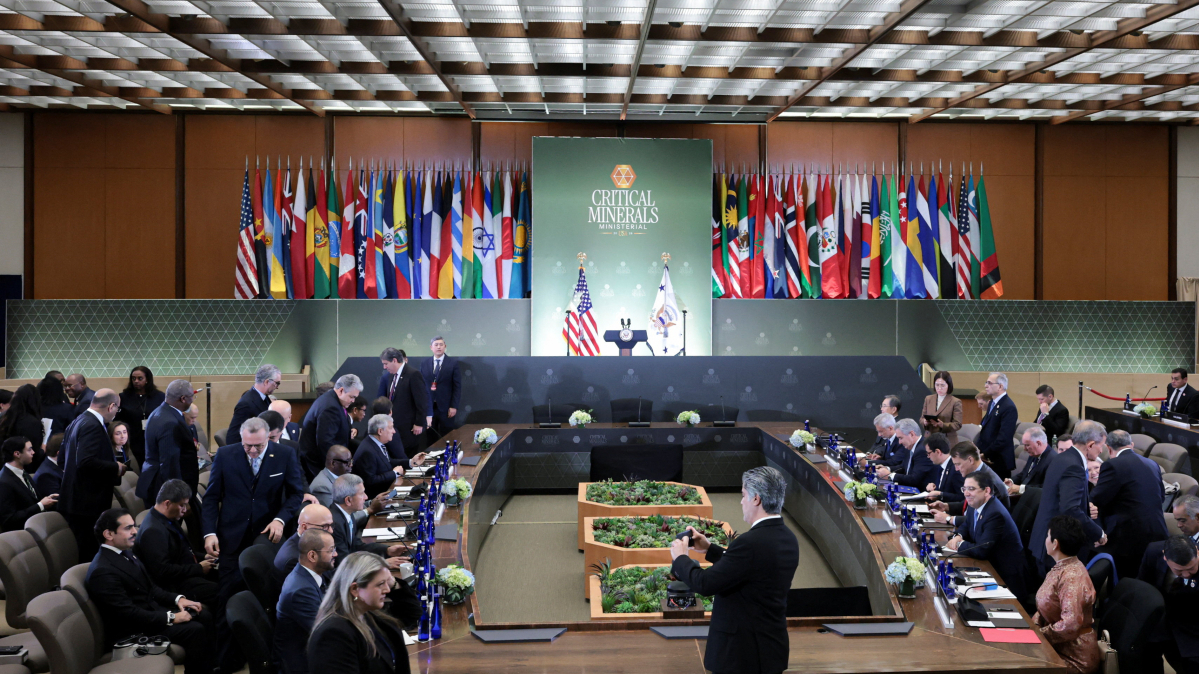
The European Union and Washington are nearing an agreement to coordinate the production and security of critical minerals, Bloomberg News reported on Friday (10 April).
Critical minerals - including lithium, nickel, cobalt and rare earth elements - are key components in clean energy technologies, electronics and military systems.
China currently controls a large share of global refining and processing capacity, raising concerns in the EU and U.S. over supply security and geopolitical leverage.
The potential deal would include incentives such as minimum price guarantees that could favour non-Chinese suppliers, the report said, citing an “action plan”.
The EU and U.S. would also cooperate on standards, investments and joint projects, along with increased coordination on any supply disruptions by countries such as China, the report added.
Officials decline comment
The European Commission declined to comment on the report. The office of the U.S. Trade Representative did not immediately respond to Reuters’ requests for comment.
EU Trade Commissioner Maroš Šefčovič said he had a “very positive” meeting in March with U.S. Trade Representative Jamieson Greer on the sidelines of a World Trade Organization ministerial meeting in Cameroon.
The two sides agreed to advance cooperation on critical minerals and also discussed tariffs.
The EU–U.S. deal would cover “critical minerals along the entire value chain and life-cycle management, including exploration, extraction, processing, refining, recycling and recovery,” Bloomberg reported, citing a non-binding memorandum of understanding.
The U.S. has been scrambling to secure access to critical mineral reserves, especially rare earth supply chains currently dominated by Chinese players.
Strategic importance of rare earths
Rare earths are widely used across strategic sectors, including energy systems, transport, artificial intelligence, aerospace, healthcare and defence technologies. Their importance has grown due to their role in enabling advanced technologies and the concentration of global supply chains.
Critical minerals are generally defined as resources essential to a country’s economic performance and national security, but which are vulnerable to supply disruptions.
While these materials are geographically widespread, production is uneven, with a small number of countries controlling a significant share of reserves and processing capacity.


















What is your opinion on this topic?
Leave the first comment