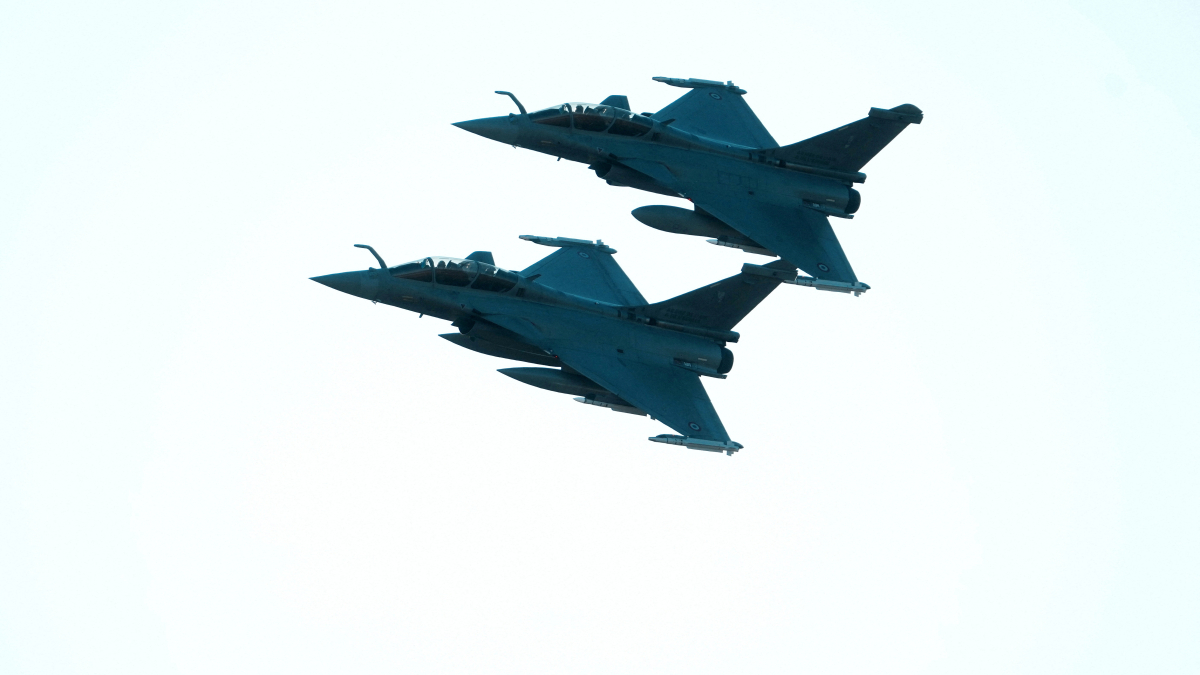
NATO fighter jets were activated on Thursday (21 May) after at least one drone entered Latvian airspace, according to Latvia’s armed forces, marking the latest in a series of security incidents across the Baltic region linked to the war in Ukraine.
Ukraine has intensified its long-range drone strikes against Russia in recent months, including operations launched over the Baltic Sea. Several Ukrainian drones have reportedly strayed into the airspace of NATO members including Latvia, Estonia, Lithuania and Finland.
“We confirm that there is at least one unmanned aircraft in Latvian airspace,” the Latvian Armed Forces said in a post on X.
Residents in eastern Latvia, near the borders with Russia and Belarus, were urged to remain indoors until further notice, while NATO aircraft were scrambled in response to the threat.
The incident comes amidst growing political pressure in Latvia, where the government resigned last week over its handling of repeated airspace incursions. Talks are continuing on the formation of a new cabinet.
Baltic drone incidents fuel regional tensions
The latest alert follows a series of similar incidents across the Baltics. On Tuesday, a NATO fighter jet shot down a suspected Ukrainian drone over Estonia. A day later, Lithuania temporarily halted flights to Vilnius and lawmakers were forced to shelter underground after another suspected airspace violation.
The Baltic states, all among Kyiv’s strongest supporters since Russia’s full-scale invasion in 2022, have accused Moscow of electronically redirecting Ukrainian drones away from their intended targets inside Russia and into neighbouring NATO territory, although no evidence has been publicly presented.
The Kremlin said on Wednesday it was monitoring developments. Moscow has previously accused the Baltic states of allowing Ukraine to launch drones from their territory, allegations denied by both NATO and the countries involved.
Poland’s defence minister said on Thursday that Ukraine needed to ensure greater precision in its drone operations to prevent Russia from interfering with flight paths.
European Commission President Ursula von der Leyen said on Wednesday that threats against Baltic countries were “unacceptable” and would be treated as threats against the entire European Union.
Russia warns Baltic states against supporting drone attacks
Tensions escalated further following remarks made by Russia’s ambassador to the United Nations, Vasily Nebenzya, during a United Nations Security Council meeting on Tuesday (19 May).
Nebenzya claimed Moscow had intelligence indicating Ukraine planned to launch drones from Latvia and other Baltic states, warning that NATO membership would not shield them from retaliation.
“The coordinates of decision-making centres in Latvia are well known, and membership in NATO will not protect you from retaliation,” he said.
Latvia rejected the accusations outright. The country’s envoy to the UN, Sanita Pavluta-Deslandes, described the claims as “pure fiction”, while Latvia’s Foreign Ministry summoned Russia’s acting chargé d’affaires to issue what it called a “categorical protest”.
The ministry said Latvia had repeatedly informed Moscow through diplomatic and public channels that neither its territory nor airspace had been used for attacks against Russia.
“Despite repeated communications by the Latvian side, the Russian side continues to spread lies and make escalatory statements,” the ministry said.
U.S. and Ukraine dismiss Moscow’s allegations
During the same Security Council session, U.S. Deputy Ambassador to the UN Tammy Bruce criticised Russia’s rhetoric, saying the UN was “no place for threats against a council member”.
Bruce also reaffirmed Washington’s commitment to NATO’s Article 5 collective defence principle, under which an attack on one alliance member is considered an attack on all.
Ukraine’s envoy to the UN, Andriy Melnyk, dismissed Russia’s accusations as “fairy tales”.
Ukraine later apologised to Estonia over the recent drone incident and insisted it was not using Latvian or Estonian territory to launch attacks against Russia.
NATO on alert as regional risks grow
Since the start of the war, several NATO countries bordering Russia and Belarus, including Poland, Romania and the Baltic states, have reported drones or missile debris entering or approaching their airspace.
The Baltic region has become increasingly significant in NATO’s security planning following the accession of Finland and Sweden to the alliance, expanding NATO’s border with Russia.
Officials on both sides have repeatedly warned that further airspace or border incidents could sharply escalate tensions between Russia and NATO.















What is your opinion on this topic?
Leave the first comment