Australia and Canada said on Thursday they had signed new agreements on critical minerals as Canadian Prime Minister Mark Carney made a landmark address to the Australian parliament, a sign of the developing bond between the "middle powers".
Carney is on a multi-leg trip across the Asia-Pacific region also taking in Japan and India. His stop in Australia included the first address to Australia's parliament by a Canadian leader since 2007.
"In a world of great power rivalry, middle powers have a choice: compete for favour or combine for strength," he told lawmakers.
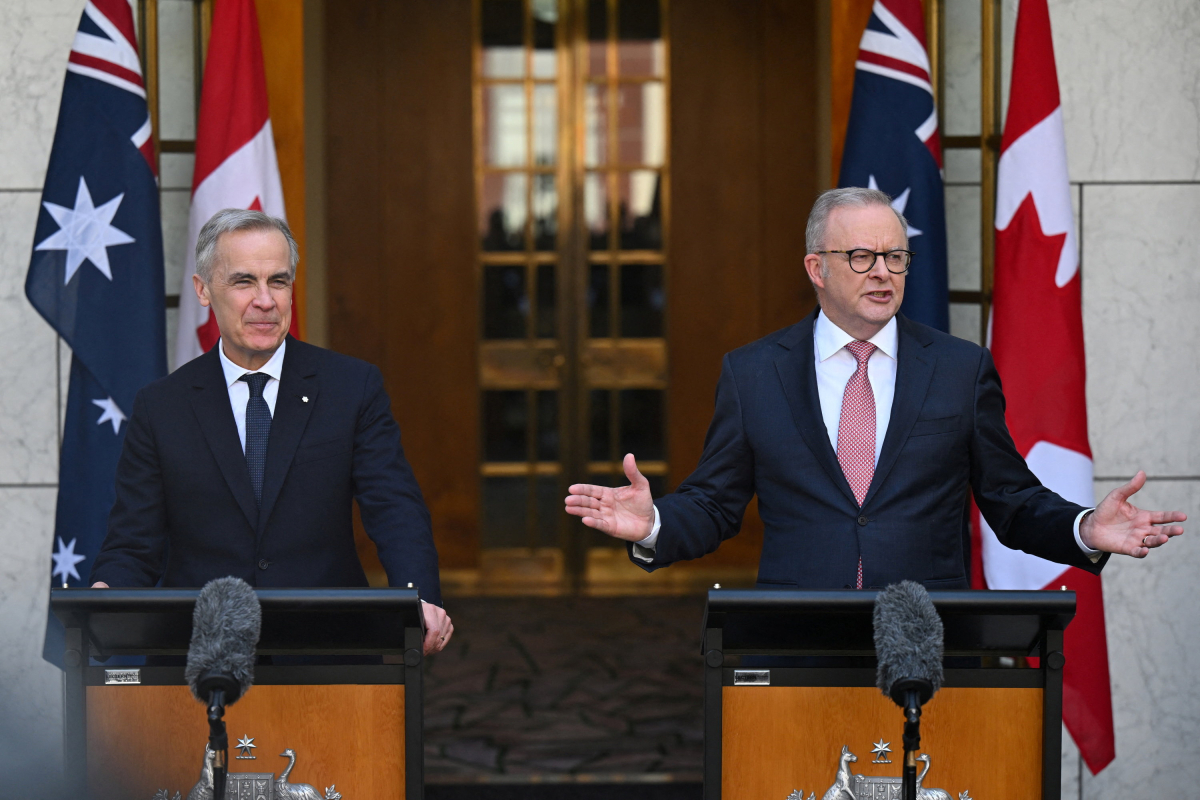
Introducing Carney in parliament, Australian Prime Minister Anthony Albanese said his address represented the closeness of the ties between the two nations.
"Australia and Canada are middle powers in a world that is changing. We cannot change it back, but we can back ourselves, back our citizens, and back each other," he said.
G7 Alliance
Albanese told a press conference that Australia would join Canada's G7 critical minerals production alliance.
"We have agreed to deepen our relationship across several areas, building on our joint declaration of intent on critical minerals that we signed last year," he told a press conference.
The G7 alliance is a Canada-led initiative to diversify and secure global critical minerals production and supply.
Canada and Australia together produce about a third of global lithium and uranium, as well as more than 40% of global iron ore.
Western nations have been attempting to diversify their supply chains away from China, which still controls the majority of production and processing of critical minerals, essential for semiconductors and defence applications.
Canada believes that the best way to address the issue of concentrated supply of critical minerals is through a production alliance or a buyers' club rather than just a price floor, Energy and Mining Minister Tim Hodgson told Reuters on Tuesday.
Australia has already allocated A$1.2 billion ($850 million) to build a critical minerals stockpile, beginning with antimony, gallium and rare earths.
That will now be more closely aligned with Canada's defence stockpiling regime that has a similar aim, Albanese said.
"There's a lot Canada and Australia can do together on critical minerals as producer nations," Australian Resources Minister Madeleine King told Reuters ahead of Carney's visit.
Australia and Canada will also deepen cooperation in areas including defence and maritime security, trade and artificial intelligence, the two leaders said.














What is your opinion on this topic?
Leave the first comment