The AnewZ Opinion section provides a platform for independent voices to share expert perspectives on global and regional issues. The views expressed are solely those of the authors and do not represent the official position of AnewZ
For decades, Central Asia has stood on the front line of a climate emergency that much of the world is only beginning to understand. Stand at the edge of a glacier in the Tien Shan today and the crisis is no longer abstract.
It is visible in the retreating ice, in the shrinking snowline, and in the water system on which millions of people depend.
These mountains have fed the great rivers of Central Asia for thousands of years. The Amu Darya, the Syr Darya and countless smaller rivers that sustain farmers, cities and communities across the steppe all begin in high mountain snow and glacial ice. That ice is now retreating at speed. No government in the region yet has a response that fully matches the scale of what is being lost: not for the Kazakh wheat farmer watching the sky, the Uzbek irrigator measuring water levels, or the Tajik city dweller filling a glass from the tap.
Regional cooperation is improving. But the physical pace of climate change remains faster than the political and institutional response.
A Water System Under Increasing Stress
Asia's climate risks are accelerating. The World Meteorological Organization has warned that Asia is warming faster than the global average, with its recent warming trend almost double that recorded in the 1961-1990 period. In Central Asia, this wider continental pattern takes a particularly dangerous form: water security depends heavily on glaciers and seasonal snow that are becoming less reliable.
Recent studies show how quickly the region's water clock is changing. In the Muzart River basin, glaciers have retreated sharply since 1976, with the pace of loss accelerating after 2000. In Kyrgyzstan's Ala-Archa basin, peak river flow is expected to move from July to June as snowmelt occurs earlier. Under a full glacier-retreat scenario, summer streamflow could fall by as much as 67 percent. For farmers and water managers, this is not a distant scientific warning. It changes irrigation schedules, reservoir planning and planting seasons.
For the Amu Darya and its tributaries, climate models point to a temporary rise in meltwater as warming intensifies, followed by a long decline as the ice reserve shrinks. In the language of glaciology, the region is approaching peak water. After that point, the problem is no longer a difficult season. It becomes a structural shortage.
Progress Amid Escalating Climate Risks
The year 2026 marked a significant shift in how Central Asian governments approach environmental and climate challenges. Regional cooperation has become more structured, more visible and more action-oriented than at any previous stage. Yet the basic tension remains: the region's institutions are moving, but the climate system is moving faster.
RES 2026 and the Rise of Regional Environmental Cooperation
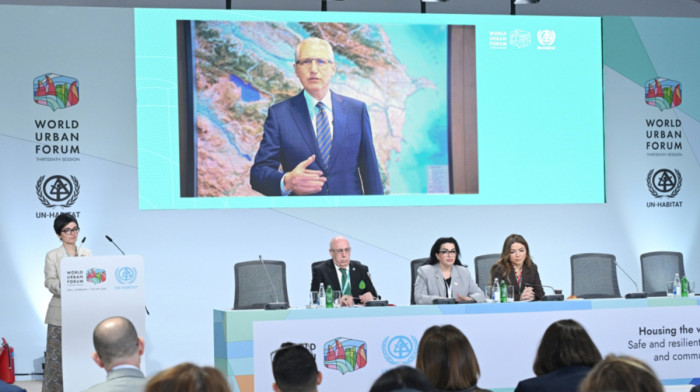
The most important milestone was the first Regional Ecological Summit, known as RES 2026, held in Astana on 22-24 April. For the first time, all five Central Asian states took part in a coordinated environmental forum prepared through a long process involving governments, experts and international partners. The summit ended with the adoption of the Astana Declaration on Environmental Solidarity in Central Asia, committing regional leaders to deeper cooperation on sustainable development and climate adaptation.
The summit also produced tangible outcomes. Seventeen agreements and investment documents worth more than US$2.3 billion were signed, largely in areas such as renewable energy, waste management, industrial decarbonisation and green technology. On water, the summit opened the door to more coordinated regional management, including digitalisation, water-saving technologies, infrastructure modernisation and improved accounting to reduce losses.
These developments demonstrate growing political will. They also show that environmental challenges can no longer be handled through isolated national policies. But the gap between declaration and delivery remains wide. Cooperation is advancing. The crisis is accelerating.
The Water Reality Behind the Declarations
Water security reveals that imbalance most clearly. During the 2026 vegetation period, the region entered the season with significantly reduced water availability. In the Amu Darya basin, water flow in February 2026 fell to 66.8 percent of the normal rate, compared with 101.8 percent a year earlier. The lower reaches of the river felt the impact quickly. The volume of the Tuyamuyun Reservoir was more than 600 million cubic metres lower than the previous year, while flushing irrigation began on 10 February instead of 15 December.
For cotton-growing areas such as Khorezm and Karakalpakstan, such delays increase the risk of soil salinity and weaker yields. Similar pressures are visible across the wider region, where each Central Asian state faces its own combination of declining water availability, ageing infrastructure and climate-related risk.
This is the central contradiction. RES 2026 and the Astana Declaration show that regional leaders increasingly understand climate change as a shared security challenge. But recognition is not implementation. A summit can set direction. It cannot refill a reservoir.
Recommendations for More Coordinated Climate Action
Central Asia's climate cooperation in 2026 represents the most ambitious collective response to environmental crisis the region has yet attempted. The summit was more substantive, the institutions more coordinated and the political attention more sustained than in previous moments. These are real achievements and should be recognised as such.
But achievements on paper are not the same as change on the ground. The glaciers are still retreating. The rivers are still shifting. Farmers are still watching water stress move from forecast to field. Closing the gap requires not more dialogue, but deliberate action in four areas where the region's response is still falling short.
1. Build a Shared Regional Climate Knowledge System
The first is knowledge. The five Central Asian states still lack the shared monitoring systems needed to track what is happening to their water in real time. Without reliable, jointly collected data on glacial melt, river flows and extreme weather, every adaptation plan rests on an uncertain foundation. A jointly operated regional climate observatory, drawing on satellites, mountain monitoring stations and meteorological networks, should be established as a priority. The data it produces should be open, regularly updated and accessible to planners and policymakers across all five countries. Better shared knowledge is not just a technical improvement. It is the basis for the trust that deeper cooperation will require.
2. Strengthen Public Engagement and Climate Awareness
The second is public engagement. Climate action cannot be sustained by governments alone. Across the region, public awareness of what is happening to water supplies remains limited, and that weakens both political will and community participation. Governments and regional organisations should invest more seriously in climate education, community outreach and the meaningful inclusion of local populations in adaptation programmes. A population that understands the crisis is more likely to support the difficult changes required to address it.
3. Create Sustainable Regional Climate Financing
The third is financing. The region cannot build a durable climate response on unpredictable external funding. A dedicated regional climate fund, jointly contributed to and jointly governed by the five states, would provide a more stable long-term base for adaptation and mitigation. Such a mechanism would not remove the need for international finance, but it would reduce dependence on donor cycles and give the region more control over its own priorities.
4. Move from Voluntary Cooperation to Accountability
The fourth is accountability. Most regional environmental commitments still rely heavily on voluntary cooperation. Voluntary commitments matter, but they are easily weakened when national pressures rise. The region should move gradually toward stronger and more enforceable commitments on the issues that matter most: water sharing, data exchange, drought response, infrastructure planning and emergency coordination. Without accountability, even the best-designed plans will struggle to survive contact with political reality.
The Race Between Institutions and the Waterline
Central Asia has begun to speak the language of regional climate cooperation. That matters. But the mountains are speaking in another language: shrinking ice, earlier river flows and drier summers. The question is no longer whether the region understands the crisis. It is whether its institutions can move before the waterline moves beyond them.























What is your opinion on this topic?
Leave the first comment