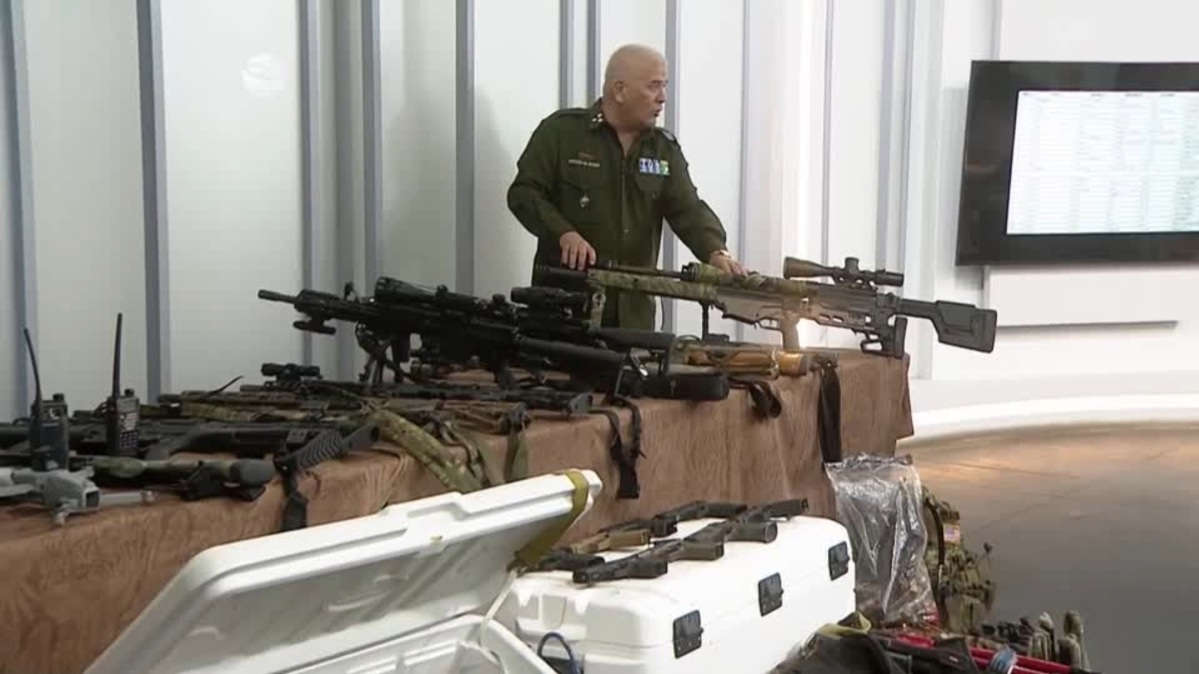
Cuba has released extensive details of a deadly midweek shootout at sea, showing rifles, pistols and nearly 13,000 rounds of ammunition that it says were carried by a group of exiles who attempted to enter the island by speedboat.
Cuban officials say the group was a commando unit of Cuban exiles who intended to infiltrate the country and was armed with 13 rifles, 11 pistols and 12,846 rounds of ammunition.
They said the men opened fire after entering Cuban waters on Wednesday, prompting a firefight in which four were killed and six wounded before being taken into custody.
Havana says 10 Cuban nationals arriving from the United States launched the attack on a border guard vessel in what has become one of the most serious maritime incidents in years.
Senior Interior Ministry officers appeared on a special television programme to show the captured armaments, including bins filled with thousands of the recovered rounds.
They displayed images of the vessels, each marked by bullet impacts from what they said was a close-range clash at roughly 20 metres.
The new details were presented to dispel doubts about Cuba’s account and to underline the scale of the attempted infiltration.
Rising tensions with the U.S.
The confrontation unfolded during a fraught period in U.S.-Cuban relations. U.S. President Donald Trump has been applying pressure on the island in recent weeks.
Officials say he imposed a virtual oil blockade in recent weeks, further straining Cuba’s alliance with Venezuela, removing a crucial Cuban ally.
Cuban authorities say the assailants were exiles, some previously placed on a list of accused terrorists, who arrived from the United States with the intention of sowing disorder and attacking military units on the communist-ruled island.
“The intent of this group was to infiltrate, promote public disorder and carry out violent acts, including attacks on military units in order to incite social unrest,” said Colonel Víctor Álvarez of the Interior Ministry.
U.S. seeks its own review
Officials in Washington have expressed unease over parts of the narrative.
Secretary of State Marco Rubio said on Wednesday that the U.S. government would independently investigate, stressing that it was not a U.S. operation and that no U.S. government personnel were involved.
Cuban officers said the group departed Marathon in the Florida Keys on two vessels but abandoned one due to technical problems before continuing on a single speedboat.
A U.S. official said the boat used was reported stolen in Florida.
How the clash unfolded
Cuba says it recovered a drone, radios, knives, a portable power generator, bolt cutters and other matériel, along with emblems linked to the November 30 Movement and People’s Self-Defense, two anti-communist groups that oppose the government.
According to the Interior Ministry, a patrol of five border guard members on a 9-metre boat spotted the incoming vessel shortly after 7 a.m., with some of the approaching crew already in the water about one nautical mile off a cay on the northern coast, roughly 100 miles from Marathon.
The officers say the infiltrators opened fire first at a distance of 185 metres, striking the Cuban captain in the abdomen.
Despite heavy bleeding, the captain stayed at the helm and steered toward the vessel, closing the distance to around 20 metres before the exchange intensified.
Cuba has described its response as “proportional”.
“It is a defensive model that practically never uses firearms, and the use of firearms is proportional to the type of action being carried out against our force,” said Interior Ministry Colonel Ybey Carballo.
Long prison terms or death penalty possible
Prosecutor Edward Robert Campbell said the captured men are receiving medical treatment and face charges including armed aggression, illegal entry into national territory, crimes associated with terrorist acts and arms trafficking.
He said they face prison terms of 10 to 15 years for lesser offences and 20 to 30 years, or even the death penalty, for the most serious charges.














What is your opinion on this topic?
Leave the first comment