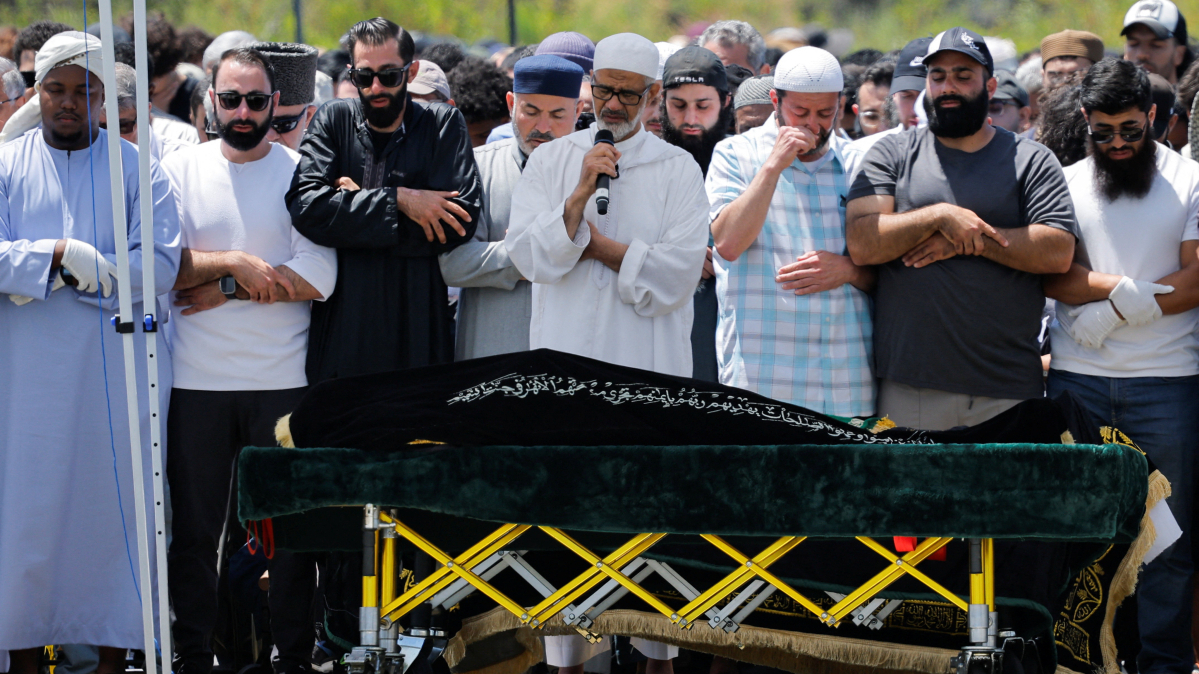
More than 2,000 people gathered in San Diego this week for funeral prayers honouring three men killed while trying to stop an attack at the Islamic Centre of San Diego, in what authorities are investigating as a suspected hate crime.
Community leaders described the men as heroes who acted to protect worshippers and children inside the mosque complex, which also houses Bright Horizon Academy. Officials said all pupils at the school were safely evacuated following the shooting.
Investigation and suspected motive
Investigators later discovered what police described as “anti-Islamic writings” inside a vehicle linked to the two teenage suspects, who were later found dead. While authorities have not released a full motive, the FBI is treating the case as a possible hate crime.
The attack has renewed concerns over anti-Muslim hatred and the security of mosques and Islamic institutions, particularly as monitoring groups in several countries report rising incidents targeting Muslims.
A global rise in anti-Muslim hatred
For Fiyaz Mughal, founder of the UK-based anti-Muslim hate monitoring organisation Tell MAMA, the San Diego shooting reflects a wider trend that has been building for years.
“We’ve seen the rise since 2010, so it’s been going on for 15 years,” he told AnewZ. “The online space, specifically, and social media platforms specifically, have been one of the major spreaders of this.”
Mughal said the spread of anti-Muslim hatred had been accelerated by a lack of regulation and moderation on social media platforms.
“The lack of removal of content, the lack of understanding of the language of anti-Muslim hatred, and for at least the first five, six, seven years, a lack of any action on anti-Muslim hate content, has all added to the volume of this and the spread of this globally,” he said.
He added that text, images and AI-generated material had made it easier for extremist narratives to spread online, particularly among younger audiences.
According to Mughal, anti-Muslim sentiment is no longer confined to isolated local incidents, but increasingly operates across borders through online networks and extremist messaging.
“It’s definitely global,” he said. “There is a global connection between action on one side of the world and reactions elsewhere.”
He pointed to links investigators have drawn between recent attacks and previous acts of anti-Muslim violence abroad, including the 2019 Christchurch mosque shootings in New Zealand.
Calls for international action
Mughal argued that individual governments acting alone would struggle to regulate global social media companies effectively and called for coordinated international action.
“We need a global coalition of governments right across the globe,” he said. “If you do not act within parameters which allow for free speech, but which do not allow for hate speech, then we will shut you down.”
“There is a lot of misinformation and disinformation about Islam around, and that is being used by extreme anti-Muslim groups,” he said.
He said stronger global pressure on social media companies was necessary because “young minds are being affected”, while extremism and mental health concerns were also increasing.
Mughal also said misinformation about Islam continued to fuel hostility towards Muslims.
"There is a lot of disinformation and discrimination about Islam around and that is being used by extreme anti-muslim groups"
- Fiyaz Mughal
He said organisations with expertise in the area should play a greater role in challenging false claims and inflammatory narratives online.
“We need organisations that have knowledge in this area to debunk and deconstruct the disinformation,” he said. “To make sure the public is aware that certain pieces of information or content are fundamentally wrong.”
Role of communities
At the same time, Mughal said Muslim communities also had a role to play in countering stereotypes and misconceptions.
“We also need more organisations working with Muslims to make the public aware of what Islam is and what Islam isn’t,” he said. “And also more Muslims talking about how they are able to live in the West and live in non-Muslim countries and still be a Muslim and be happy.”
Security concerns at places of worship
The San Diego attack has also renewed debate around security at mosques and other places of worship.
Mughal said Islamic centres should improve security measures, but avoid creating environments that appear isolated or heavily militarised.
“You can do security measures without them being visible to the public,” he said. “You don’t want to give the impression that a mosque is some kind of fortress.”
He suggested discreet measures such as CCTV and less visible security systems could help protect worshippers while preserving openness and community trust.
Long-term impact on communities
Beyond physical safety, Mughal warned that repeated incidents of anti-Muslim hatred could have deeper long-term consequences for Muslim communities.
“If they suffer anti-Muslim hatred, they don’t feel wanted, they don’t feel connected, they don’t feel part of the country,” he said.
“That disconnects them from the local community, disconnects them from the nation, and disconnects them from feeling they have a future in the area.”
He added that repeated incidents of hatred could affect emotional wellbeing, mental health and people’s sense of belonging.
While Mughal acknowledged that a small number of extremist Muslim voices had, at times, inflamed tensions through provocative rhetoric, he stressed that such individuals represented only a minority.
“These people have given fuel to the fire,” he said, adding that anti-Muslim groups often use such examples to portray Muslims unfairly.













What is your opinion on this topic?
Leave the first comment