Belarusian President Alexander Lukashenko has said Belarus will not be dragged into the war in Ukraine, while also stressing that Minsk and Moscow would jointly respond to any aggression against them.
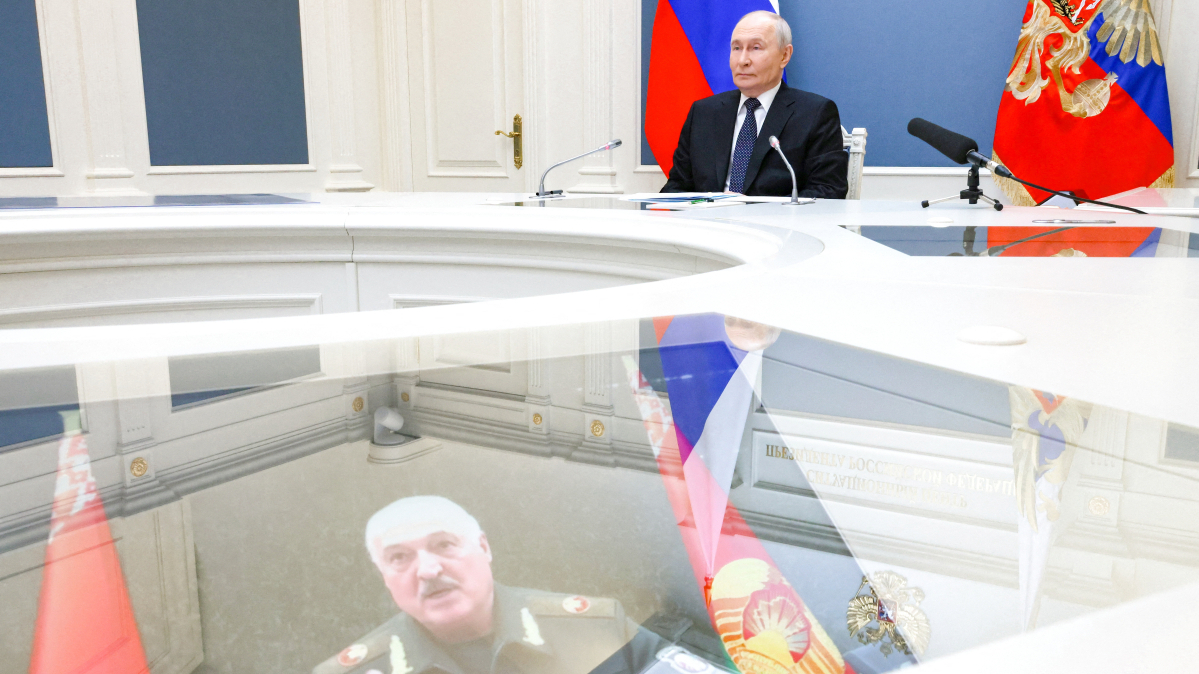
His comments were reported by Belarus’ state news agency BELTA on Thursday (21 May) during joint nuclear exercises conducted with Russia, which he and Russian President Vladimir Putin observed via video link.
'Only if there is aggression'
Lukashenko directly rejected warnings from Ukrainian President Volodymyr Zelenskyy that Belarus could be further pulled into the conflict.
“As for (Zelenskyy’s) statements that Belarus will be drawn into the war… this will occur in only one instance - if aggression is committed on our territory,” he said, according to BELTA.
He added that Belarus and Russia would act together in such a scenario.
“We will together defend our Fatherland… where our two countries stand,” Lukashenko said.
Openness to talks with Kyiv
Despite the tensions, Lukashenko said he was willing to meet Zelenskyy to discuss the situation directly.
“If Zelenskyy wanted to talk about something… we are open to this. Any location - Ukraine, Belarus - I am ready to meet him and discuss problems in our relations,” he said.
The Belarusian leader’s remarks come after repeated Ukrainian warnings that Belarus could be used as a platform for renewed Russian military activity. Belarus allowed Russian forces to use its territory during the February 2022 full-scale invasion of Ukraine.
Zelenskyy warns of pressure on Belarus
In his nightly address on Thursday, Zelenskyy said Russia was attempting to pull Belarus deeper into the war. He also said Ukraine was strengthening its defences along its northern border.
Russia is “eager to draw Belarus deeper into this war,” he said, adding that Ukraine had “the capability to strengthen our defences… and to work preventively.”
Ukrainian officials have recently reported increased monitoring of the border area with Belarus, including in northern regions.
Nuclear exercises and security messaging
Lukashenko made his comments while observing joint nuclear drills with Russia. The exercises were presented by Moscow and Minsk as a demonstration of defensive readiness.
The Belarusian leader insisted the drills were not linked to any intention of escalation, but part of ongoing military cooperation with Russia.
Diplomatic signals amid sanctions pressure
Belarus remains under Western sanctions over human rights concerns and its support for Russia’s war effort in Ukraine.
However, recent months have seen limited diplomatic engagement with the United States. Several rounds of talks have reportedly led to the release of detainees described by Western governments as political prisoners, in exchange for partial easing of sanctions.
U.S. envoy John Coale has suggested Lukashenko could visit the United States in the near future.
Lukashenko points to Western politics
Lukashenko also suggested that improved dialogue between Washington and Minsk may be influencing Kyiv’s statements.
“They see that we are having a specific dialogue with the Americans,” he said, according to BELTA. “And not everyone likes that. And that’s why they are nudging Zelenskyy.”








What is your opinion on this topic?
Leave the first comment