The AnewZ Opinion section provides a platform for independent voices to share expert perspectives on global and regional issues. The views expressed are solely those of the authors and do not represent the official position of AnewZ
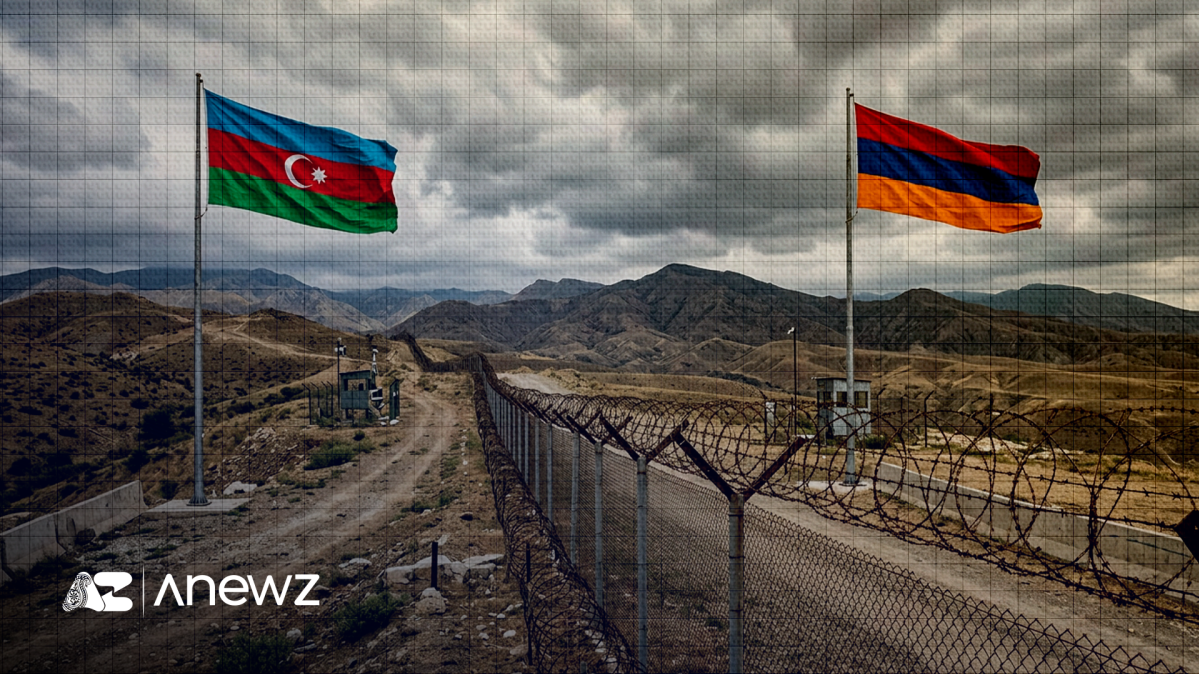
In a region where borders have long been drawn in blood rather than ink, even the act of sitting across the table carries strategic weight. The latest border talks between Armenia and Azerbaijan may appear procedural, but they carry profound geopolitical significance.
The recent visit of an Azerbaijani delegation led by Shahin Mustafayev to Armenia - and the reported agreement on preliminary drafts for border delimitation - may appear procedural at first glance.
It is anything but. It signals a cautious yet meaningful step towards redefining one of Eurasia’s most fragile geopolitical fault lines.
From Soviet ambiguity to sovereign reality
For decades, the absence of clearly demarcated borders between Azerbaijan and Armenia has been more than a cartographic anomaly; it has been a persistent source of tension, miscalculation and intermittent violence. The legacy of Soviet Union administrative boundaries - never designed to serve as sovereign frontiers - left behind ambiguities that repeatedly ignited clashes.
In that context, any movement towards formal delimitation is not merely technical. It is profoundly political.
From symbolism to structure
What distinguishes the current moment is not the novelty of dialogue, but its gradual institutionalisation. This is no longer about sporadic summits or externally mediated declarations. It is about working groups, draft agreements and the slow, methodical translation of political intent into legal and geographic clarity.
That shift - from symbolism to structure - matters. It reflects a recognition that durable peace is built not on declarations, but on mechanisms.
Yet it would be premature to speak of a breakthrough. The South Caucasus has witnessed many hopeful openings dissolve into renewed distrust. What we are seeing today is better understood as the early architecture of peace.
The path from draft texts to mutually recognised borders is long, technically complex and politically sensitive.
Risk One: The weight of domestic politics
Public sentiment remains deeply shaped by years of conflict, displacement and trauma. Leaders on both sides must navigate nationalist pressures that can quickly turn compromise into perceived capitulation.
Even incremental concessions - inevitable in any delimitation process - can trigger backlash, eroding political space for continued dialogue.
Risk Two: A crowded geopolitical chessboard
The South Caucasus does not exist in isolation. Russia, the European Union, the U.S. and regional actors such as Türkiye all have stakes in the outcome.
External engagement has at times facilitated dialogue, but competing strategic agendas can just as easily complicate or stall progress. The risk is not the presence of external actors, but the absence of coordination among them.
Risk Three: The complexity of drawing lines
Borders are not drawn with a single stroke of a pen. They require agreement on historical maps, legal references, geographic markers and present-day realities on the ground.
A disagreement over a seemingly minor stretch of land can escalate into confrontation if not managed with precision and patience.
This is a process that demands not only political will, but sustained technical cooperation.
Corridor of opportunity
Despite these risks, the potential upside is transformative. A stable and clearly defined border between Azerbaijan and Armenia would do more than reduce the likelihood of military incidents.
It could unlock a new phase of economic and infrastructural integration. The South Caucasus could evolve from a geopolitical bottleneck into a strategic corridor - linking the Caspian basin to Europe and facilitating trade, energy flows and regional connectivity.
Why it matters for Türkiye and beyond
For Türkiye, this process carries particular significance. Durable normalisation between Baku and Yerevan could pave the way for long-discussed transport links and logistical corridors, reshaping regional supply chains.
For the European Union, it offers an opportunity to anchor stability along a critical energy and transit route. For the wider international community, it represents something increasingly rare: the gradual resolution of a protracted conflict through negotiation rather than coercion.
Peace in this region will not emerge from a single visit or a single agreement. It will be constructed incrementally - through sustained engagement, careful compromise and a willingness to prioritise long-term stability over short-term political gain.
The current process is reversible. Missteps - whether on the ground or in political rhetoric - could quickly undo recent progress.
An unthinkable peace - now within reach
Still, something has shifted. The language of confrontation is, however tentatively, giving way to the language of delineation. Lines on a map - once sources of dispute - are being reconsidered as instruments of clarity.
This does not erase history, nor does it guarantee harmony. But it opens the possibility of a different trajectory.
The question now is whether both sides - and the external actors surrounding them - possess the strategic patience to carry this process through to completion. In the South Caucasus, peace has always been elusive.
But for the first time in a long while, it is no longer unthinkable.













What is your opinion on this topic?
Leave the first comment