The AnewZ Opinion section provides a platform for independent voices to share expert perspectives on global and regional issues. The views expressed are solely those of the authors and do not represent the official position of AnewZ
European Commission President Ursula von der Leyen’s latest statements have become a contested topic in Türkiye and beyond - less for what they intended to say than for what they inadvertently revealed.
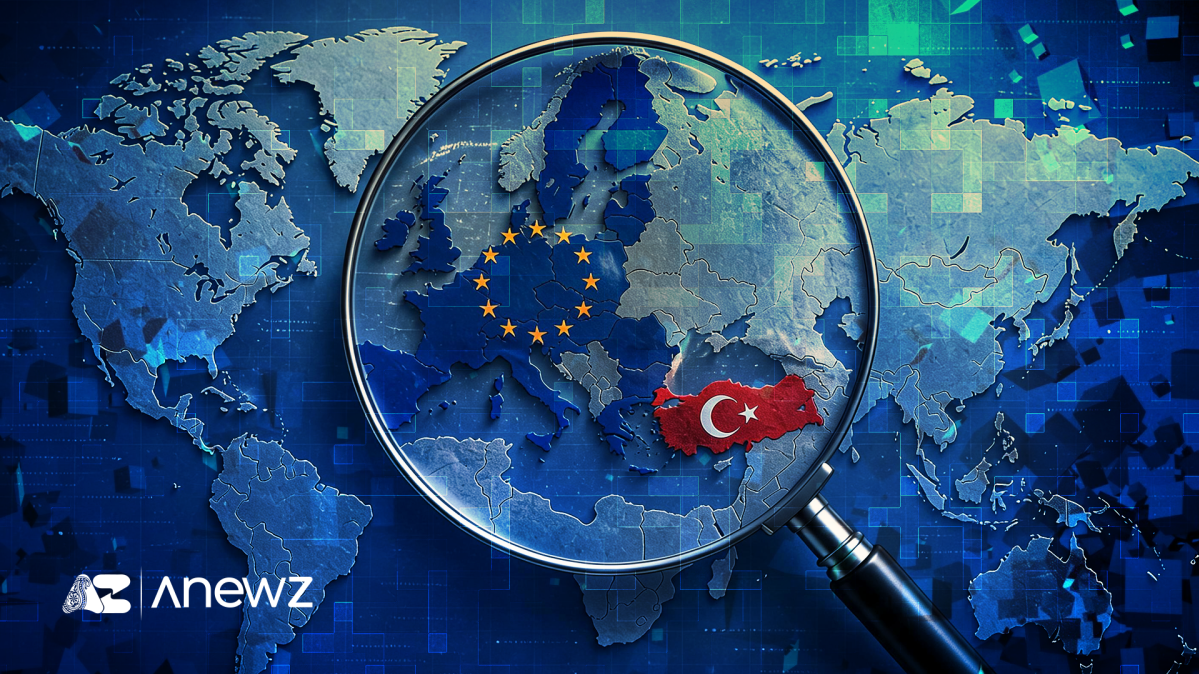
When she recently suggested in an internal occasion in her country, Germany, that “Europe must be ‘completed’ in a way that shields it from the influence of Russia, Türkiye, or China”, she likely intended to articulate a geopolitical ambition. Instead, she exposed a deeper, unresolved tension at the heart of the European project: who is considered part of Europe - and who is perpetually cast as its “other.”
The backlash was swift, but most striking came recently also from within Europe’s own institutional elite. Former President of the European Council from 2019 to 2024, Charles Michel, publicly rebuked the framing, reminding Brussels that Türkiye, in fact, is not an “external disruptor”, but a “core NATO ally,” a migration partner, and a strategic actor embedded in Europe’s security architecture.
This was not merely a personal clash between two high-ranking officials. It was a moment of institutional candour - one that revealed the European Union’s ongoing struggle to reconcile its geopolitical ambitions with its normative identity.
Classical way of politics: Categorisation and Türkiye as the 'other'
At first glance, grouping Türkiye alongside Russia and China might seem like a rhetorical shortcut - an attempt to describe external pressures on Europe. But language matters, especially in geopolitics. Hence, categories are not neutral; they construct reality.
By placing Türkiye in the same conceptual basket as revisionist or systemic rivals, von der Leyen implicitly downgraded its status from partner to problem. This is not a trivial shift. Türkiye is, after all, a NATO member, a longstanding candidate for EU accession. Ankara is also a critical intermediary in migration, energy transit, and regional security.
Michel’s response - warning against “simplifying reality” and applying “double standards” - was less a defence of Türkiye per se than a critique of Europe’s intellectual laziness.
Because the contradiction is glaring. Europe depends on Türkiye in practice, yet hesitates to recognise it in principle.
Strategic dependency vs. normative distance
At such a point, the tension between dependence and distance has long defined EU-Türkiye relations. Europe relies on Türkiye to manage migration flows, stabilise its southeastern flank, and act as a traditional energy corridor connecting East and West.
Yet, politically and culturally, Türkiye also remains suspended in a state of permanent ambiguity: too European to ignore, too “other” to fully embrace.
Von der Leyen’s remark did not create this contradiction - it merely crystallised it, maybe in what may be perceived as a too “German rational and direct way”. Yet, in doing so, it exposed a deeper structural problem in EU foreign policy: the inability to integrate complex partners into a coherent strategic narrative, particularly in such a critical period of world politics.
Recent developments only reinforce this pattern. The Commission under von der Leyen has increasingly embraced a more “interest-driven” foreign policy, signalling a shift from idealism toward geopolitical pragmatism. But pragmatism without conceptual clarity risks producing precisely the kind of rhetorical missteps we are witnessing. Von der Leyen has made a similar misstep before, offering what many saw as overstated support for the Israeli government despite the atrocities on the ground.
If Türkiye is essential to Europe’s security and prosperity - as Michel insists - then treating it as a quasi-adversary is not just inconsistent; it is strategically self-defeating.
Brussels power games: Ideology behind the institutional tone
To understand Ursula von der Leyen’s rhetoric, one has to look beyond Brussels and into Berlin. A senior figure in the Christian Democratic Union, von der Leyen’s political DNA is rooted definitely in Germany’s centre-right tradition - “Atlanticist”, “security-focused”, and “increasingly assertive in global affairs”. This places her in notable alignment with current Bundeskanzler Friedrich Merz, whose leadership has steered German conservatism further toward a harder geopolitical posture during recent months.
Both figures share a preference for clarity over ambiguity in foreign policy - sometimes at the expense of nuance and skilful diplomacy. This is particularly visible in von der Leyen’s strong pro-Israel stance, especially in the aftermath of recent Middle Eastern crises, where she positioned the EU firmly within a Western security framework rather than as a balancing diplomatic actor.
Such positioning reflects a broader ideological shift: from the EU as a normative power to the EU as a strategic bloc. In this paradigm, actors such as Türkiye risk being assessed less on their functional importance and more on their alignment with a values-based geopolitical camp. The result is a more polarised discourse - one that mirrors domestic political currents within Europe as much as it responds to external realities.
Risk of 'strategic myopia'
What makes this debate particularly consequential is the broader geopolitical context. Europe is navigating an increasingly fragmented world - one in which rigid alignments are giving way to overlapping, sometimes contradictory partnerships.
In such a landscape, strategic flexibility and a wider realm for non-ideological and skilful diplomacy is not a luxury; it is a necessity.
By framing Türkiye as an external influence to be countered, the EU risks undermining its own strategic interests. It also sends a confusing signal to Ankara: cooperation is essential, but recognition is conditional; partnership is valued, but never fully acknowledged.
This ambiguity is not sustainable.
Moreover, it feeds into a larger narrative - one that portrays Europe as selectively inclusive, willing to embrace diversity when convenient but quick to revert to exclusionary logic under pressure.
Other prominent EU figures, including Charles Michel, have warned about “double standards.” This concern deserves attention, not as an uncritical defence of Türkiye, but as an indication of a deeper and ongoing “credibility gap” within the EU.
Toward a more honest European discourse: 'Europe’s mirror moment'
If there is a constructive lesson to be drawn from this episode, it is this: Europe needs a more honest conversation about its identity and its borders - both literal and conceptual.
This does not mean abandoning discussions surrounding Türkiye, nor does it require fast-tracking accession talks that have long stalled. It does mean, however, acknowledging the reality of interdependence and resisting the temptation to reduce complex relationships to simplistic categories.
A mature geopolitical actor does not need to flatten nuance to assert itself. On the contrary, it thrives on its ability to manage ambiguity.
Von der Leyen is right about one thing: Europe must “think bigger.” But thinking bigger should not mean thinking “narrower” - reducing a multifaceted partner to a convenient rhetorical foil.
Michel, perhaps unintentionally, has pointed toward a more constructive path: one that recognises Türkiye not as an external threat, but as an integral, if complicated, part of Europe’s strategic landscape.
And in the end, this controversy is less about Türkiye than it is about Europe itself. How the EU speaks about Türkiye reveals how it understands its own identity - its boundaries, its values, and its place in the world.
Is Europe a fortress, defined by exclusion? Or a network, defined by interdependence? The answer, as this episode makes clear, is still very much contested. And until that contest is resolved, Europe’s rhetoric will continue to betray its uncertainties - no matter how carefully it is crafted.














What is your opinion on this topic?
Leave the first comment