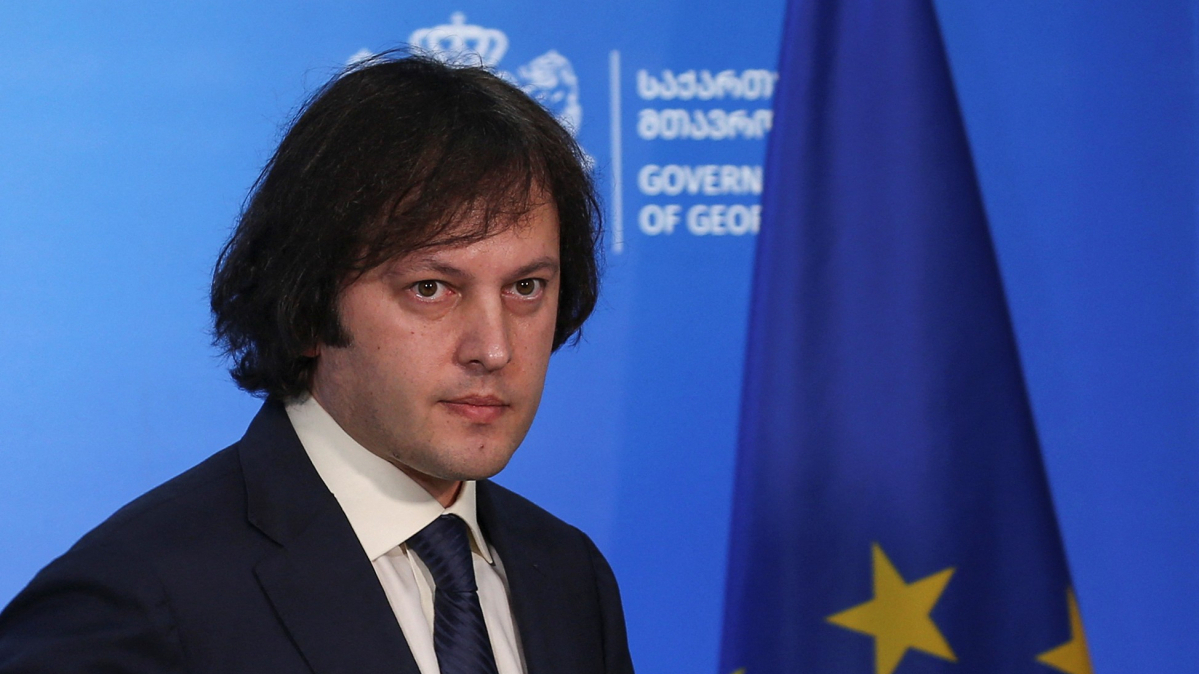
Prime Minister Irakli Kobakhidze has published an open letter questioning the EU’s democratic credibility, in what may be the clearest sign yet of Georgia’s deepening political and diplomatic rupture with Brussels.
The letter was not delivered through diplomatic back channels, but published in full for anyone to read. Georgian Prime Minister Irakli Kobakhidze’s open letter to the heads of the European Commission, Council and Parliament this week was many things at once: a rhetorical challenge, a domestic political manoeuvre and perhaps the clearest sign yet that Tbilisi and Brussels are not simply arguing. They may no longer be speaking.
What the letter actually says
On the surface, the letter asks a pointed question: how does the EU reconcile its promotion of democratic values with scenes from Copenhagen, where police dispersed pro-Palestinian demonstrators outside the offices of a Danish shipping company using batons and dogs? Kobakhidze frames this not as a provocation, but as a genuine enquiry from a country that “expects a clear answer.”
He goes further, describing what he sees as a broader European crisis - democratic decline, economic stagnation, migration pressures and the erosion of national identity. Georgia, he argues, is a country rooted in Christian morality, freedom and European civilisation - more European, the implication suggests, than Europe itself.
The backdrop: A relationship in freefall
To understand why this letter matters, it is necessary to understand where relations currently stand. In November 2024, the Georgian Dream government unilaterally suspended the country’s EU accession talks until 2028 and refused EU budget support - a decision that triggered months of mass protests from a public that, according to polling at the time, overwhelmingly supported European integration. The disputed October 2024 elections had already set the stage: the European Parliament refused to recognise the results, described them as rigged and called for fresh elections under independent monitoring.
Since then, the situation has only worsened. In March 2026, the EU suspended visa-free travel for Georgian government officials in response to what Brussels described as the systematic suppression of protests, the imprisonment of opposition politicians and the near-collapse of independent media. The European Parliament went so far as to describe Georgia as “a candidate country in name only.”
“The letter is not addressed to Brussels. It is addressed to Georgians.”
Reading between the lines
Opposition figure Nika Gvaramia offered the sharpest interpretation of the letter’s underlying message. In his view, it carries three arguments at once: that Brussels has already closed the door on this government; that the EU’s leadership is no longer a legitimate partner; and that Georgia does not need Europe if Europe has abandoned its own values.
The open letter, in other words, is less about Copenhagen and more about offering the Georgian public a narrative to live with - one in which the country is not being left behind, but is instead choosing to stand apart from a continent portrayed as being in decline.
There is also a personal dimension. Danish officials had recently emerged among the Georgian government’s sharpest critics, and Kobakhidze himself attended a European Political Community summit in Denmark last year, only for Copenhagen to publicly clarify that participation in the forum did nothing to alter its critical stance on Georgia’s democratic backsliding. The letter therefore carries something of a score-settling tone.
What it means for Georgia-EU relations
Diplomatically, the letter is unlikely to change very much. It is doubtful that it will land on the desks of Ursula von der Leyen or António Costa as a serious policy document. Politically, however, its implications are significant. By publicly portraying EU institutions as illegitimate - and their values as hollow - the Georgian Dream government is narrowing whatever space for re-engagement still remained.
For ordinary Georgians who continue to support EU membership - and polling consistently suggests they remain the majority - the letter represents something more uncomfortable: a government steering away from a destination much of the country still wants to reach. The EU, for its part, has repeatedly said that its door remains open to the Georgian people, even as it closes further on their government.
Whether that distinction can hold in practice - and for how long - is the question likely to define Georgia’s next chapter.














What is your opinion on this topic?
Leave the first comment