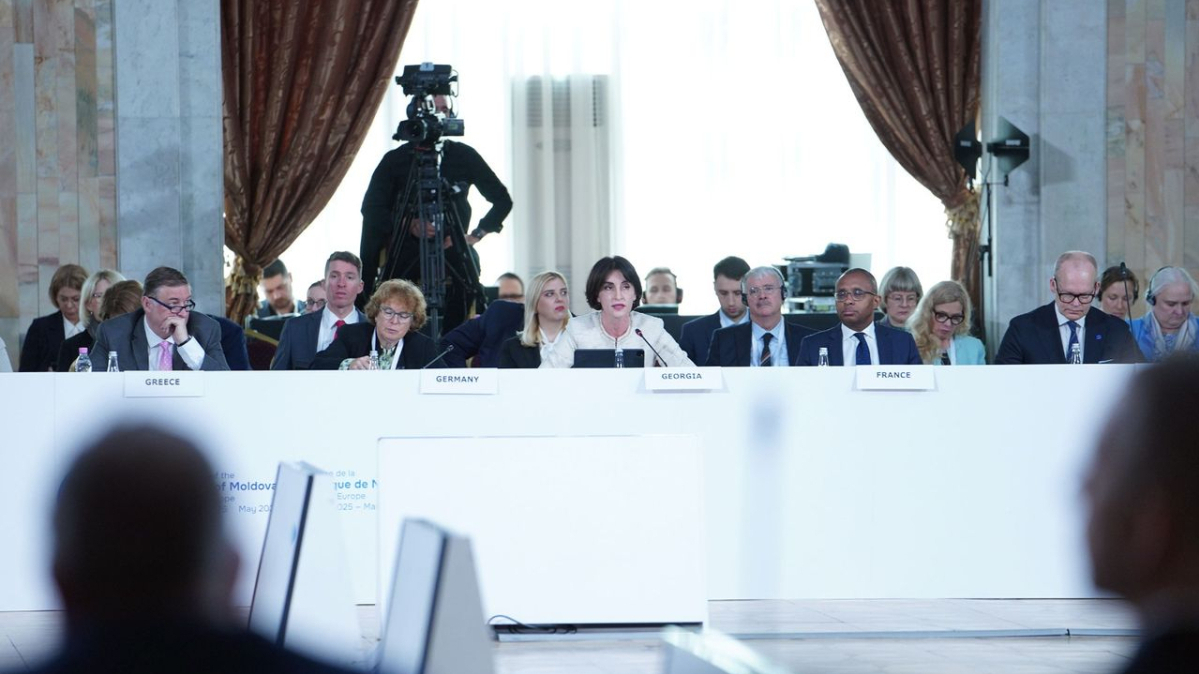
When 36 nations signed up to prosecute Russia over its invasion of Ukraine, Georgia - a country partly occupied by Russia - declined to join. Tbilisi blamed strained relations with the EU. Critics blamed the government itself.
The tribunal, years in the making, is designed to do what the International Criminal Court currently cannot: prosecute senior Russian political and military leaders for the decision to invade Ukraine in the first place.
It is a landmark moment in international accountability. And Georgia was not part of it.
'The EU's attitude does not allow us'
Georgia’s Foreign Minister, Maka Bochorishvili, did not pretend the decision was straightforward. In her explanation, she pointed directly at the European Union, arguing that the inconsistent and, in her view, hostile attitude of certain EU member states towards Georgia’s current government makes it impossible to take actions that could “create additional risks and threats” for the country.
In short: if Brussels will not treat us as a partner, we cannot afford to antagonise Moscow on its behalf.
It is a remarkable statement from a country that is, by any legal definition, already under Russian occupation. Since the 2008 war, Russia has controlled approximately 20% of Georgia’s internationally recognised territory. The Russian military sits roughly 50 kilometres from Tbilisi. The threat is not theoretical. It is permanent.
Georgia’s ruling Georgian Dream party has long framed its cautious posture towards Russia as pragmatic self-preservation. Reinforcing that argument, Bochorishvili and Georgian Dream MP Tornike Paghava pointed out that Georgia has joined roughly 1,000 international resolutions supporting Ukraine - on territorial integrity, humanitarian assistance and condemnation of Russian aggression. The tribunal refusal, they argue, is an exception born of circumstance rather than a shift in principle.
Critics accuse government of appeasing Moscow
The opposition sees it differently - and they are not holding back.
Grigol Gegelia of the Strong Georgia - Lelo party called the government’s reasoning “very clear evidence that this regime is trading with values and Georgian national interests.” His argument is that a country which genuinely sees Russia as an occupying threat does not refuse to join a coalition specifically designed to hold that occupier to account - and then cite EU hostility as justification.
The accusation is pointed. Georgian Dream has grown increasingly authoritarian in recent years, drawing sustained criticism from EU institutions and European capitals. That tension is real. But critics argue the government is using it selectively - as a shield against decisions it simply does not want to make.
Whether Bochorishvili’s statement reflects a genuine security calculation or political convenience is a question only Tbilisi can answer honestly. What is certain is that both things can be true at once: the EU’s relationship with Georgia is genuinely strained, and Georgian Dream appears genuinely ambivalent about confronting Russia.
The South Caucasus bloc: A region that held back together
Georgia’s absence was not an anomaly in its neighbourhood. Neither Armenia nor Azerbaijan signed the agreement. The entire South Caucasus stayed out.
Both Yerevan and Baku have their own reasons for remaining cautious. Armenia and Azerbaijan initialled a landmark peace agreement at the White House in August 2025 - a deal that remains unsigned, fragile and vulnerable to Russian disruption. Neither country is eager to antagonise Moscow while the process remains unresolved.
Azerbaijan, meanwhile, has spent years refining a strategy of deliberate non-alignment: selling energy to Europe, trading with Russia and avoiding coalitions that threaten either relationship.
The South Caucasus is not a pro-Russian region. It is a region where Russia remains the permanent and proximate risk - and where every government, for its own reasons, continues calculating the cost of saying so publicly.
Other holdouts reveal wider divisions.
Beyond the Caucasus, the list of non-signatories carries its own political logic. It includes EU members Hungary, Slovakia and Bulgaria; four Balkan states - Serbia, Bosnia and Herzegovina, North Macedonia and Albania — as well as Turkey.
Several of these governments share a broadly conservative, sovereignty-first outlook that tends towards scepticism of multilateral legal institutions, particularly those targeting a neighbouring great power.
Bulgaria and Slovakia both have governments that have shown ambivalence about the depth of Western support for Ukraine. Serbia maintains close cultural and political ties with Russia. Turkey has spent years balancing NATO membership with an independent foreign policy that includes extensive economic links with Moscow.
Hungary is perhaps the most striking example. In April 2026, Viktor Orbán was swept from power in a landslide election, with Péter Magyar’s pro-European Tisza party securing a constitutional supermajority. It marked Hungary’s most significant political shift in 16 years.
Yet Hungary still did not join the tribunal agreement during the 15 May session. Regime change, it seems, does not produce instant foreign policy transformation. The new government has barely had time to form, let alone reverse 15 years of entrenched institutional inertia on Russia policy. Elections change governments; they do not immediately change states.
What the tribunal means — and what the absences signal
The Special Tribunal for the Crime of Aggression against Ukraine is not merely a legal instrument. It is, as one observer described it, a moral foundation for a new European security and political order — one asserting plainly that the decision to invade a sovereign country is a crime for which its architects should be held personally responsible.
That 36 countries and the EU chose to participate is significant. That 12 Council of Europe members did not is equally telling.
The pattern of absences does not map neatly onto the simplistic pro-Russia versus pro-West divide that dominates much coverage of the war. Instead, it reflects geography and exposure: countries sharing borders, energy networks or unresolved territorial disputes with Russia; governments facing domestic pressures that make open confrontation with Moscow politically costly; and countries such as Georgia, where the gap between official foreign policy rhetoric and political reality has become increasingly difficult to ignore.
Russia did not need to threaten anyone to keep them from signing. Its proximity was enough.











What is your opinion on this topic?
Leave the first comment