Georgia ranked second only to Türkiye for the number of citizens expelled from the European Union in 2025, according to new Eurostat data, placing the South Caucasus country at the centre of growing tensions over migration, visa-free travel and its deteriorating ties with Brussels.
Georgia, a country of fewer than four million people, ranked just behind Türkiye in the EU’s annual tally of returned nationals. The figures raise urgent questions about emigration, visa-free travel and Georgia’s increasingly strained relationship with Brussels.
Georgians returned from EU
10,475
2nd highest in EU, 2025
Total EU returns
135,460
↑ 21% year on year
Georgians refused EU entry
4,785
7th among all nationalities
Orders to leave EU
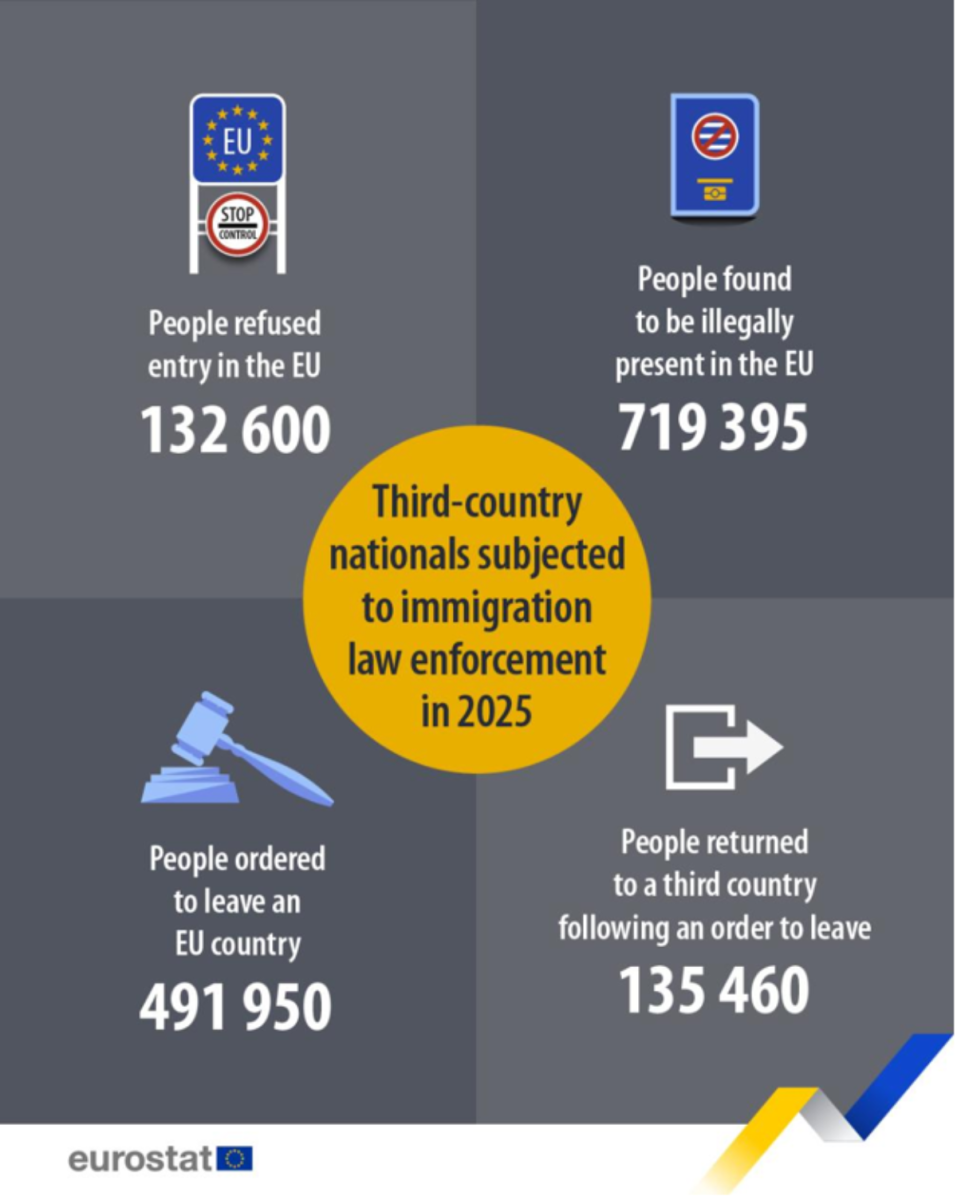
491,950
↑ 5.8% from 2024
Eurostat’s latest enforcement data, released in May 2026, shows that the European Union returned 135,460 third-country nationals to their home countries in 2025 - a 21 per cent increase on the previous year. Among them, Georgian citizens ranked second, with 10,475 people returned. Only Türkiye, with 13,405 returnees, ranked higher. Syria came third with 8,370, followed by Albania with 8,020.
For Georgia, the figure carries significance beyond the raw numbers. It reflects years of migration pressure shaped by economic hardship, political instability and the visa-free access to the Schengen area that Georgia secured in 2017 - a milestone that opened new opportunities but also created new vulnerabilities.
Who was returned, and from where
Germany carried out the highest number of returns of any EU member state, with 29,295 people sent back to third countries. France followed with 14,940, while Sweden recorded 11,250. Together, the three countries accounted for more than 40 per cent of all EU returns in 2025.
"Remittances from Georgian workers in Europe account for nearly 14 per cent of the country's GDP - making emigration not just a social story, but an economic one."
Visa-free travel under pressure
The migration figures come at a sensitive moment in Georgia’s relationship with Brussels. Since 2024, the ruling Georgian Dream party has suspended EU accession talks and adopted legislation widely viewed as Russia-aligned, including a foreign agent law closely modelled on Kremlin-era statutes.
The EU responded by suspending visa facilitation privileges for holders of Georgian diplomatic and service passports, while also updating its visa suspension mechanism - a tool now aimed, at least in part, directly at Tbilisi.
If Georgia fails to meet the EU’s reform benchmarks, all Georgian citizens could lose visa-free access to the Schengen area entirely. The irony is stark: the very freedom that enabled a wave of Georgian emigration may soon be revoked, partly because of the scale of irregular stays and returns that followed.
Georgia seventh for refused entry
Beyond expulsions, a further 132,600 non-EU nationals were refused entry at Schengen borders in 2025 - up 7.1 per cent on 2024. Ukrainians topped that list with 26,975 refusals, followed by Albanians and Moldovans. Georgia ranked seventh, with 4,785 citizens turned away at the border.
The most common grounds for refusal across all nationalities were failure to justify the purpose of travel, overstaying the 90-day limit within a six-month period, and the absence of a valid visa or residence permit.
One encouraging sign
Not all the data points in the same direction. The number of third-country nationals found to be illegally present within EU territory fell by 21.7 per cent in 2025. Fewer people are going undetected - or fewer are attempting irregular stays in the first place. Either way, the enforcement picture is shifting, and Georgia remains at the centre of it.





















What is your opinion on this topic?
Leave the first comment