This is the second of three articles examining Georgia’s growing crisis over access to treatment for Duchenne muscular dystrophy (DMD), a fatal genetic disease affecting around 100 children in the country.
Government's position
Georgia’s Minister of Health, Mikheil Sarjveladze, has not remained silent. On 29 April, he appeared before parliament - at the invitation of an opposition party - and spoke for nearly half an hour about the risks he believes are associated with the drugs parents are requesting.
His central argument is that the medicines are neither as safe nor as well-proven as their supporters claim. He focused in particular on Elevidys, the gene therapy, noting that the EMA declined to authorise it in July 2025, and that the FDA added serious safety warnings to its label following two patient deaths.
He also referred to a small number of deaths recorded during clinical use of Givinostat, although regulators have yet to confirm any direct causal link between the drug and those deaths. On exon-skipping therapies, he argued that their FDA authorisations were conditional, meaning further clinical data is still being gathered.
Only on Vamorolone did he adopt a more open tone, acknowledging that the ministry was “intensively studying” whether it could represent an improvement on the steroids currently prescribed to Georgian patients.
Commercial claims
The minister also suggested that the campaign was being driven, at least in part, by commercial and political interests - a charge the parents reject forcefully.
He did announce that a draft legislative amendment had been submitted to the government for consideration. The proposal would expand outpatient, inpatient, and research services for DMD patients, although he gave no detail about what this would mean in practice.
Parliament Speaker Shalva Papuashvili echoed the government’s cautious approach. “The main principle from which the state proceeds in the field of healthcare is to do no harm. We must approach all issues in such a way that the results are not worse.”
International approval
It is a position that many in Georgia’s medical and civil society communities find frustrating. Parents argue - with considerable force - that Georgia does not need to conduct its own review of medicines that have already undergone years of clinical trials and received approval from both the FDA and the European Medicines Agency (EMA).
Families also point out that several European countries - including Italy, Germany, France, Spain, and the United Kingdom - are already funding or actively reimbursing some or all of these treatments, while negotiations are under way in many others. Italy, Spain, and Scotland have already agreed to fund treatment with Givinostat, while the process remains under consideration in the UK, Ireland, and Germany.
Vamorolone was approved by NICE for use on the NHS in December 2024, making it available to treat people aged four and over with Duchenne muscular dystrophy.
Healthcare policy experts point to a mechanism known as a Managed Entry Agreement (MEA) - a confidential bilateral negotiation between a government and a pharmaceutical manufacturer - as one way of bringing medicines to patients at prices significantly below the listed cost, while sharing financial and clinical risk between the state and the company. Several European countries have used this model specifically for rare disease treatments.
Life on the pavement: Protest in detail
Every night, in rain and wind, they stay.
"WHAT IF IT WAS YOUR CHILD?"
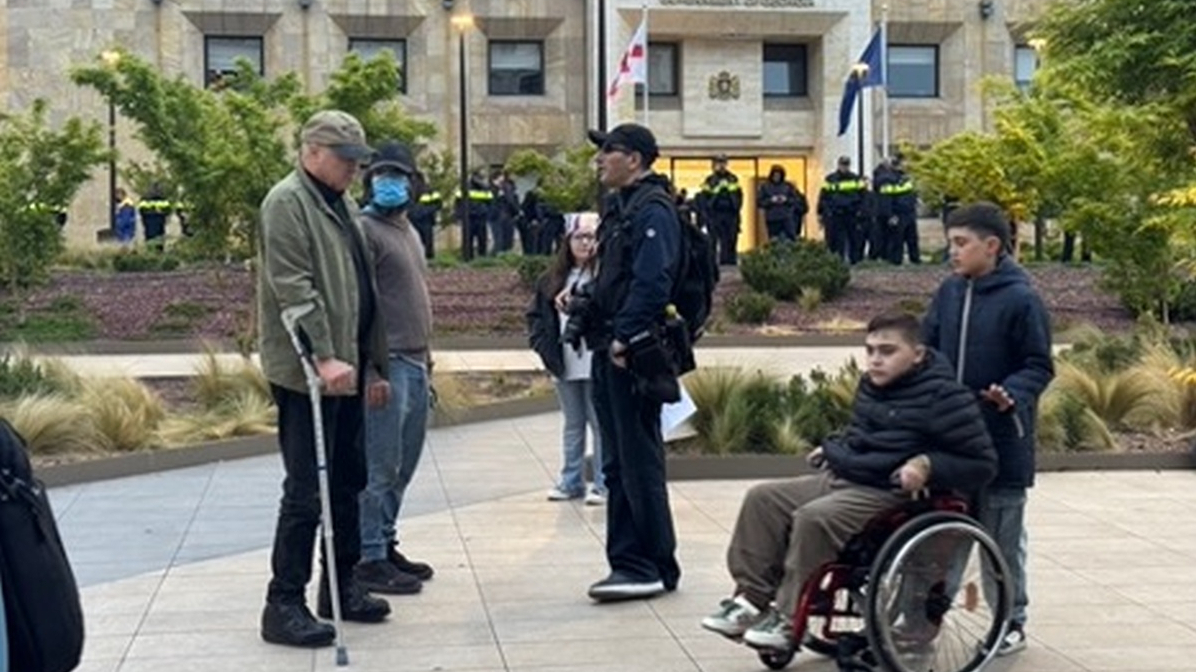
The protest outside the Government Chancellery in central Tbilisi began on 20 April. It has continued ever since. Parents take turns sleeping on wooden benches in the square - authorities have barred them from bringing tents or even soft cushions into the area, a restriction currently being challenged in Tbilisi City Court and before the Prosecutor’s Office.
Representatives from the Public Defender’s Office intervened to allow basic poufs and blankets, but the dispute over tents continues.
On most nights, the square is cold, wet, and exposed. The families - already carrying the emotional burden of watching their children deteriorate - are spending their nights in conditions that would test anyone’s endurance.
Loud message
The protest is quiet in its organisation but loud in its message: handmade banners, chants, and an unwavering refusal to leave until someone in government agrees to listen properly.
“When we return home, the children ask us: will there be medicine soon? Will we be okay? Can I run like all the other children?” Tako Gogoladze told Anewz. Her son, Andria, could climb stairs when the campaign began. He can no longer walk independently.
The families say they have not had a meaningful face-to-face dialogue with the Prime Minister’s Office. Meetings with the Ministry of Health ended around two months ago, following approximately eight or nine sessions that parents say produced almost nothing of substance.
The one tangible outcome from more than a year of engagement was that children were granted disabled status automatically upon diagnosis - a basic recognition that previously had to be applied for separately. Beyond that, the government’s response has consisted largely of public statements and parliamentary speeches.
“The government has not come to an open, public dialogue - with television present, with experts in the room - so that society can draw its own conclusions,” Kakha Tsikarishvili told AnewZ.
“Meanwhile, the condition of our children is worsening every single day. A child who reaches a wheelchair will not stand up again, even with modern medication. Every day of government inaction has deadly consequences.”
Key facts
- Affects roughly one in every 3,000 boys born worldwide. Rare in girls.
- Caused by mutations in the gene responsible for producing dystrophin, the protein that holds muscle fibres together.
- First signs typically appear between the ages of two and five, including delayed walking, frequent falls and difficulty climbing stairs.
- Most boys lose the ability to walk entirely between the ages of 10 and 12, making wheelchair use permanent.
- Heart and lung muscles are eventually affected, and ventilators often become necessary during adolescence.
- Average life expectancy is between 20 and 30 years. The disease is, without exception, fatal.
- Approximately 250,000–300,000 people worldwide live with DMD. Around 100 cases are registered in Georgia, the majority involving children.
What comes next?
The third article in this series will examine how other countries are financing Duchenne muscular dystrophy treatments, including confidential pricing agreements and rare disease funding models used across Europe.
It will also explore whether Georgia’s healthcare system can realistically sustain long-term access to these therapies - and what the political cost could be if it does not.























What is your opinion on this topic?
Leave the first comment