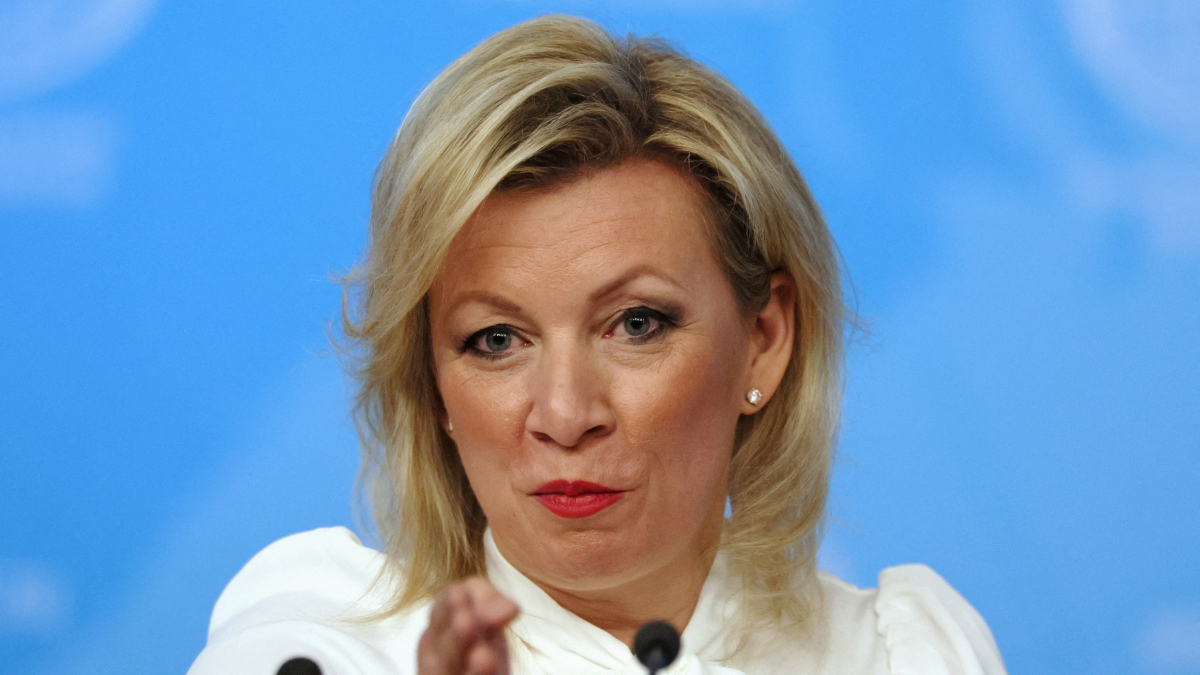
Russia's Foreign Ministry spokeswoman Maria Zakharova praised Georgia for resisting Western pressure (30 May), defending its national interests and pursuing a "multi-vector foreign policy" - language that closely mirrors the rhetoric of the ruling Georgian Dream party.
What Zakharova said
Responding to a question about Russia–Georgia relations, Zakharova said Moscow was pursuing ties with Tbilisi on the basis of "pragmatism and equality". She accused the EU of making "brazen attempts" to force Georgia onto an anti-Russian course, describing Brussels' approach as "Western political madness." Georgia, she said, had chosen wisely.
She backed her argument with figures. Bilateral trade in 2025 reached $2.7 billion. Russian tourist arrivals totalled 1.4 million. Russia remains Georgia's key supplier of energy and grain.
The figures are broadly supported by official data. Georgia's National Statistics Service confirms that total trade with Russia reached $2.69 billion in 2025, up 6.3% year on year, and rose by a further 12% between January and April 2026. Russia has topped Georgia's tourism rankings in every quarter in recent years, with 1.61 million arrivals in 2025 alone - an increase of 13.4% - while Russian visitors brought more than $120 million into the Georgian economy during the first three months of 2026.
Georgian Dream's own script
The language used by Zakharova is not coincidental. "Multi-vector foreign policy" has been a central feature of Georgian Dream's political messaging for years. The party presents it as pragmatism, arguing that Georgia cannot afford to open a second front with Russia while a full-scale war continues in Ukraine.
Party leaders have repeatedly claimed that Georgia was encouraged to do exactly that after February 2022 and that refusing was the responsible, peace-preserving choice.
At the same time, Georgian Dream has increasingly portrayed the EU not as a partner but as an external force exerting pressure on Georgia's sovereignty. Prime Minister Irakli Kobakhidze has repeatedly accused what he calls the "European bureaucracy" of acting against Georgia's national interests, supporting opposition "radicals" and attempting to destabilise the country.
The party has refused to join Western sanctions against Russia, supported the resumption of direct flights between the two countries and, in November 2024, suspended EU accession talks until 2028, triggering mass protests and sharp criticism from France, Germany and Poland.
When Moscow praises these policies as examples of "pragmatism" and a "healthy multi-vector policy," it is effectively endorsing Georgian Dream's own public narrative.
The Kallas moment: when the alignment became difficult to ignore
The timing of Zakharova's remarks is notable.
Just two days earlier, on 28 May, EU foreign policy chief Kaja Kallas said during an informal meeting of EU foreign ministers in Cyprus that any future peace negotiations over Ukraine should also address the withdrawal of Russian troops from Georgia and Moldova.
"If you think about Russian troops in countries like Georgia and Moldova," Kallas said, "it is also in the interest of European security that these troops are not there."
The responses followed familiar lines.
Russian Foreign Minister Sergei Lavrov dismissed Kallas's remarks with a single sentence: "I do not discuss idiotic statements."
Kobakhidze, meanwhile, said EU officials should back their words with actions and argued that "the European bureaucracy" had spent years working against Georgia's national interests rather than supporting them.
The chairman of parliament's legal affairs committee went further, mockingly asking whether Kallas had located Georgia on a map herself or needed assistance from her aides.
Two days later, Zakharova publicly praised Georgia's foreign policy direction.
Russia described the EU's position as idiotic. Georgia's government described it as unhelpful. Moscow then applauded Tbilisi's approach.
The sequence is difficult to ignore.
The occupation context often left out
None of this takes place in a vacuum.
Russian troops have occupied South Ossetia and Abkhazia since the 2008 war, accounting for roughly 20% of Georgia's internationally recognised territory. The gradual process of borderisation - whereby Russian-backed forces move administrative boundary lines deeper into Georgian-controlled territory - has continued in the years since.
This is the country that Zakharova describes as Georgia's pragmatic and historically close partner, bound by "shared values".
Georgian Dream does not ignore the occupation. Party leaders frequently cite it as a reason why Georgia cannot risk provoking Russia further.
Critics, however, argue that presenting the occupation as a reason for caution rather than confrontation amounts to accommodation. They contend that Georgian Dream's rhetoric has moved so close to Moscow's preferred narrative that the distinction between the two has become increasingly difficult to discern.












What is your opinion on this topic?
Leave the first comment