Iran’s Revolutionary Guards (IRGC) said on Wednesday that they had targeted the U.S. Fifth Fleet headquarters in Bahrain and a U.S. air base in the Persian Gulf with missiles and drones, in retaliation for Tuesday’s air raid on a telecommunications tower on an island in the Strait of Hormuz.
IRGC announces retaliatory strikes
“The American enemy targeted an IRGC telecommunications tower to the south of Qeshm Island with its aerial missiles,” the IRGC said in a statement.
“In response to this aggression, their air base and helicopter base located in one of the countries in the region, as well as the headquarters of the U.S. Fifth Fleet, were attacked by missiles and drones of the IRGC Aerospace Force.”
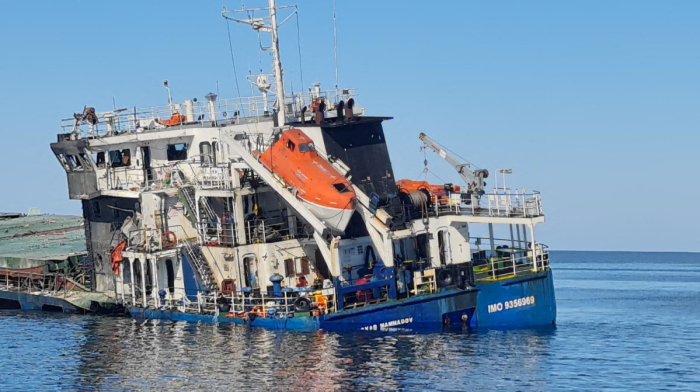
According to the Sepah News website, which carried the statement, the IRGC also targeted a tanker said to be owned by the “American-Zionist enemy” in response to an attack on an Iranian tanker at the strategic waterway linking the Persian Gulf and the Gulf of Oman.
“Late last night, the U.S. aggressor military hit an Iranian tanker near the Strait of Hormuz with an aerial missile, which damaged the tanker's engine room.”
“In response to this aggression and violation of the regulations of the Strait of Hormuz, a vessel belonging to the American-Zionist enemy, the PANAYA, was targeted by IRGC naval missiles,” the statement said.
The IRGC stressed that “we had previously warned that in the event of aggression, the response would be different and more severe, and we acted accordingly. These responses should have been a lesson learned.”
Escalating tensions despite ceasefire efforts
The incident is the latest in a series of attacks involving the Revolutionary Guards and the U.S. military in the region, despite a fragile ceasefire and an indirect exchange of messages between the two sides aimed at securing an extended truce.
On Monday, the IRGC Navy said it had struck a cargo ship with a cruise missile after an Iranian freighter was attacked in the Sea of Oman.
While Iran has vowed to respond to any ceasefire violations by striking U.S. air bases in the region, from which it says attacks are being launched, Foreign Minister Abbas Araghchi has been engaged in intensive diplomatic efforts to secure a peace agreement.
On Tuesday, he held telephone conversations with his Saudi and Egyptian counterparts, with official sources saying the discussions focused on the latest developments in the region.
Over the weekend, Iran’s top diplomat also spoke by telephone with his counterparts from Belgium, France, Pakistan, Qatar and Türkiye. He additionally held talks with Pakistan’s army chief, whose country is mediating efforts to extend the ceasefire agreement between Iran and the U.S.
Tehran blames Washington for stalled negotiations
Following weeks of stalled negotiations, with neither Iran nor the U.S. making significant concessions, Foreign Ministry spokesman Esmaeil Baghaei blamed Washington’s “shifts in positions and contradictory demands” for the lack of progress in talks with Tehran.
In his weekly press briefing, he outlined the reasons why Iran-U.S. talks have been slow to produce a breakthrough through a mediated exchange of proposals and counter-proposals.
“In circumstances where one party constantly changes its views, raises new demands, and sends contradictory messages by media, it is natural that it prolongs the negotiation process.”
Iran criticises U.S. role in Israeli military actions
Meanwhile, Iran’s Deputy Foreign Minister for Legal and International Affairs, Kazem Gharibabadi, said on Tuesday that a recent statement by U.S. President Donald Trump about dissuading Israeli Prime Minister Benjamin Netanyahu from launching a major attack on Lebanon’s capital demonstrated Washington’s direct involvement in Israel’s military policies in the region.
“President Trump's claim that he persuaded Netanyahu not to launch a major attack on Beirut, rather than demonstrating Washington's commitment to peace, confirms the United States' direct role in managing the Israeli regime's aggression,” he said in a post on the social media platform X.
The senior Iranian diplomat also criticised Western countries for supporting Israel’s military operations against neighbouring states.
“If a decision to attack the capital of a sovereign state can be changed with a single phone call, the real question is why months of ceasefire violations, attacks on Lebanon, displacement of civilians, and threats to the country's sovereignty continued with Western political and military support?”

















What is your opinion on this topic?
Leave the first comment