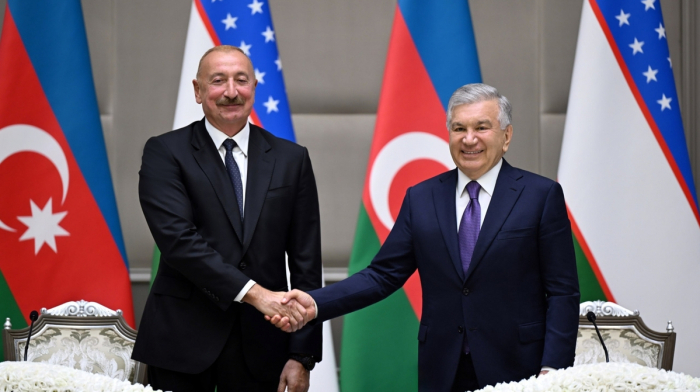
Azerbaijan and Uzbekistan emerge as key transit hubs amid global trade shifts
Amid shifting global supply chains and rising geopolitical competition over trade corridors, attention is increasingly turning to the strategic rol...
Amid shifting global supply chains and rising geopolitical competition over trade corridors, attention is increasingly turning to the strategic role of transit states linking Central Asia, the South Caucasus, Europe and the Middle East.
In this context, Baku and Tashkent are increasingly being highlighted as emerging coordination hubs for regional connectivity and infrastructure diplomacy.
On AnewZ's Daybreak Nadia Gyane asked Firdavs Kobilov, Deputy Dean for Scientific and International Cooperation, whether Azerbaijan and Uzbekistan are emerging as critical transit coordinators across these interconnected markets.
Kobilov said energy and infrastructure diplomacy are becoming central pillars of cooperation between Azerbaijan and Uzbekistan.
“Energy and also infrastructure diplomacy are rapidly becoming backbone of the Azerbaijan and Uzbekistan's strategic cooperation. The fragmentation of the global supply chains and also the geopolitical consequences of ongoing conflicts, growing competition over trade corridors have dramatically increased the importance of this transit states, including Uzbekistan and Azerbaijan.”
He added that both countries hold significant strategic weight within the Eurasian transport and logistics landscape.
“Azerbaijan and Uzbekistan occupy highly strategic, geostrategic importance in Eurasia. Azerbaijan functions as a getaway between Europe and the Caspian Basin, while Uzbekistan represents one of the largest economies in Central Asia with the largest population.”
Kobilov also noted that current geopolitical and economic trends are strengthening the case for deeper transit cooperation between the two countries.
“If current trends continue, Baku and Tashkent, I would think that they could emerge as a key transit coordinators linking Central Asia with South Caucasus and also with Europe, as well.”
Kobilov underscored the growing strategic importance of Azerbaijan and Uzbekistan within Eurasian connectivity networks. He highlighted how shifting global supply chains and geopolitical tensions are increasing the value of transit states, with Baku and Tashkent potentially positioned as key coordinators linking Central Asia with Europe through the South Caucasus.
United Nations World Urban Forum 13 continues in Baku, Azerbaijan on 19 May with sessions and roundtable discussions focused on strengthening dialogue and advancing cooperation in urban development. Organisers say there are nearly 3 billion people globally who face some form of housing inadequacy.
Azerbaijan and Georgia have agreed to resume daily passenger train services on the Baku-Tbilisi-Baku route from 26 May, 2026, marking a major step in restoring regional rail connectivity after services were suspended in 2020 due to the COVID-19 pandemic.
Pakistan has deployed around 8,000 troops, fighter jets and air defence systems to Saudi Arabia under a mutual defence agreement, according to security officials and government sources familiar with the arrangement.
U.S. President Donald Trump said on Monday that he had paused a planned attack on Iran after Tehran sent a peace proposal to Washington. He said there was now a “very good chance” of reaching a deal to limit Iran’s nuclear programme.
Lithuania on Wednesday issued an “air danger” warning urging residents to seek shelter and temporarily suspended operations at the capital’s airport amid fears that drones had entered the country’s airspace, as tensions between Russia and the Baltic states continue to escalate.
Kyrgyzstan has suspended 50 locally registered companies over what authorities described as “high sanctions risk” operations, in the clearest sign yet that Bishkek is responding to growing European scrutiny over alleged sanctions circumvention linked to Russia.
Somaliland has announced plans to open an embassy in Jerusalem, marking a further step in its emerging diplomatic engagement with Israel, its ambassador Mohamed Hagi said. The move comes after Israel became the first country to formally recognise the self-declared republic.
In a sweeping diplomatic push in Baku, Georgia and Azerbaijan have signed a landmark package of energy and transport agreements, cementing a partnership set to shape the South Caucasus corridor for decades to come.
Kazakh President Kassym-Jomart Tokayev has called for closer security coordination between Central Asia and China, warning that expanding trade and infrastructure links are exposing the region to increasingly sophisticated cross-border threats.
Azerbaijan and Georgia have agreed to resume daily passenger train services on the Baku-Tbilisi-Baku route from 26 May, 2026, marking a major step in restoring regional rail connectivity after services were suspended in 2020 due to the COVID-19 pandemic.
You can download the AnewZ application from Play Store and the App Store.
What is your opinion on this topic?
Leave the first comment