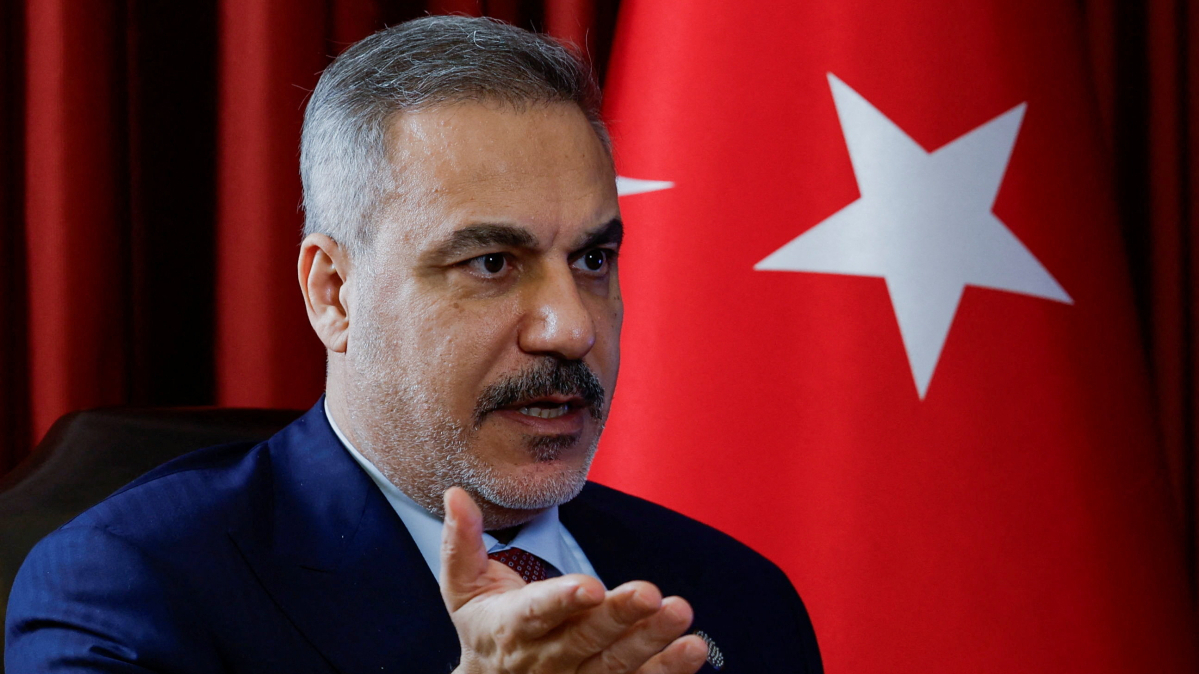
Turkish Foreign Minister Hakan Fidan has criticised the European Union (EU) for its inability to achieve deeper unity, describing the bloc’s shortcomings as a historic misfortune for Türkiye.
In an interview with Portugal’s public broadcaster RTP during his trip to Portugal, Fidan said Ankara had worked for decades to join the bloc but had been held back by political obstacles in Brussels.
“Türkiye’s inability to fully integrate with the EU, including as a full member, represents a historic missed opportunity for both Türkiye and Europe,” he said.
Fidan highlighted Türkiye’s dynamic economy, young population, advanced defence industry and strategic geography as factors that could strengthen Europe.
He argued that incorporating Türkiye’s military capacity and regional influence could create a historic partnership benefiting both sides and the wider region.
The foreign minister also stated that while the EU has formed a supranational union, it has not yet achieved a "civilisation‑transcending unity", which he said is the type of cohesion the world truly needs.
During his official visit to Portugal, Fidan is scheduled to meet a number of counterparts, including Portugal’s Foreign Minister Paulo Rangel, to explore avenues for cooperation across strategic industrial fields, with maritime sectors expected to feature prominently.
The discussions are also set to cover broader Türkiye-EU relations, focusing on Ankara’s role in the European Union’s industrial framework as well as its potential involvement in EU security and defence initiatives.
The talks are expected to underline the strategic weight of these areas for both sides.
Türkiye's EU history
Türkiye’s efforts to join the EU date back more than six decades.
The Ankara Agreement, signed in 1963 with the European Economic Community, laid the groundwork for economic cooperation and eventual political integration.
Türkiye was granted EU candidate status in 1999 and formal accession negotiations began in 2005. Despite this, progress has been slow.
Since 2018, the European Council has effectively halted significant advancement of negotiation chapters due to concerns over democratic standards, human rights and political differences between Ankara and Brussels.
The European Parliament’s 2025 report reaffirmed that Türkiye’s accession process must remain frozen under current conditions, calling for a focus on strategic partnership until concrete reforms are implemented.
Several EU members cite issues with democratic norms, judicial independence, and unresolved geopolitical disputes, including the Cyprus question, as obstacles to full membership.
However, Türkiye remains one of the EU’s largest trading partners, with bilateral trade reaching tens of billions of dollars annually, according to recent industry data.
Moreover, Hakan Fidan has repeatedly emphasised that political will in Brussels, particularly a clear statement that the EU has no reservations about Türkiye joining, is essential to overcoming the current deadlock.
Bilateral cooperation with key member states such as Germany and Italy has also been highlighted as a potential catalyst for reinvigorating accession talks.
Analysts note that Türkiye’s role as a NATO member and its bridging function between Western and non‑Western regions gives it unique influence in regional diplomacy and security.
They note that Türkiye occupies a geostrategically crucial position at the crossroads of Europe, Asia and the Middle East, reinforcing its importance for EU security and economic networks.
However, while Ankara insists it can meet technical and professional accession requirements, Brussels’ political will remains the decisive factor for advancing Türkiye’s membership.













What is your opinion on this topic?
Leave the first comment