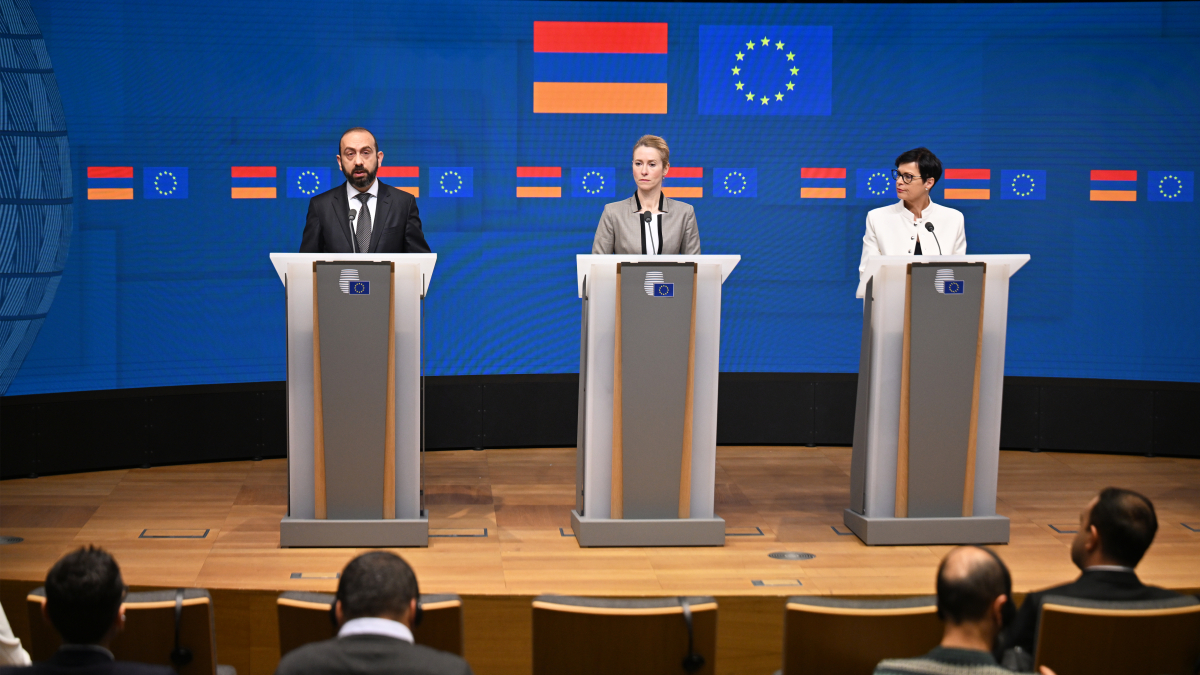
The European Union’s newly adopted Partnership Agenda with Armenia has prompted strong concern in Baku, where officials say several passages depart from factual accuracy and introduce political messages that could damage an already fragile negotiation environment.
The 64 page document, presented as a framework for deeper bilateral cooperation, outlines reforms and integration goals but includes terminology that Azerbaijan considers incompatible with regional realities.
A central point of contention is the definition of Armenian movement from the former Karabakh area as displacement. Azerbaijan says this portrayal is baseless because the decision to relocate was taken voluntarily following appeals by the separatist leadership and structures funded from the Armenian state budget. Prior to the September 2023 anti terror measures, Azerbaijani officials held direct meetings with Armenian representatives in Xocali and Yevlax, and a reintegration plan was introduced with practical mechanisms. According to Baku, the document’s phrasing overlooks these facts and feeds a politicised humanitarian narrative that shifts responsibility away from Armenia.
The use of the term “Nagorno Karabakh” is seen as a further indication of conceptual inconsistency. Azerbaijan notes that the region no longer exists as an administrative unit and argues that employing outdated terminology contradicts principles the EU claims to uphold, including respect for sovereignty and territorial integrity. Such wording, Baku says, weakens confidence in the EU’s neutrality and raises questions about the professional standards applied in drafting the agenda.
Another issue that has drawn attention is a reference to a military school in Armenia named after Monte Melkonyan, a figure associated with severe violence against Azerbaijanis. According to Baku, integrating such an institution into an EU affiliated training network is neither explained nor justified, and the ambiguity risks contradicting the values the Union itself promotes.
Azerbaijan also notes the imbalance created by extensive focus on Armenian humanitarian messaging while omitting its own security concerns. The presence of illegal armed formations, long standing mine contamination and threats to territorial integrity are not acknowledged in the document. Officials say this selective framing undermines trust in mediation efforts and may embolden revisionist tendencies in Yerevan at a moment when constructive dialogue is essential.
The agenda’s reference to supporting the release of Armenian detainees is also viewed as problematic. Azerbaijan argues that these individuals are not prisoners of war but persons prosecuted for involvement in terrorism and unlawful violence. The document does not clarify the legal basis for this commitment, which in Baku’s view risks transforming a judicial matter into a political instrument.
There is similar concern about a vague call for the full, immediate and effective implementation of decisions by international courts. Azerbaijan says the absence of specificity opens the door to manipulation and may allow Armenia to use the clause selectively in future arguments, to the detriment of the peace process.
Another imbalance highlighted by Baku relates to the humanitarian dimension. While the agenda refers to the integration of Armenians who voluntarily moved to Armenia, it makes no mention of the more than 300 thousand Azerbaijanis deported from Armenia in the late Soviet period. Azerbaijan sees the absence of this reference as further evidence of an unequal approach and says the principle applied to one community should apply to all.
In this context, the agenda is viewed as containing provisions that could impede the cautious progress achieved in the region. Although the document was designed to guide EU Armenia cooperation, its tone and selected terminology do not contribute to confidence building between Armenia and Azerbaijan. Officials say the agenda creates space for future misinterpretation and may reinforce positions that complicate the ongoing effort to secure a durable settlement.
This development has drawn analytical reaction as well. Experts argue that the agenda reflects geopolitical ambitions within the EU and does not fully take into account the current security balance in the South Caucasus. They note that certain elements of the document may indirectly overshadow the momentum created by the 8 August Washington statement facilitated by the United States, which had strengthened expectations of progress on a peace treaty and on the opening of regional connections.
Azerbaijan says the EU should reconsider its approach if it wishes to play a constructive role. Officials add that the peace process requires accuracy, legal clarity and sensitivity to regional realities, and that imbalanced narratives or ambiguous commitments risk introducing new complications rather than supporting stability. Baku expects further clarification from Brussels and is preparing an official communication through the Ministry of Foreign Affairs.












What is your opinion on this topic?
Leave the first comment