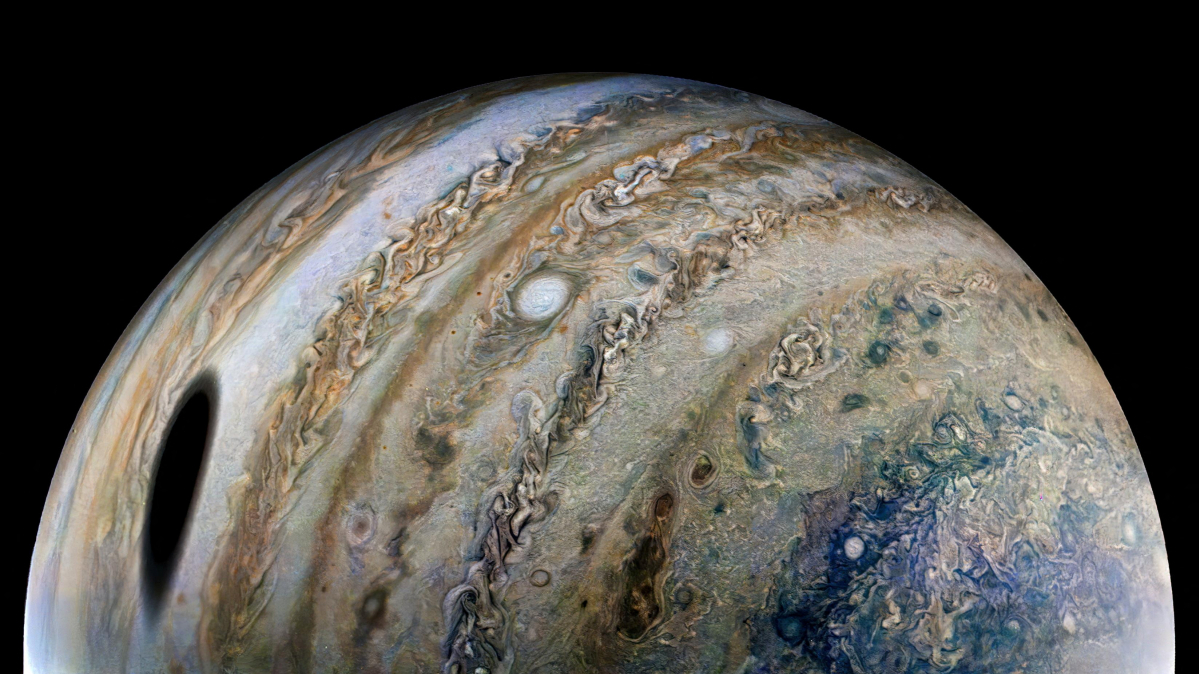
New Juno measurements show Jupiter’s equatorial and polar diameters are slightly smaller than once believed, giving scientists a clearer understanding of the gas giant’s structure.
New observations from NASA’s Juno mission have produced the most precise measurements yet of Jupiter’s size and shape, refining decades-old estimates from earlier missions.
Juno data show the planet’s equatorial diameter is 88,841 miles (142,976 km) - about 5 miles (8 km) smaller than previous measurements - while its north-south diameter is 83,067 miles (133,684 km), roughly 15 miles (24 km) less than earlier figures.
The planet is “not a perfect sphere, but rather a bit flattened” and now appears slightly more so than previously known.
The earlier figures were based on data from Voyager and Pioneer missions in the late 1970s.
NASA’s extension of the Juno mission in 2021 enabled the geometry needed to refine the measurements, including Juno passing behind Jupiter from Earth’s point of view.
“When Juno passed behind Jupiter from Earth’s perspective, its radio signal traveled through the planet’s atmosphere before reaching Earth,” said planetary scientist Eli Galanti of the Weizmann Institute of Science, lead author of the study published this week in Nature Astronomy.
“Measuring how the signal changed due to Jupiter’s atmospheric composition, density and temperature allowed us to probe the atmosphere and determine the planet’s size and shape with high precision.”
Galanti added that this alignment “did not occur during Juno’s prime mission, so these experiments were not originally planned.”
Jupiter, the fifth planet from the sun, remains the largest in the solar system, vast enough to contain more than 1,300 Earths.
Composed mainly of hydrogen and helium, it displays strong winds and large storms that form its colourful bands.
Precise measurements of Jupiter’s radius are essential for models of its interior.
“Jupiter is the largest planet in the solar system and contains most of its planetary mass, so understanding its composition and internal structure is central to understanding how the solar system formed and evolved,” Galanti said.
Volatiles such as water, carbon dioxide and ammonia delivered to the inner solar system were “key ingredients for its atmosphere and for life,” he added.






















What is your opinion on this topic?
Leave the first comment