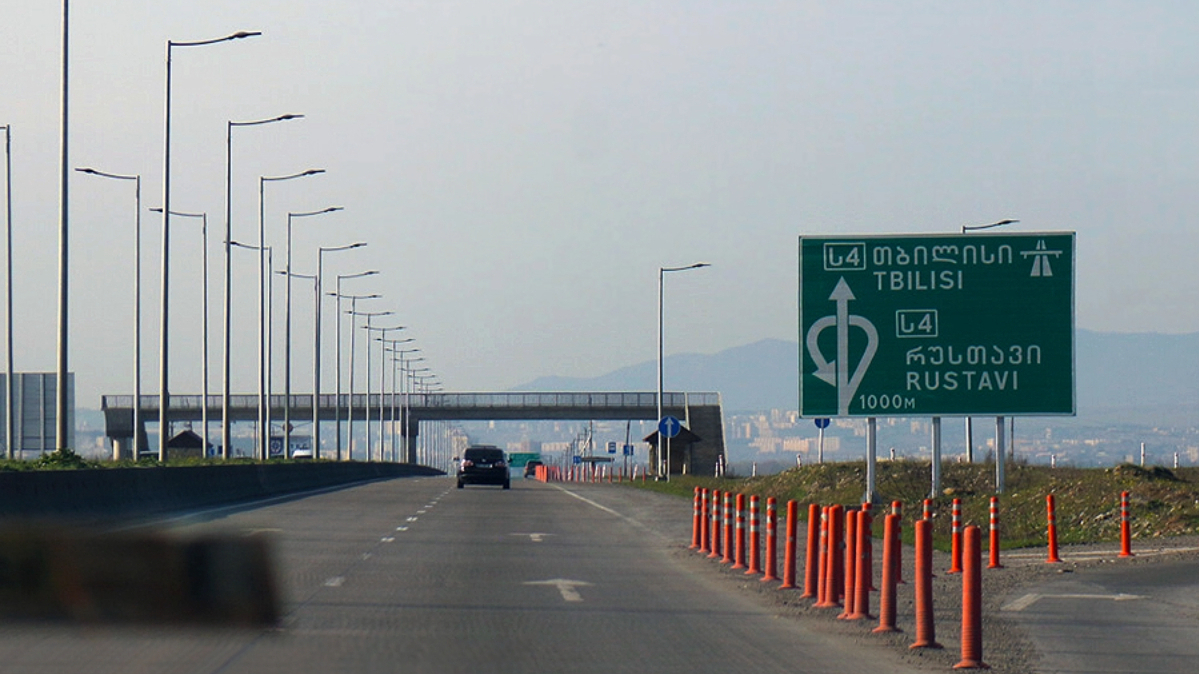
Georgia has cancelled international tenders for the construction of major road sections that form part of a regional highway linking the country with the borders of Armenia and Azerbaijan.
The Georgian Roads Department said tenders announced in August 2024 for the Rustavi–Tsiteli Bridge and the Algeti–Sadakhlo road section were cancelled due to low competition among bidders.
The procurement process covered both construction works and project supervision services.
The planned infrastructure is part of international transport routes connecting Georgia with neighbouring countries and wider Eurasian trade networks.
The project included building a 61.3-kilometre four-lane concrete expressway equipped with lighting systems, along with 26 bridges and 11 interchanges designed to improve traffic flow and safety.
The road sections form part of the regional East–West Corridor and North–South Corridor, which connect the South Caucasus to trade routes linking Europe and Asia.
Construction had originally been scheduled to start in 2025 and be completed in phases over around 30 months.
The project was jointly financed by the Georgian government and the European Investment Bank, which allocated a €250 million loan.
Officials say the main reason behind the cancellation was low participation in the bidding process.
Limited competition in large infrastructure tenders can indicate several issues, including concerns about project costs, complex technical requirements, or market uncertainty affecting international construction companies.
Governments often cancel and relaunch tenders under revised conditions in order to attract more bidders.
Broader infrastructure concerns
Experts say the situation also reflects wider challenges in Georgia’s transport infrastructure.
Political analyst David Dzidzishvili, speaking to AnewZ, said the country still faces infrastructure gaps that slow cargo movement across the region.
He noted that freight traffic heading towards Armenia often experiences congestion and damaged road sections, which delays deliveries and increases logistics costs.
Dzidzishvili also highlighted the stalled Anaklia Deep Sea Port, a strategic maritime development that has yet to secure a final investor.
Connectivity ambitions
Georgia’s location between Europe and Asia gives it the potential to become a key transit hub in the South Caucasus.
However, transport experts say progress on large infrastructure projects — including highways, ports and logistics corridors — will be critical for improving regional connectivity and strengthening trade links with partners such as the European Union.



















What is your opinion on this topic?
Leave the first comment