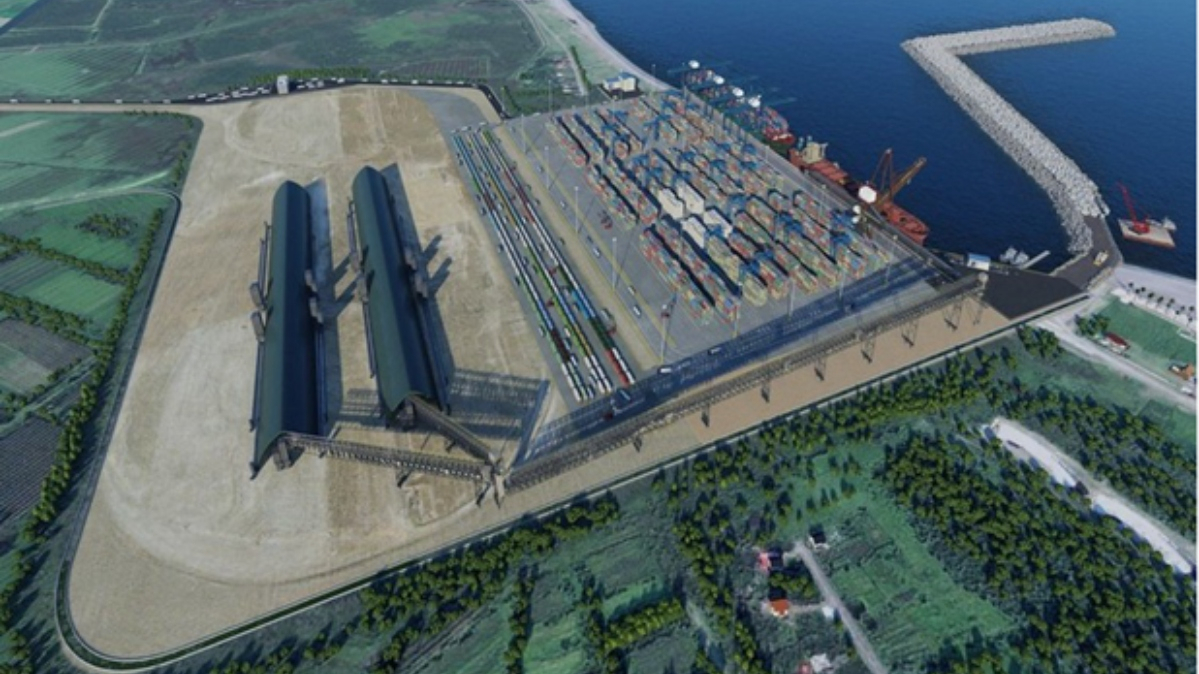
Georgia’s decision to indefinitely suspend the Anaklia deep-water port project has stripped the country of a historic chance to become a key link in global trade routes, according to the Transport Corridor Research Center (TCRC).
The Anaklia port was designed to position Georgia as a strategic alternative to Russia-controlled corridors, linking Europe, the Black Sea, the Caspian region, Central Asia, and China.
Its suspension, experts argue, has closed a rare window of opportunity—one that opened especially after Russia’s invasion of Ukraine, when demand for alternative routes surged.
According to TCRC, the Anaklia deep-water port was envisioned as a global logistics hub, capable of receiving large vessels without transshipment and redistributing cargo toward Azerbaijan, Central Asia, China, Afghanistan, and Pakistan.
Together with expanding ports in Azerbaijan, Kazakhstan, and Turkmenistan, Anaklia was meant to form a synchronized Black Sea–Caspian Sea corridor—a genuine alternative to Russia’s transport networks.
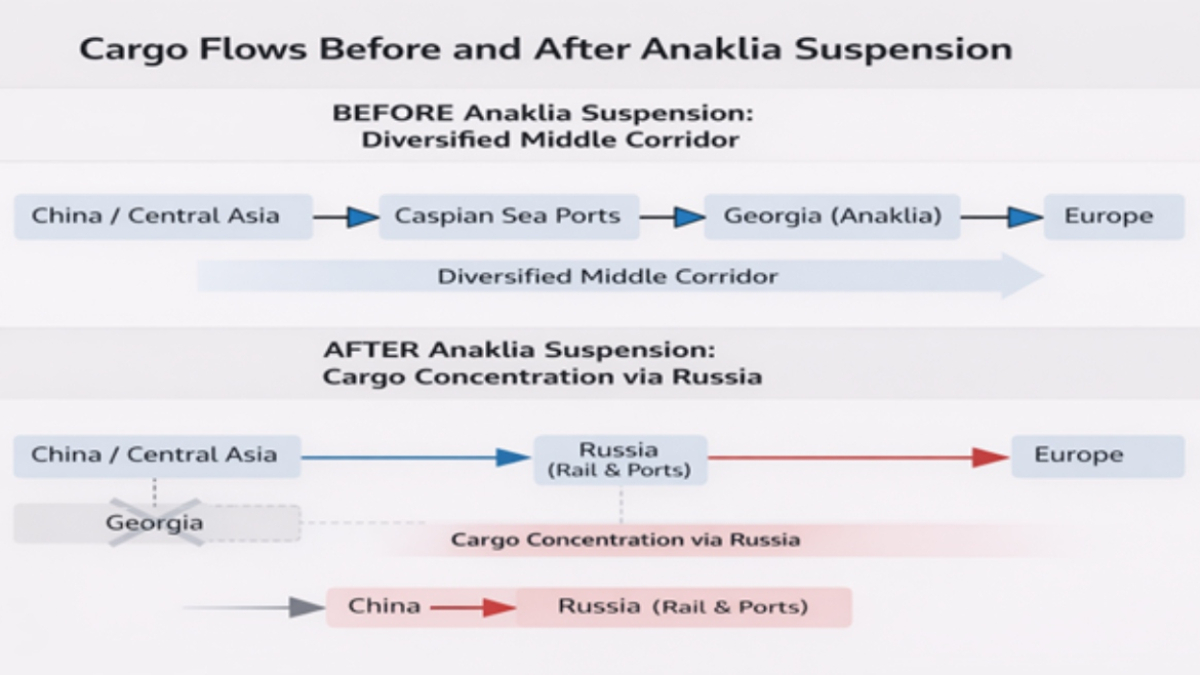
TCRC states that postponing Anaklia has deprived the Georgian corridor of its ability to compete with Russia’s routes, allowing Moscow to consolidate cargo flows through its own infrastructure—including Novorossiysk, Taman, Baltic ports, and the North–South corridor via Iran.
With Anaklia removed from the equation, Central Asian exports continue to move through Russian railways and ports.
Meanwhile, alternative “reverse” cargo flows from Eastern and Central Europe—potentially via Romania’s Constanta port—are no longer viable through Georgia.
Political responsibility and domestic criticism
Opposition figures argue that the Anaklia project was not merely delayed but systematically blocked. Tazo Datunashvili, executive secretary of the Lelo – Strong Georgia party, says the chronology of the ruling Georgian Dream party’s actions shows deliberate obstruction.
“The construction of the Anaklia port is not a whim. It was the only way for Georgia to become part of the international trade chain as an independent state,” Datunashvili said.
According to him, Georgia’s geopolitical function has historically been tied to corridor transportation. Without it, the country lacks a distinct role in international trade, as it does not rely on major natural resources.
Datunashvili also notes that the suspension coincided with a period when the so-called Middle Corridor became a realistic alternative due to geopolitical shifts following the war in Ukrainemaking the missed opportunity even more costly.
Experts warn that losing the Anaklia project affects more than transit revenues. Two pillars of state sovereignty—security guarantees and rapid economic development—are undermined when Georgia loses both its EU integration momentum and its strategic transit function.
TCRC emphasises that suspending Anaklia has:
- Reduced Georgia’s attractiveness for American and European investment
- Damaged its reputation as a reliable logistics partner
- Allowed Russia to entrench long-term control over regional cargo flows
Adding to domestic controversy, Datunashvili points out that in 2026, 100 million GEL was removed from the Anaklia project budget, funds that will instead be used to pay a fine to Russian energy company Inter RAO.
According to critics, under current political conditions, Georgia risks being sidelined from international trade chains for years—if not decades.
As TCRC concludes, blocking the Anaklia port has cost Georgia its status as a global regional player, at a time when strategic geography should have been its strongest asset.















What is your opinion on this topic?
Leave the first comment