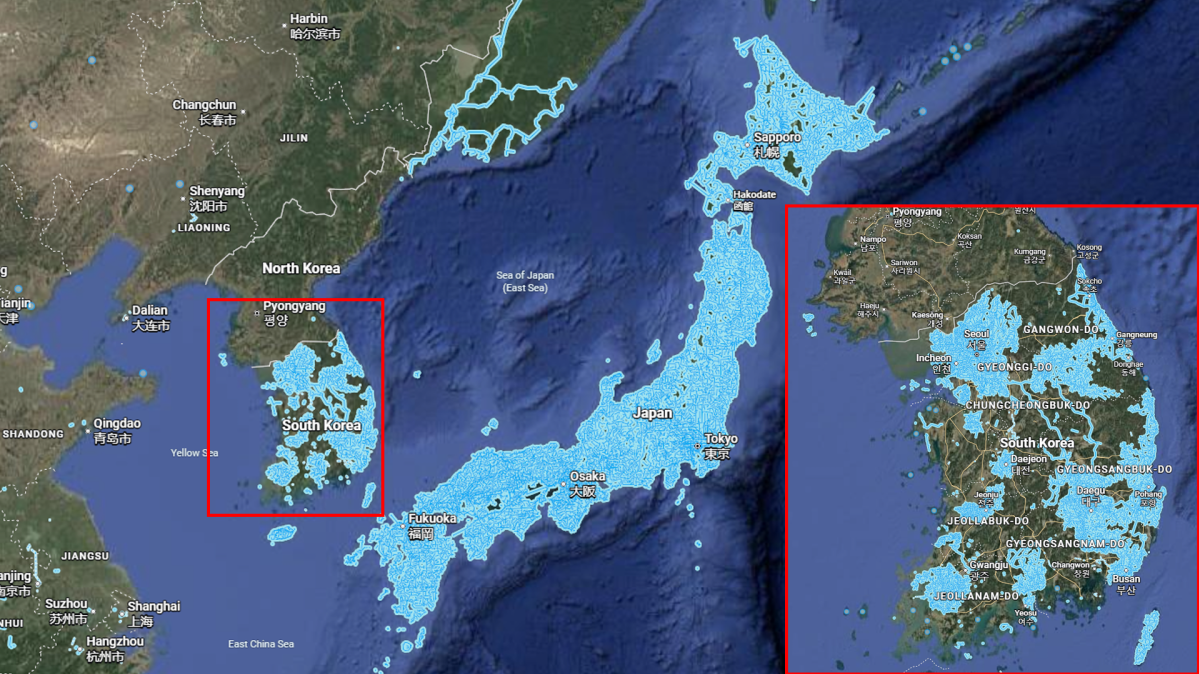
South Korea will soon cease to be one of the few countries where Google Maps does not function fully, after its security-conscious government reversed a two-decade-old policy and approved the export of high-precision map data to overseas servers.
The Ministry of Land, Infrastructure and Transport said the approval was granted “on the condition that strict security requirements are met”.
Those requirements include blurring military and other sensitive security-related facilities, as well as restricting longitude and latitude coordinates for South Korean territory on products such as Google Maps and Google Earth.
The ministry said Google must process core map data on locally based servers and export only pre-approved navigation and directions data.
The decision is expected to weaken South Korea’s dominant platforms, Naver and Kakao, but it responds to long-standing pressure from Washington, which has argued that Seoul’s rules disadvantage U.S. technology firms.
“We welcome today’s decision and look forward to our ongoing collaboration with local officials to bring a fully functioning Google Maps to Korea,” said Cris Turner, a vice president at Google.
Seoul had rejected Google’s earlier requests in 2007 and 2016 over concerns that military sites could be exposed in a country that remains technically at war with North Korea.
The data covered under the approval is at a 1:5000 scale, meaning one centimetre on a map represents fifty metres in reality.
Google has argued that it must export the material in order to provide global real-time navigation, including for people planning trips to Korea from abroad.
Under the new terms, the government retains the right to request revisions and requires Google to maintain a security incident prevention framework capable of responding rapidly to emergencies.
Choi Jin-mu, a geography professor at Kyung Hee University, said the decision exposed deeper risks, describing a chain of consequences that could unfold if Google gained too much ground.
“Google can now come in, slash usage fees, and take the market,” he said.
He warned that weakening domestic services could shift control towards a single global provider. “If Naver and Kakao are weakened or pushed out and Google later raises prices, that becomes a monopoly.”
Naver’s shares closed 2.3% lower after the announcement, while Kakao rose 1.5%.
Choi said the impact would not be limited to consumers. “Then even companies that rely on map services - logistics firms, for example - become dependent, and in the long run even government GIS (geographic information systems) could end up dependent on Google or Apple.
“That’s the biggest concern,” he said.
James Kim, chairman of AMCHAM, welcomed the shift, saying it “sends a positive signal about Korea’s commitment to innovation, open markets, and ensuring a level playing field for global companies operating in Korea.”


























What is your opinion on this topic?
Leave the first comment