China records lowest birthrate since 1949 as population decline deepens
China’s birthrate fell to its lowest level since 1949 last year, accelerating a population decline that has now continued for four consecutive years...
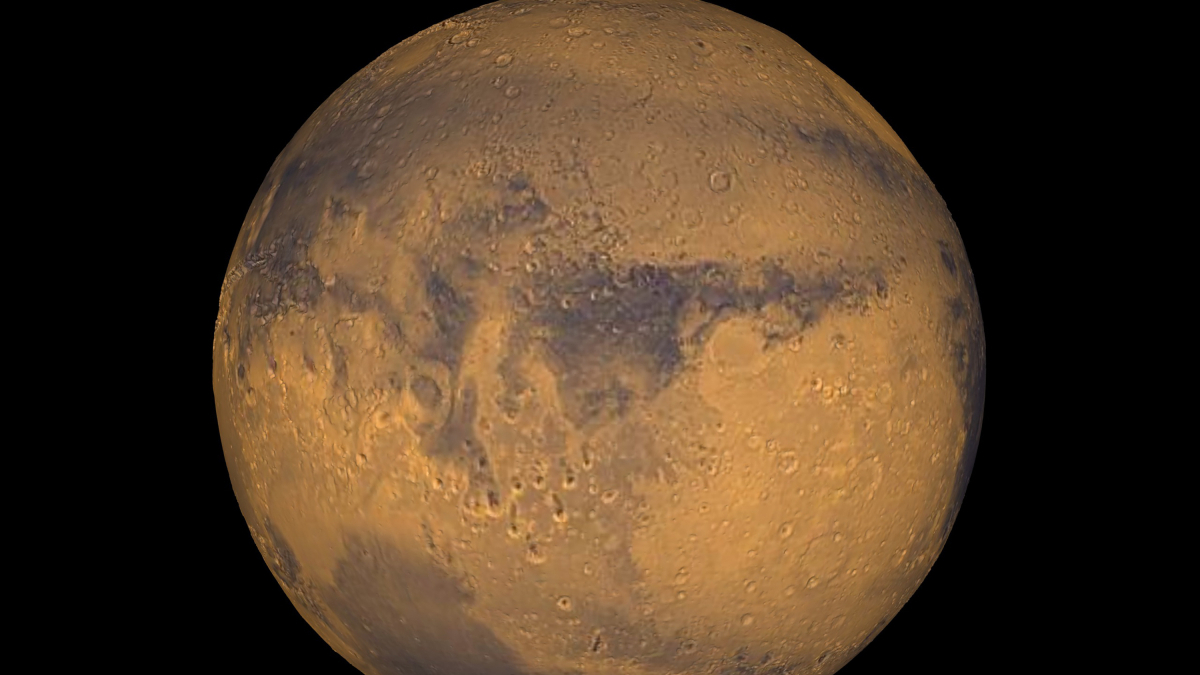
New modelling suggests Mars shapes some of Earth’s long-term orbital rhythms, including shorter eccentricity cycles and a 2.4-million-year pattern that vanishes without its gravitational pull.
A study published in Publications of the Astronomical Society of the Pacific says Mars affects several elements of Earth’s Milankovitch cycles, the slow variations in orbit and axial tilt that help steer long-term climate behaviour.
These cycles arise from gravitational exchanges among planets that gradually redistribute how solar energy reaches Earth over tens of thousands of years.
Researchers tested how altering Mars’ mass changes the stability of orbital elements such as eccentricity, perihelion, ascending node and obliquity.
The modelling showed that the 405,000-year eccentricity cycle, largely controlled by Venus and Jupiter, remains stable regardless of Mars’ mass.
But shorter eccentricity cycles of about 100,000 years became increasingly prolonged and pronounced as the red planet’s mass increased, indicating stronger gravitational links among the inner planets.
The team also reported that the 2.4-million-year grand eccentricity cycle disappears entirely if Mars’ mass approaches zero, pointing to a direct dependence on the planet’s gravitational influence.
Scientists involved in the work say the results broaden understanding of how neighbouring planets contribute to climate-forcing patterns and may help identify the masses of Earth-like worlds elsewhere by tracking similar orbital signatures.

Italian Prime Minister Giorgia Meloni said on Saturday (17 January) that concerns over security in Greenland should be addressed within the framework of NATO, describing a ground military intervention as highly unlikely.
Egypt and Sudan have welcomed an offer by U.S. President Donald Trump to restart mediation with Ethiopia in a bid to resolve the long-running dispute over Nile River water sharing.
Elon Musk is seeking up to $134 billion from OpenAI and Microsoft, arguing that the companies profited unfairly from his early support of the artificial intelligence firm, according to a court filing made public on Friday.
Poland plans to expand its armed forces to 500,000 by 2039, including 300,000 active-duty troops and 200,000 reservists, officials said Friday. The enlarged force would feature a new high-readiness reserve unit.
European leaders voiced growing alarm on Sunday over U.S. threats to impose tariffs on eight NATO allies, warning the move could destabilize transatlantic relations and heighten tensions in the Arctic.
Ashley St. Clair, mother of one of Elon Musk’s children, has filed a lawsuit against Musk’s company xAI, alleging that its AI tool Grok generated explicit images of her, including one portraying her as underage.
Britain’s Royal Navy has successfully conducted the maiden flight of its first full-sized autonomous helicopter, designed to track submarines and carry out high-risk maritime missions amid rising tensions in the North Atlantic.
Dubai is set to launch commercial air taxi services by the end of the year, according to the emirate’s Roads and Transport Authority (RTA).
Astronomers have observed a white dwarf - a highly compact Earth-sized stellar ember - that is creating a colourful shockwave as it moves through space, leaving them searching for an explanation.
Apple will use Google’s Gemini artificial intelligence (AI) models for its revamped Siri voice assistant later this year, in a multi-year deal that strengthens the tech giants’ partnership and boosts Alphabet’s position in the race against OpenAI.
You can download the AnewZ application from Play Store and the App Store.
What is your opinion on this topic?
Leave the first comment