New research suggests 40,000-year-old carved objects from south-western Germany bear repeated marks arranged in organised sign sequences similar to early proto-cuneiform, although they are not regarded as a form of writing.
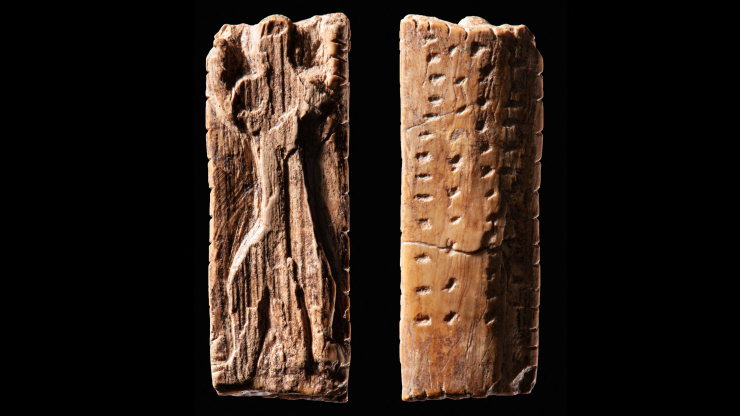
At the centre of the study is the Adorant figurine, discovered in a German cave in 1979 and carved from mammoth ivory around 40,000 years ago. Depicting a hybrid lion-human figure and marked with notches and dots, it forms part of a broader group of Aurignacian artefacts carrying comparable sequences.
The study concludes that while the marks do not constitute writing, they display structural features comparable to a script that emerged in ancient Mesopotamia around 3300 BC, the precursor to cuneiform.
Researchers analysed more than 200 artefacts from four cave sites in south-western Germany, dating from approximately 43,000 to 34,000 years ago. The Adorant figurine, from Geissenklösterle Cave in Baden-Württemberg, measures about 1½ inches (38 mm) by half an inch (14 mm).
The team categorised the carvings into sign types, including notches, dots, lines, crosses and star shapes and assessed them using computational methods focused on information density.
Christian Bentz, a linguist at Saarland University and lead author of the study published in the Proceedings of the National Academy of Sciences, said: “We would argue that these sign sequences go beyond decoration that was aesthetically pleasing to particular individuals. Namely, our statistical results show that these signs were applied selectively and conventionally.”
Crosses, for example, appeared only on tools and animal figurines, not human ones.
Bentz added, "The convention to carve certain sign types only into surfaces of certain artifacts must have been handed down over many generations, otherwise we would not find these statistical patterns in the data."
The Aurignacian culture produced some of the oldest known figurative art, with objects carved from mammoth ivory, bone and antler. The figurines include mammoths, cave lions, horses and human-animal hybrids, alongside tools, ornaments and flutes.
The study found that the sign sequences differ from modern writing systems, yet display information density close to early proto-cuneiform examples from Uruk.
Some features of written language are present, but others are absent, including any proven link to spoken language. Archaeologist Ewa Dutkiewicz of the Museum of Prehistory and Early History in Berlin said: "We can only speculate about the status of spoken languages at the time.
"In general, archaeologists and linguists would certainly assume that modern humans (Homo sapiens) 40,000 years ago had spoken languages structurally similar to those spoken around the world today."






















What is your opinion on this topic?
Leave the first comment