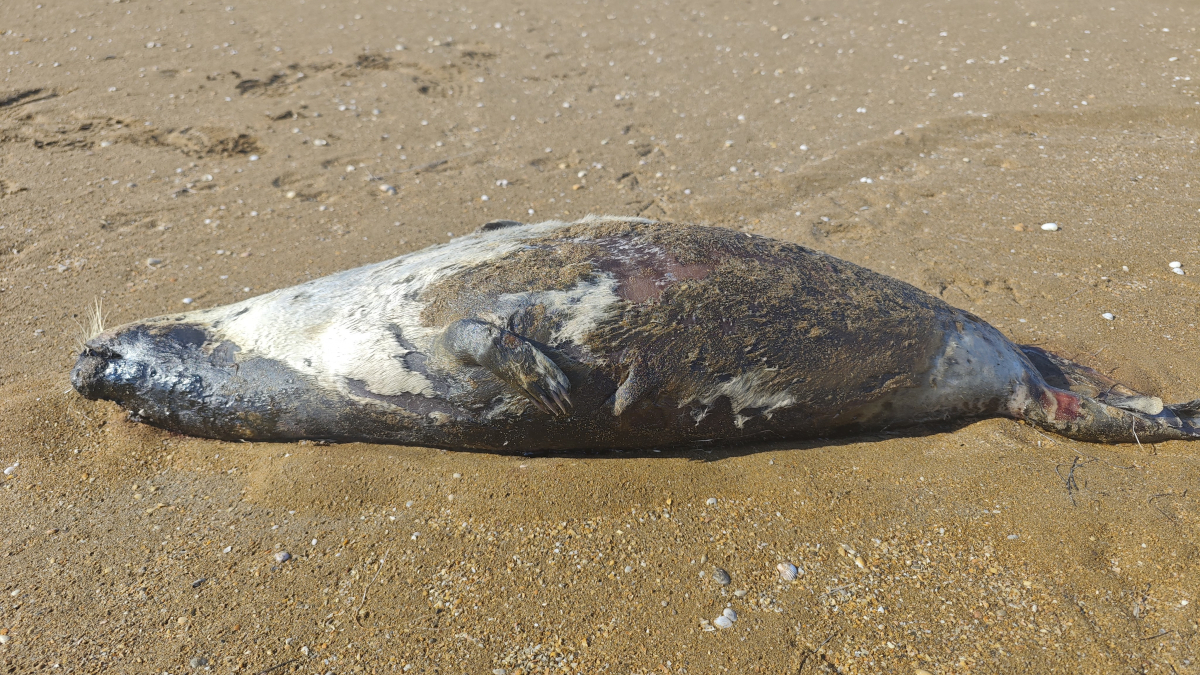
The number of dead Caspian seals discovered along Kazakhstan’s section of the Caspian Sea continues to rise, with the latest findings reported near the Karazhanbas and Buzachi oilfields in the Mangystau region.
Environmental volunteers monitoring the shoreline say dozens of additional carcasses were found over just two days, deepening concerns about the sea’s ecological condition and the vulnerability of its endemic wildlife.
Speaking to AnewZ, long-time environmental activist Daniyar Akimzhanov, head of the regional branch of the Republican Association of Fisheries and Aquaculture “Qazaq Balyk”, said eco-volunteers surveyed parts of the coastline on 10 and 11 May and documented 37 dead seals.
Some stretches of the shore, he said, are inaccessible by car, forcing volunteers to use motorcycles to inspect remote coastal areas and count carcasses scattered along the shoreline.
Further discoveries continue to be reported. Volunteers said another 20 dead seals were found near the Tokmak area in the Karakiya district. Since 17 April, around 300 seal carcasses have been recorded along the Caspian coast, although environmental groups believe the actual number could be considerably higher.
“We, as eco-volunteers, are only able to monitor a small part of the coastline,” Akimzhanov said, adding that winds from the south-west, west and north may also be carrying carcasses from the shores of neighbouring Caspian states towards Kazakhstan’s coastline.
Cause of deaths still unknown
Information about each discovery is being passed to local authorities and district administrations to organise the collection and disposal of the carcasses in line with public health procedures. However, the exact cause of the deaths remains unclear.
Akimzhanov believes the primary reason behind the seal deaths is the broader degradation of the Caspian ecosystem. Scientists and conservationists have long warned that the sea is coming under mounting pressure from climate change, industrial activity, pollution and rapidly falling water levels.
The Caspian seal, found nowhere else in the world, is listed as endangered and is widely regarded as a key indicator of the sea’s environmental health.
Investigations underway
The latest discoveries follow similar incidents reported in April, when nearly 100 dead seals washed ashore in the Tupkaragan district of the Mangystau region. According to Kazakhstan’s Institute of Hydrobiology and Ecology, the animals had likely died more than a month before they were discovered.
Officials from the Ministry of Agriculture said samples taken from both the seals and birds are currently undergoing laboratory testing, with results expected to be released once examinations are complete.
Meanwhile, Deputy Ecology Minister Nurken Sharbiyev said preliminary analyses of water samples collected from the affected coastal areas did not reveal concentrations of harmful substances above permissible levels.




















What is your opinion on this topic?
Leave the first comment