The AnewZ Opinion section provides a platform for independent voices to share expert perspectives on global and regional issues. The views expressed are solely those of the authors and do not represent the official position of AnewZ
Global oil prices rose sharply in early 2026, with Brent crude exceeding $100 per barrel in mid-March after disruptions in the Middle East and heightened risks in the Strait of Hormuz.
Prices fluctuated between $92 and $111 per barrel during the month, pushing up petrol and diesel costs in oil-importing economies and placing immediate pressure on transport, freight and manufacturing expenses.
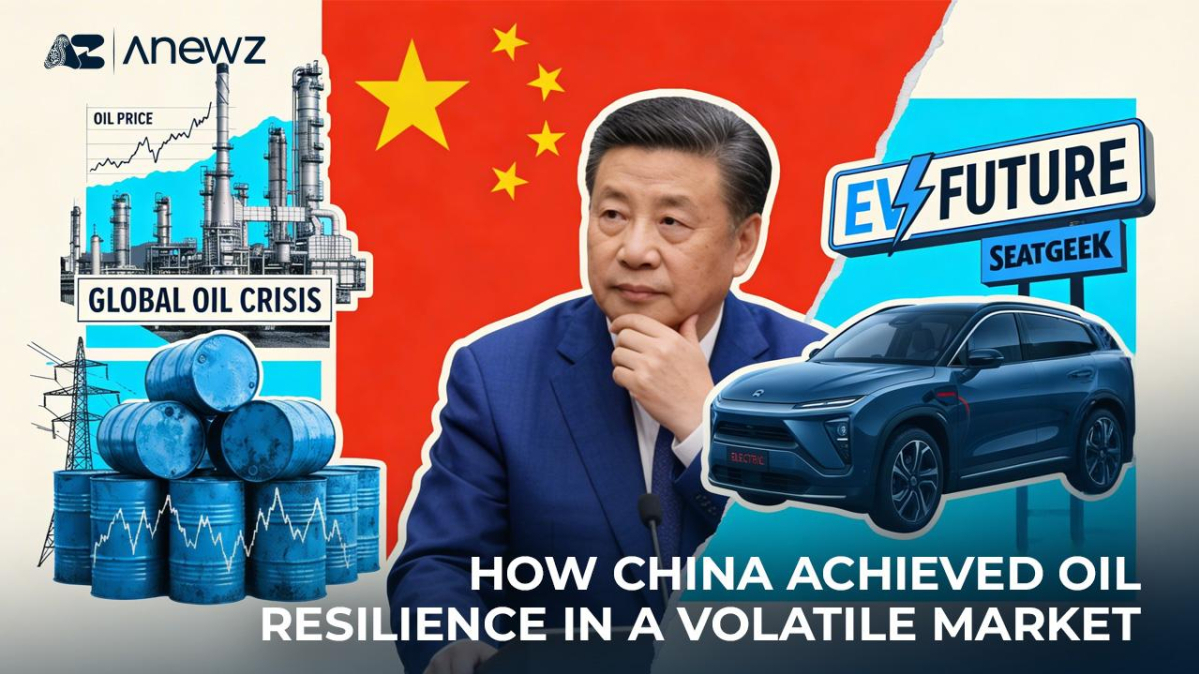
While many countries faced direct pass-through of these increases, China experienced limited disruption. The main reason is a structural reduction in oil demand for transport fuels, achieved through two decades of policy and investment in electric vehicles (EVs) and renewable power generation.
China began addressing energy security concerns in the early 2000s, when oil imports rose rapidly and passed through vulnerable chokepoints. By 2004, official statements already described the Strait of Malacca as a potential lifeline under external control.
The response was a multi-pronged strategy: building strategic petroleum reserves (now estimated at over 500 million barrels of commercial and government stocks), diversifying import sources (with Russia and Central Asia now supplying a larger share), and accelerating domestic alternatives.
The transport sector received focused attention. In 2009, the government launched a large-scale EV subsidy programme that totalled more than RMB 200 billion (about $30 billion at the time) between 2009 and 2022. Subsidies covered purchase incentives, infrastructure grants and R&D support for domestic manufacturers. BYD, for example, received the largest share and became the world’s top EV seller in 2024. The programme was gradually phased out after 2022 as costs fell and market momentum built.
By the end of 2025, new-energy vehicles (EVs and plug-in hybrids) accounted for 52.4% of passenger car sales in China, according to China Passenger Car Association data. In December 2025 alone, NEV retail penetration reached 58.3%. Battery electric vehicles (BEVs) made up 38.7% of total sales, with plug-in hybrids at 13.7%.
Commercial segments also shifted: electric buses accounted for over 95% of new urban bus sales in major cities, and roughly 32% of new heavy-duty trucks sold in late 2025 were fully electric, driven by mandates in logistics and mining sectors.
This adoption directly reduced oil demand. Petrol consumption in China peaked around 2020–2021 and has declined since, falling by an estimated 3–5% annually in recent years. Diesel demand for road transport has levelled off as electric trucks and LNG alternatives gain share.
The International Energy Agency’s 2025 Oil Market Report projected that China’s transport oil demand would plateau between 2025 and 2030 before entering a structural decline, with EVs and efficiency gains as the primary drivers. CNPC Economics & Technology Research Institute reached a similar conclusion, forecasting peak refined oil product demand around 2025–2027.
The power system supports this transition. By the end of 2025, total installed generation capacity stood at 3.89 terawatts. Clean sources (hydro, wind, solar, nuclear and biomass) accounted for 51.9% of the fleet. Solar capacity reached 1.2 terawatts, wind 640 gigawatts, hydro 430 gigawatts, and nuclear 58 gigawatts. Annual additions in 2024–2025 averaged 300–350 gigawatts of renewables alone. Coal remains dominant in absolute terms, but its share of new capacity has fallen below 20% in recent years.
These shifts create a measurable buffer. When oil prices rise, the incremental cost to Chinese consumers and firms is lower because a growing share of mobility relies on electricity priced through regulated tariffs or market mechanisms less tied to crude oil. In March 2026, retail fuel prices were raised by 5% - the largest single adjustment in four years - to 7.96 yuan per litre, but the impact on overall transport expenditure is mitigated by the EV fleet. Industrial users benefit from stable electricity tariffs for electrified processes.
How China executed the shift - and replicable elements
The approach combined several elements that other countries can adapt:
-
Targeted subsidies with phase-out discipline: Early purchase incentives (up to RMB 60,000 (8750 U.S. dollars) per vehicle in peak years) were reduced as prices fell, avoiding long-term fiscal drag.
-
Infrastructure first: By the end of 2025, China had over 12 million public charging points, including 2.7 million fast chargers. Mandates required new residential and commercial buildings to include charging capacity.
-
Domestic supply-chain build-out: Policies required local content in batteries and vehicles, leading to scale in lithium refining, cathode and anode production, and cell manufacturing. CATL and BYD now hold over 50% of the global battery market share.
-
Regulatory push: Fuel-efficiency standards tightened annually, NEV mandates required automakers to meet sales quotas, and city-level restrictions on internal-combustion vehicles accelerated urban adoption.
-
Power-sector reform: Feed-in tariffs and auctions drove renewable additions at low cost; curtailment rates fell below 3% nationally by 2024.
Lessons for other countries
The Chinese case shows that reducing oil dependence in transport is achievable within 15–20 years when policies align incentives, infrastructure, and industry. For oil-importing economies:
-
Early subsidies and mandates can jump-start demand when technology is immature, but they must be tapered as costs decline.
-
Charging and grid upgrades need to precede mass adoption to avoid bottlenecks.
-
Building local manufacturing reduces import dependence on batteries and components.
-
Tightening efficiency standards and restricting high-emission vehicles in cities creates demand pull.
-
Diversifying power sources (renewables + nuclear + existing baseload) ensures electricity remains affordable during oil shocks.
These steps do not require identical conditions to China’s. Smaller markets can focus on urban fleets (buses, two-wheelers), high-density corridors, or off-grid solar plus battery storage. The key is sequencing: infrastructure and supply chains come before scale.
China’s current insulation from oil price spikes is the direct result of these policies. Other importers facing similar exposure can achieve comparable resilience by adapting the same building blocks to their own circumstances. The numbers - 52% NEV sales share, 1.2 TW of solar capacity and declining petrol demand - demonstrate what is possible when execution is consistent over time.





















What is your opinion on this topic?
Leave the first comment