U.S. President Donald Trump said on Tuesday that Americans’ financial struggles are not a factor in his decision-making as he seeks to negotiate an end to the Iran war, saying that preventing Tehran from acquiring a nuclear weapon is his top priority.
Asked by a reporter to what extent Americans’ financial situations were motivating him to strike a deal, Trump said: “Not even a little bit.”
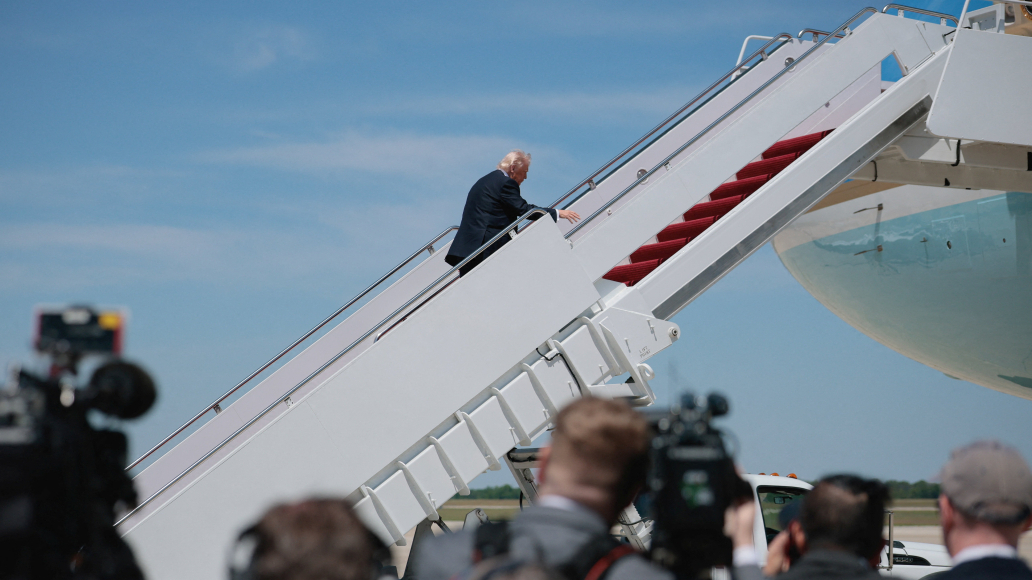
"The only thing that matters, when I’m talking about Iran, they can’t have a nuclear weapon," Trump said before departing the White House for a trip to China. "I don’t think about Americans’ financial situation. I don’t think about anybody. I think about one thing: We cannot let Iran have a nuclear weapon. That’s all. That's the only thing that motivates me."
Trump's remarks are likely to draw scrutiny from critics who argue the administration should balance geopolitical objectives with the economic impact on Americans, particularly as cost-of-living concerns remain a top issue for voters ahead of the November midterm elections.
Asked to elaborate on the president's comments, White House Communications Director Steven Cheung said that Trump's "ultimate responsibility is the safety and security of Americans. Iran cannot have a nuclear weapon, and if action wasn’t taken, they’d have one, which threatens all Americans."
Trump is under growing pressure from fellow Republicans who fear economic pain caused by the war could spark a backlash against the party and cost it control of the House of Representatives and possibly the Senate in November.
Rising energy costs linked to the Iran conflict have pushed up gasoline prices and contributed to inflation.
U.S. consumer inflation in April posted its largest gain in three years, according to data released on Tuesday.
Trump framed his approach as a matter of national and global security, suggesting economic concerns were secondary to preventing nuclear proliferation.
Surveys show the war is unpopular with U.S. voters less than six months before nationwide elections that will determine whether Trump's Republican Party retains control of Congress.
Two out of three Americans, including one in three Republicans and almost all Democrats, think Trump has not clearly explained why the country has gone to war, according to a Reuters/Ipsos poll completed on Monday.
U.S. intelligence assessments, however, indicate that the time Iran would need to build a nuclear weapon has not changed since last summer, when analysts estimated that a U.S.-Israeli attack had increased the timeline to nine months to a year, according to three sources familiar with the matter. The assessments of Tehran's nuclear programme remain broadly unchanged even after two months of a war.
Trump's allies have echoed his argument that the risks posed by a nuclear-armed Iran outweigh short-term economic hardships.
Iran denies seeking nuclear weapons and says its programme is for peaceful purposes, though Western powers suspect it aims to develop the capability to build a bomb.
Trump's visit to China
Meanwhile, ahead of a high-stakes summit in Beijing, President Trump said he did not think he would need to enlist Chinese President Xi Jinping to resolve the conflict, which has continued to block maritime traffic that normally provides one-fifth of the world's oil supply.
"I don't think we need any help with Iran. We'll win it one way or the other, peacefully or otherwise," he told reporters.
More than one month after a tenuous ceasefire took effect, the two sides have made no progress on an agreement to end hostilities.
Iran tightens control over Hormuz
Iran, meanwhile, has appeared to firm up its control over the Strait of Hormuz, cutting deals with Iraq and Pakistan to ship oil and liquefied natural gas from the region, according to sources with knowledge of the matter.
Other countries are exploring similar deals, sources said, in a move that could normalise Tehran's control of the waterway on a more permanent basis.
The Trump administration said on Tuesday that senior U.S. and Chinese officials had agreed last month that no country should be able to charge tolls on traffic through the region, in an effort to project consensus on the issue ahead of the summit.
China, which maintains ties with Iran and remains a major buyer of its oil, did not dispute that characterisation.
Trump is due to discuss the war with Xi during meetings scheduled for Thursday to Friday, and is widely expected to encourage China to convince Tehran to make a deal with Washington to end the conflict.
Stalemate between the two sides
U.S. demands include ending Iran's nuclear programme and lifting its chokehold on the strait.
Iran has responded with demands of its own, including compensation for war damage, the lifting of the U.S. blockade, and an end to the war on all fronts, including Lebanon, where U.S. ally Israel is fighting Iran-backed Hezbollah militants. Trump dismissed those positions as "garbage" on Monday (11 May).
Financial cost of war
Brent crude oil futures extended gains, climbing to more than $107 a barrel, as the deadlock left the Strait of Hormuz largely closed.
U.S. Central Command said the aircraft carrier Abraham Lincoln was in the Arabian Sea enforcing the U.S. blockade, where it had redirected 65 commercial vessels and disabled four others.
The Pentagon put the cost of the war at $29 billion so far, an increase of $4 billion from an estimate provided late last month. An official told lawmakers the new cost included updated repair and replacement of equipment and operational costs.
Iranian officials stand firm
Iranian officials remained defiant. A Fars news agency report cited an Islamic Revolutionary Guard Corps (IRGC) official as saying Iran had expanded its definition of the Strait of Hormuz into a zone stretching from the coast of the city of Jask in the east to Siri Island in the west.
In Tehran, the Guards held drills "centred on preparation to confront the enemy", state TV reported.















What is your opinion on this topic?
Leave the first comment