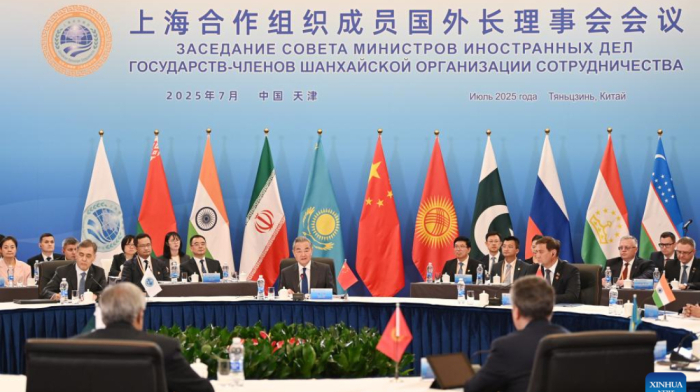
The 2025 Shanghai Cooperation Organisation (SCO) Summit, held in Tianjin, China, has been hailed as one of the most significant gatherings in the bloc’s history.
Leaders from SCO member states convened amidst a backdrop of rising geopolitical tensions, focusing on security coordination, economic cooperation, and long-term strategic planning.
One of the central outcomes of the summit was the adoption of the Tianjin Declaration, a document that outlines the key priorities for the bloc in the coming years.
Alongside this declaration, the SCO members approved a new development strategy, which will guide the organisation from 2026 to 2035. This comprehensive document focuses on a broad range of issues, from regional stability and economic resilience to institutional reform.
The development strategy places particular emphasis on enhancing regional integration, ensuring peace and security, and fostering economic cooperation.
The ambitious framework signals a commitment to the long-term vision of a more interconnected and prosperous region, with a focus on addressing global challenges such as climate change and technological disruption.
Security cooperation was a prominent feature of the summit, as the SCO members recognized the growing threats posed by terrorism, extremism, cyber threats, and transnational crime.
In response, leaders agreed to strengthen joint mechanisms for combating these challenges, further cementing the SCO’s role as a key regional security platform.
The participants acknowledged that such threats require a collective approach and stressed the importance of increasing information-sharing and operational coordination among member states.
As the world faces increasingly complex security dynamics, the SCO is positioning itself as an organisation that can address both traditional and emerging security concerns.
A significant economic breakthrough emerged from the summit, as leaders announced the establishment of the SCO Development Bank.
The new institution is expected to play a vital role in financing infrastructure, connectivity, and social development projects across the region.
With a focus on sustainable growth, the bank aims to strengthen economic ties among member countries while addressing their developmental needs.
This initiative is expected to have a far-reaching impact, facilitating large-scale projects that will improve infrastructure, promote trade, and enhance regional integration.
The establishment of the SCO Development Bank marks a major step in the organisation's evolution, as it moves beyond dialogue to take tangible actions on economic and social development.
Energy security and sustainable development were also key topics of discussion at the summit. In light of the global shift towards clean energy and environmental sustainability, SCO members agreed to intensify cooperation on green energy initiatives and ensure the stability of energy supply chains.
Leaders called for greater collaboration in the development of renewable energy sources, as well as the promotion of energy-efficient technologies.
By aligning their efforts, the SCO aims to create a more sustainable energy framework that can meet the growing demand for clean energy in the region.
The Tianjin Summit underscored the Shanghai Cooperation Organisation’s increasing geopolitical weight. As the world becomes more multipolar, the SCO is positioning itself as a powerful force capable of shaping global developments.
The bloc’s ability to move beyond dialogue and take concrete steps towards regional stability, economic development, and security cooperation highlights its evolving role on the global stage.
In conclusion, the 2025 SCO Summit in Tianjin marks a turning point in the organisation’s history. With the adoption of the Tianjin Declaration and the new development strategy, the SCO is setting its course for the future, focusing on a more integrated and resilient region.
The summit’s outcomes signal the bloc’s readiness to tackle the challenges of the 21st century and to enhance its role as a pillar of regional stability and prosperity.

























What is your opinion on this topic?
Leave the first comment