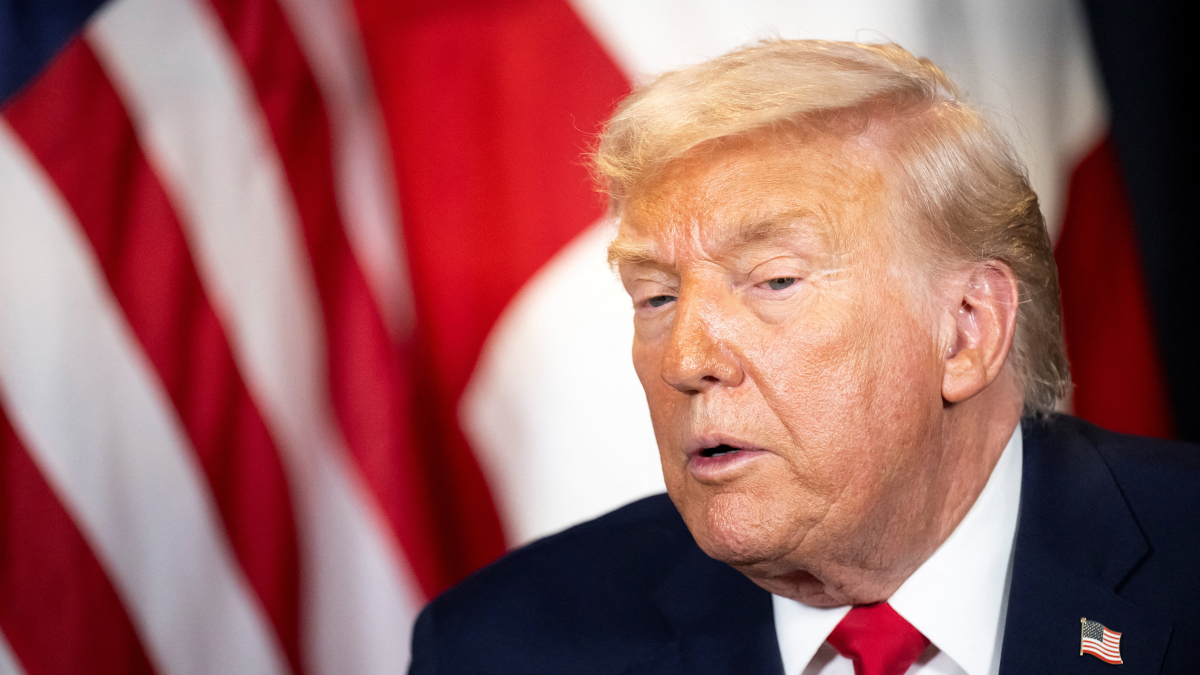
President Donald Trump says he has agreed a "framework" for a Greenland deal with NATO.
Speaking on the sidelines of the World Economic Forum in Davos, Trump said the understanding with NATO prompted him to back away from previously announced punitive tariffs on several European countries, which had been due to take effect on 1 February.
Trump did not provide details on the scope or substance of the Greenland framework, but said discussions with NATO were continuing. European officials have yet to comment publicly on the announcement.
NATO Secretary General Mark Rutte confirmed that talks with Trump had taken place, describing the meeting as constructive, but unfinished. He said the issue of whether or not Greenland stays with Denmark did not come up during the talks.
“We had a very good meeting tonight, but there is still a lot of work to be done,” Rutte told AFP.
In a separate statement, NATO spokesperson Allison Hart said the discussions focused on the strategic importance of security in the Arctic region for all NATO allies, including the United States.
She said talks among NATO members on the framework referenced by Trump would centre on collective efforts to ensure Arctic security, particularly involving the alliance’s seven Arctic member states.
Following Trump’s remarks, financial markets reacted positively, with U.S. stocks rising sharply after news of the tariff reversal.
Moreover, on Thursday, Trump told Fox Business on Thursday that his administration is negotiating a deal to secure the U.S. “total access” to Greenland.
Trump reiterated that a U.S. presence on the island is vital for national security, saying, “Everything comes over Greenland. If the bad guys start shooting, it comes over Greenland. It’s pretty invaluable.”
He added that the negotiations aim for unrestricted access, with “no end” or time limit, noting that advances in technology now make the concept more feasible than in Ronald Reagan’s era.
Background: How Greenland became a transatlantic flashpoint
Greenland has moved to the centre of transatlantic tensions after Donald Trump renewed pressure for the United States to secure a greater strategic role in the Arctic territory, arguing that it is vital to U.S. national security.
The island, which is part of the Denmark but enjoys extensive self-governing powers, occupies a critical position between North America and Europe. Its importance has grown amid rising military and economic competition in the Arctic, particularly involving Russia and China, as well as expanding shipping routes and defence infrastructure.
In early 2026, Trump escalated the dispute by linking Greenland to broader economic pressure on Europe, threatening punitive tariffs against several European countries opposed to U.S. ambitions. The move drew strong criticism from European capitals and raised concerns about strain within NATO, at a time when allies are coordinating closely on security challenges.
Danish and Greenlandic authorities have repeatedly rejected any suggestion of a transfer of sovereignty, stressing that Greenland’s future can only be decided by its population. At the same time, NATO allies have stepped up coordination on Arctic security, reflecting the region’s growing strategic significance.
Tensions eased temporarily at the World Economic Forum in Davos after Trump announced that he had agreed a “framework” with NATO and withdrew the planned tariff measures. However, the substance of that framework has not been made public, and discussions among the United States, NATO allies and regional stakeholders remain ongoing.












What is your opinion on this topic?
Leave the first comment