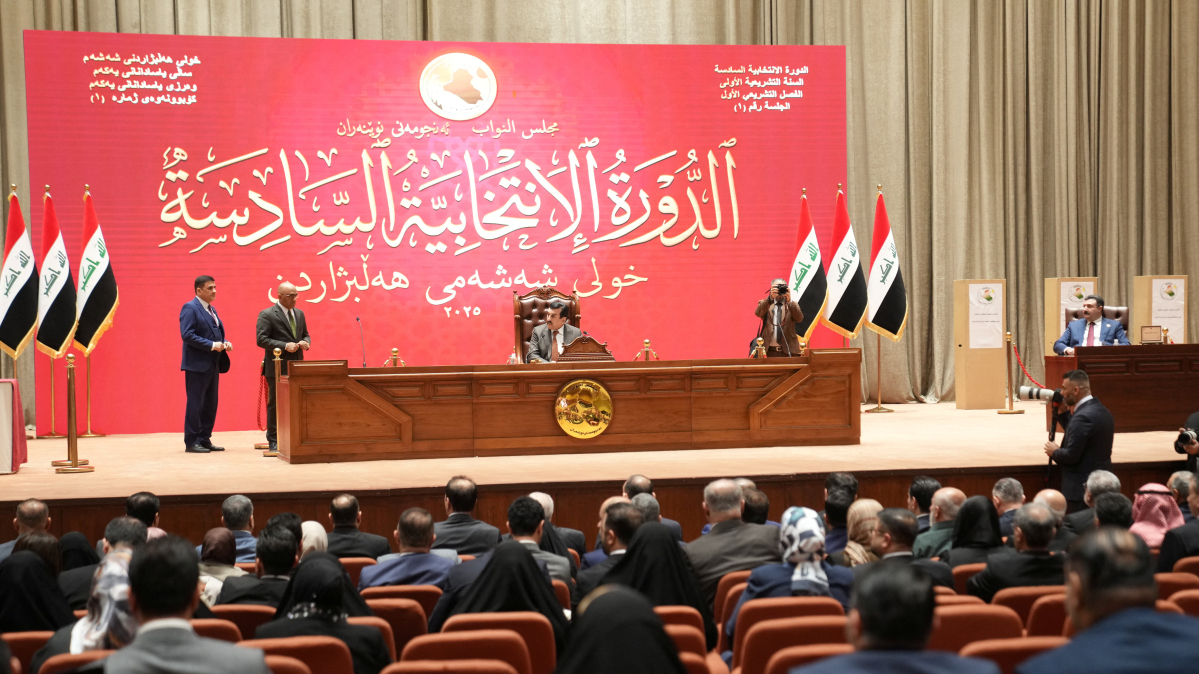
Iraq’s newly elected parliament has chosen Haybat al-Halbousi as its speaker, marking the first formal step toward forming a new government after months of uncertainty.
The vote was held during parliament’s first session on Monday, with Iraqi media reporting that al-Halbousi secured 208 votes, defeating two rival candidates who received 66 and 9 votes. He represents the Taqaddum (Progress) Party, which draws much of its support from Sunni-majority areas in western and northern Iraq.
The opening session of the Council of Representatives was closely watched by Iraqis seeking clarity on the country’s leadership following the November 11 election, which produced a fragmented political landscape.
Under Iraq’s long-standing muhasasa power-sharing system, the speaker of parliament is a Sunni figure elected during the first session, alongside two deputy speakers. This is followed by the election of a Kurdish president, who then tasks the nominee of the largest Shia bloc with forming a government.
Attention now shifts to the Shia Coordination Framework (SCF), which must decide whom to nominate for prime minister. Incumbent Prime Minister Mohammed Shia al-Sudani, previously backed by the SCF, ran independently in the election and performed strongly, winning around 46 seats through his Reconstruction and Development Coalition.
However, a recent Federal Supreme Court ruling effectively returned him to the SCF’s political orbit, where key decisions are often shaped by influential figures outside parliament.
The SCF also faces growing scrutiny over the rising number of lawmakers linked to Shia factions with armed wings aligned with Iran. Between 80 and 90 SCF members are associated with such groups, many of whom are under U.S. sanctions, a sharp increase compared with previous parliaments.
Analysts say their expanded presence could complicate Iraq’s relations with foreign partners and deepen domestic resentment over Iran’s influence in the country’s political system.


















What is your opinion on this topic?
Leave the first comment