Three killed in San Diego Islamic Centre shooting as police confirm suspects dead
Three people have been killed in a shooting at the Islamic Centre of San Diego, including a security guard while the two suspects were later found ...
United States chipmaker AMD will supply artificial intelligence chips to OpenAI in a multi-year agreement that could generate tens of billions of dollars in annual revenue and give the ChatGPT maker the option to acquire up to 10% of the company.
Shares of AMD surged more than 34% on Monday following the announcement, marking their biggest one-day gain in over nine years and adding roughly $80 billion to the company’s market value.
The deal underscores the AI sector’s soaring demand for computing power as companies race to develop systems that match or surpass human intelligence.
“We view this deal as transformative — not just for AMD, but for the industry’s dynamics,” said Forrest Norrod, AMD’s executive vice president.
The agreement deepens ties between OpenAI and one of Nvidia’s key rivals, following Nvidia’s own major investments in the company.
Analysts say the move is a strong vote of confidence in AMD’s chips and software, though it is unlikely to threaten Nvidia’s market dominance.
AMD expects the partnership to bring in tens of billions annually and more than $100 billion in new revenue over four years from OpenAI and other clients. The company is forecast to post $32.78 billion in revenue this year, compared with Nvidia’s projected $206.26 billion.
“AMD has really trailed Nvidia for quite some time, so this helps validate their technology,” said Leah Bennett, chief investment strategist at Concurrent Asset Management. Nvidia shares slipped over 1% after the news.
Bulgaria has won the Eurovision Song Contest for the first time, taking victory in a final overshadowed by a boycott over Israel’s participation and the war in Gaza.
The World Urban Forum (WUF13) continues in Baku, Azerbaijan on 18 May, addressing the global housing crisis. The day’s agenda includes the official opening press conference, the WUF13 Urban Expo opening and a ministerial dialogue on the Nairobi Declaration to advance Africa's urban agenda.
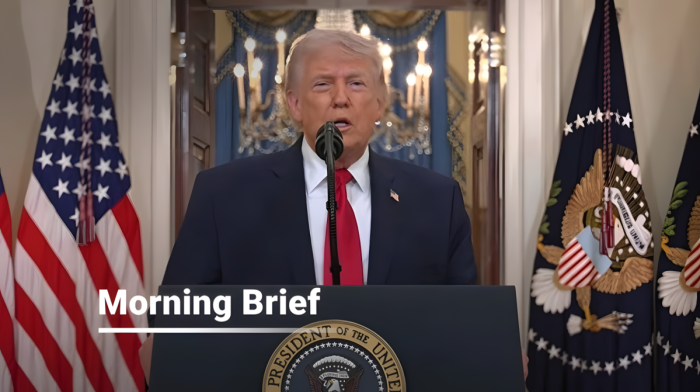
U.S. President Donald Trump said on Monday he had paused a planned attack on Iran after appeals from the leaders of Qatar, Saudi Arabia and the United Arab Emirates, allowing negotiations to continue over a possible deal to end the conflict.
A 5.2 magnitude earthquake struck China’s Guangxi region early on Monday, killing two people and forcing more than 7,000 residents in Liuzhou to evacuate as rescue efforts continued.
U.S. President Donald Trump says China's Xi Jinping agreed Iran must reopen the Strait of Hormuz, as Tehran prepares a new shipping mechanism. Tensions over the U.S. blockade and stalled nuclear talks continue to disrupt global oil supplies.
China has launched the world’s first experiment to study how artificial human embryos develop in space, marking a major step in understanding whether humans could one day reproduce beyond Earth.
Japanese filmmaker Koji Fukada has said that the use of artificial intelligence (AI) to “jump straight to the result” risks undermining the purpose of art, which he believes should be rooted in self-expression and a deeper understanding of the world.
The Spanish government has issued a defiant message to Silicon Valley, confirming it will push ahead with stringent new legislation designed to make social networks and Artificial Intelligence (AI) demonstrably safer.
A robotics startup says it has built an AI “brain” that can teach humanoid robots new physical skills in days rather than months, as the race to deploy human-shaped machines in factories and warehouses accelerates.
Apple and Meta have publicly opposed a Canadian bill they say could force technology companies to weaken encryption on devices and online services if it becomes law.
You can download the AnewZ application from Play Store and the App Store.
What is your opinion on this topic?
Leave the first comment