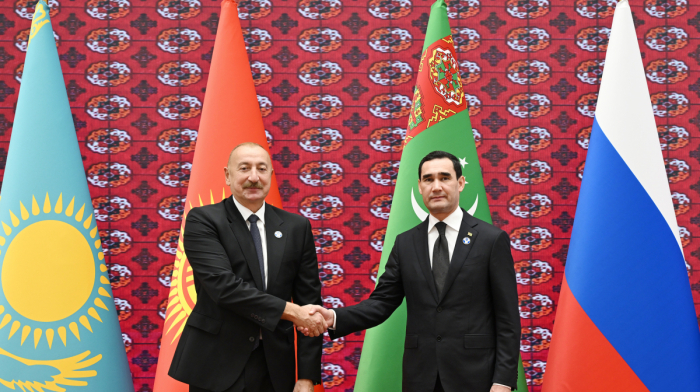
The official visit of Azerbaijan President Ilham Aliyev to Georgia marks a significant moment in South Caucasus diplomacy, highlighting a deepening strategic partnership amid global uncertainty.
Hosted by President Mikheil Kavelashvili and Prime Minister Irakli Kobakhidze, the visit focused on shared priorities including regional stability, connectivity and economic cooperation. It also reflects a broader regional recalibration in response to shifting geopolitical dynamics and ongoing conflicts.
Notably, following Georgia’s recent presidential election, Kavelashvili’s first official foreign visit was to Azerbaijan, signalling continuity in bilateral ties. Aliyev’s return visit reinforces this trajectory, underscoring consistent alignment in strategic outlook and regional engagement.
High-level meetings signal continuity and coordination
Aliyev’s visit began with an official welcoming ceremony at the Orbeliani Palace in Tbilisi, followed by bilateral and expanded-format meetings with both Kavelashvili and Kobakhidze. Discussions centred on maintaining and expanding what both sides described as a high-level strategic partnership.
Talks reaffirmed mutual political support, particularly on sovereignty and territorial integrity - a longstanding pillar of relations between the two countries. Both leaders emphasised that cooperation is grounded in trust and shared interests, positioning their partnership as a model within the region.
The visit also included ceremonial elements, such as a wreath-laying at Heroes’ Square and tributes to national figures, reinforcing the symbolic dimension of bilateral ties.
Focus on regional stability in a changing geopolitical landscape
A central theme of the visit was the shifting international environment. Against the backdrop of conflicts in the Middle East and wider geopolitical tensions, both sides stressed the importance of preserving stability in the South Caucasus.
Aliyev highlighted what he described as a “new reality” in the region, calling for sustained efforts to ensure peace, particularly in the context of ongoing dialogue between Azerbaijan and Armenia. Kobakhidze reiterated Georgia’s support for this process and its willingness to facilitate dialogue if required.
The discussions framed the South Caucasus not only as a region facing risks but also as one with the potential to present itself as a zone of cooperation, stability and connectivity.
Energy and transport corridors remain central
Economic cooperation featured prominently, with particular attention on energy security and transport infrastructure. Azerbaijan continues to play a key role in supplying energy to international markets via Georgia, reinforcing Tbilisi’s position as a critical transit hub.
Key projects such as the Baku-Tbilisi-Ceyhan pipeline, the Southern Gas Corridor and the Baku-Tbilisi-Kars railway were highlighted as essential components of regional connectivity. Both sides also pointed to the growing importance of the so-called Middle Corridor, linking Asia and Europe through the South Caucasus.
These routes are increasingly relevant in the context of global supply chain diversification and shifting trade patterns, enhancing the strategic importance of both countries.
Expanding economic ties and investment outlook
Trade and investment relations continue to deepen, with Azerbaijan remaining one of Georgia’s largest economic partners. According to statements made during the visit, Azerbaijani investments in Georgia have reached approximately $3.6 billion.
Leaders discussed plans to further expand cooperation, including the possibility of joint investments in third countries. The upcoming session of the intergovernmental commission on economic cooperation is expected to provide additional momentum.
The emphasis on economic collaboration reflects a broader effort to fully utilise existing potential while adapting to new regional and global opportunities.
Diplomatic signalling and internal political context
Alongside official meetings, Aliyev is also expected to meet Bidzina Ivanishvili, the honorary chairman of the ruling Georgian Dream party. While Ivanishvili does not currently hold a formal state position, such high-level engagement is likely to attract attention.
The planned meeting may be interpreted by observers as indicative of his continued informal influence in Georgian politics - a subject of ongoing debate among analysts and critics. Georgian authorities have not framed the meeting in political terms, and no official statements have been made regarding its agenda.
Outcome: reinforcing a strategic axis in the South Caucasus
Overall, the visit reaffirmed the depth and resilience of Georgia-Azerbaijan relations. It highlighted a shared commitment to stability, economic integration and strategic connectivity at a time of heightened regional and global uncertainty.
By aligning positions on key geopolitical issues and advancing practical cooperation in energy and transport, both countries are positioning themselves as central actors in the evolving architecture of the South Caucasus.
The visit also demonstrated continuity in bilateral priorities following Georgia’s recent political transition, suggesting that the partnership with Azerbaijan will remain a cornerstone of Tbilisi’s foreign policy in the near term.










What is your opinion on this topic?
Leave the first comment