Georgia and the United States have held a rare high-level meeting in Washington, reopening cautious discussion about relations after years of political stagnation.
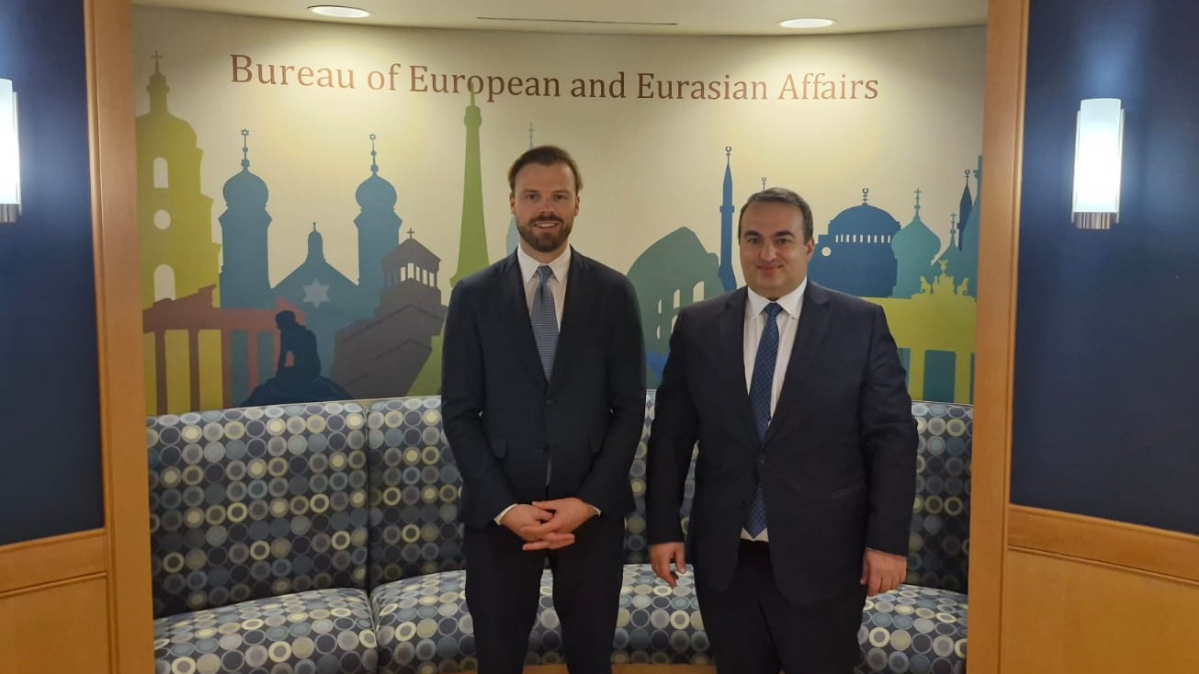
Deputy Foreign Minister Lasha Darsalia met U.S. Assistant Secretary of State Brendan Hanrahan during a working visit to Washington.
The meeting took place at the U.S. Department of State and was attended by Georgia’s ambassador to the United States, Tamar Taliashvili, and U.S. Deputy Assistant Secretary Sonata Coulter.
According to Georgia’s foreign ministry, the talks focused on bilateral relations, regional developments and prospects for future cooperation.
Tbilisi said the U.S. side reaffirmed its unconditional support for Georgia’s sovereignty and territorial integrity.
The Georgian government describes the meeting as a step toward resetting relations.
Parliament Speaker Irakli Kobakhidze said Georgia is ready to “turn the page,” proposing a renewed strategic partnership built on what he called a clean slate and a concrete roadmap.
He emphasised that working-level cooperation between the two foreign ministries continues, even as political relations remain, in his words, “in waiting mode.”
The talks were held behind closed doors, and Washington did not issue a separate readout, leaving Georgia’s account as the only official version available.
Opposition parties remain sceptical, saying the meeting does not signal a shift in U.S. policy and arguing that Washington has little reason to deepen ties with a government they accuse of drifting from democratic standards and leaning toward Russia, China and Iran.
Washington seeking ‘clear signal’ from Tbilisi
Political analyst Dr Vakhtang Maisaia said the meeting was “actually a surprise” and “unexpected” given the current state of relations.
He suggested the talks aimed to “probe or test how it is possible to reset relations” between Georgia and the United States, even at what he called a “normal stage”, without implying a full return to previous levels of partnership.
He outlined four issues he believes were discussed behind closed doors: a limited reset, a possible U.S. visit linked to upcoming travel to Armenia and Azerbaijan, and Georgia’s role in transit corridor projects.
He added that there is rising concern in Washington over “Georgian-Iran relations”, which he noted had recently prompted discussion in the British parliament.
Maisaia said the meeting was not a high-level negotiation but a chance to “share positions” and clarify how each side interprets Georgia’s foreign policy direction.
He described it as “only a probe and test”, adding that Washington now seeks a “clear signal” and a “clear vision” from Tbilisi.
On the wider regional picture, he said the United States is reshaping its engagement through new formats involving Armenia, Azerbaijan, Türkiye and Washington, leaving Georgia outside the emerging security framework.
He argued that Georgia’s inclusion in what he called the “Trump corridor” would “increase the implications” for Tbilisi’s regional standing.










What is your opinion on this topic?
Leave the first comment