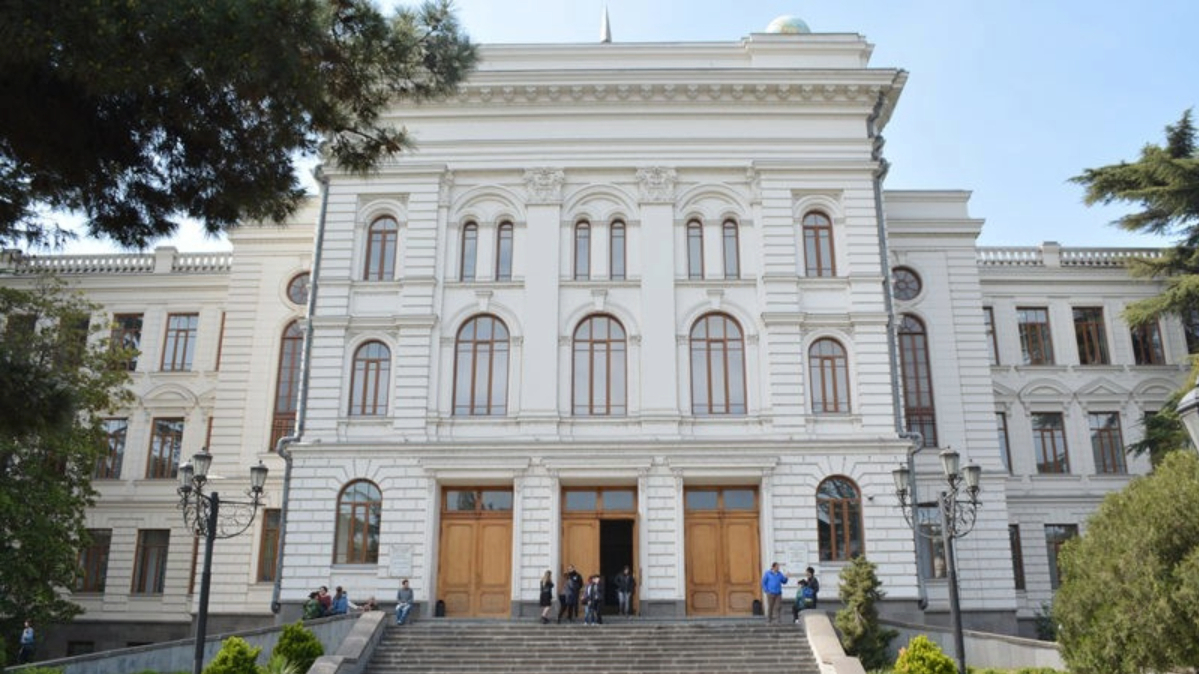
Georgia is facing one of the most significant and controversial changes in its modern educational history after the government announced plans to merge the country’s two largest public universities - Ivane Javakhishvili Tbilisi State University and the Georgian Technical University.
Tensions in Tbilisi have reached boiling point after lawmakers fast-tracked legislation granting the state unprecedented control over higher education institutions, a move designed to facilitate the controversial unification of the nation's two most prominent universities.
Georgia is currently facing one of the most significant and divisive upheavals in its modern educational history. The unrest began late last month after the ruling party announced plans to merge Ivane Javakhishvili Tbilisi State University (TSU) and the Georgian Technical University (GTU) into a single entity.
While authorities have framed the proposal as a necessary modernisation strategy to boost global competitiveness, the decision has ignited a firestorm of criticism regarding academic freedom, transparency, and state interference.
Following days of demonstrations, the situation intensified on 4 February when Georgia's Parliament urgently adopted a package of legislative amendments. These changes provide the legal framework for the government to bypass traditional university autonomy during the reorganisation process, further fuelling the anger of students, faculty, and civil society groups who fear the erosion of democratic norms within the education sector.
Crisis of autonomy and sudden reform
The initial catalyst for the unrest was the abrupt announcement by Georgia’s Minister of Education, Science and Youth, Givi Mikanadze, on 29 January. He revealed that TSU and GTU would be consolidated into a single institution, retaining the name of Ivane Javakhishvili Tbilisi State University.
The government argues that this fusion is based on "in-depth analysis" and international best practices. By pooling research infrastructure, budgets, and academic staff, officials claim the unified university will rise in international rankings and serve as a premier scientific hub for the region.
Parliamentary Speaker Shalva Papuashvili defended the move as an "historical correction," noting that Georgia’s first national university was originally conceived in 1918 as a unified hub of humanities and technical disciplines, arguing that their separation during the Soviet era was politically motivated rather than academically sound.
However, the execution of this plan has been met with deep suspicion. The primary grievance among the academic community is the lack of consultation. The decision appeared to blindside university leadership. Davit Gurgenidze, the rector of the Georgian Technical University, confirmed he was informed of the plan only one day before it was made public.
Faculty members say this lack of transparency has led to widespread anxiety regarding the security of their positions and the future of specialised engineering and technical programmes. Critics argue that dissolving GTU, an institution with roots dating back to the Tbilisi Polytechnic Institute of 1917, risks erasing a distinct academic identity.
Furthermore, rumours have circulated on social media suggesting the merger is a prelude to the privatisation of valuable university real estate in central Tbilisi.
While Speaker Papuashvili dismissed these claims as speculation, insisting the goal is "quality education, not selling property," the assurances have done little to quell the fears of staff who feel they are being excluded from a process that will define their professional futures.
Legislative overhaul sparks further outrage
The controversy deepened significantly on Wednesday, when Georgia's Parliament moved to solidify the government's control over the process.
In an urgent session, lawmakers adopted a package of amendments to the laws governing higher education in the third and final reading. The vote, which passed with 86 in favour and only 10 against, grants the Ministry of Education and Science expanded powers to unilaterally manage the reorganisation of state-founded institutions.
Under the new legislation, the government can now issue decrees to define the goals of reorganisation and, crucially, alter governance mechanisms temporarily. This effectively legalises the appointment of temporary governing councils and acting rectors by the ministry, bypassing existing university senates and elected bodies during the transition period.
Beyond the structural changes, the amendments introduce specific academic reforms that have raised eyebrows.
The legislation cancels the integrated bachelor’s–master’s teacher training programmes and introduces a new academic rank of "leading professor." Critics argue that these changes are being rushed through without sufficient debate.
The government asserts these measures are vital for streamlining the merger and aligning universities with state-approved educational standards. However, opponents view the urgency of the vote as a power grab intended to stifle resistance from within the universities.
The legislative move seems to have galvanised the protest movement. Students, professors, and opposition figures, who had already gathered outside university buildings on 29 and 30 January, view the new law as a confirmation of their worst fears: the loss of institutional independence.
Many demonstrators argue that the issue transcends education policy, viewing it as symptomatic of a broader drift away from democratic inclusion and Euro-Atlantic standards of governance.
With Russia recently signalling support for the ruling party’s policies, the protesters frame the fight for university autonomy as a fight for Georgia’s European future.
As the temporary councils prepare to take charge, further demonstrations are anticipated, with the academic community vowing to challenge the reorganisation through both legal avenues and continued street action.

















What is your opinion on this topic?
Leave the first comment