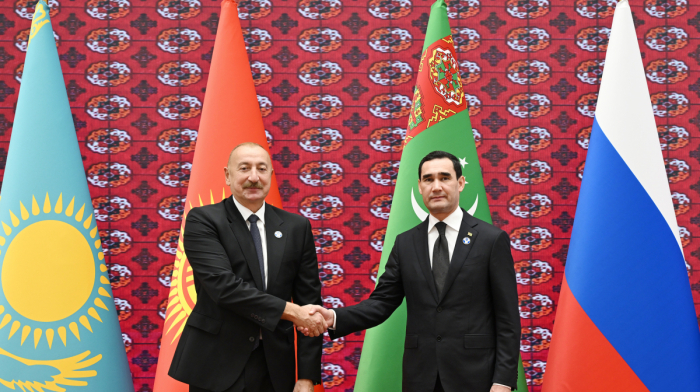
Azerbaijan has long understood the importance of fostering strong relations with its Central Asian neighbours as the country is strategically located at the crossroads of Eastern Europe and Central Asia.
In the aftermath of the 2020 Second Karabakh War, Azerbaijan has increasingly focused on deepening ties with Central Asia, ensuring that the region’s priorities remain intact while positioning itself as a vital link between the region and the West.
This shift in foreign policy reflects the country's growing role in the broader geopolitical landscape, as it actively participates in regional initiatives and consultative meetings.
As Azerbaijan continues to navigate its role within the C6 framework, comprising of Central Asian states and external partners—it seeks to strengthen relationships and mutual support without overshadowing the region's primary focus.
Roza Bayramli, leading advisor at the Air Centre, shared her insights with AnewZ on how Azerbaijan can strategically position itself within the C6 framework without shifting the group's focus away from Central Asia.
Speaking on AnewZ's Daybreak programme, Bayramli emphasised that Azerbaijan’s relationship with Central Asia has been a central priority for its foreign policy since the Second Karabakh War.
Bayramli noted that the Central Asian states were among the first to support Azerbaijan's efforts during the war, which laid the foundation for deeper collaboration.
"The relations with Central Asia were among the priorities of the foreign policy of Azerbaijan," she said.
She also highlighted how this growing partnership led to Azerbaijan’s active participation in regional consultative meetings.
“In 2023 and 2024, the President of the Republic of Azerbaijan, Mr. Ilham Aliyev, participated in the format of the consultative meetings as a guest of honour at the invitation of the president of Tajikistan and the president of Kazakhstan,” she explained.
Bayramli emphasised that Azerbaijan’s involvement in the C6 format, particularly in the consultative meetings, was a natural outcome of this long-standing cooperation.
Azerbaijan’s role, she stated, is not one of dominance but rather of collaboration, where consensus and voluntary participation are key.
"Here we can say more about cooperation but not the dominating of one party in the consultative meetings," she clarified.
She elaborated on Azerbaijan’s position as a bridge to several critical pathways in the region enhancing regional and international cooperation.
“Azerbaijan is mainly a bridge connecting the Central Asian states to Western partners and through the Caspian Sea, through South Caucasus region,” she said.
Bayramli also addressed the internal dynamics of Central Asia, noting that no one country dominates the region or the C6 meetings.
"Among the Central Asian states itself, like within the region, there is no dominant state at all. So, these meetings, this format is mainly based on consensus and on a voluntary basis," she said.
Azerbaijan see its role within the C6 framework to reflect a strategic, cooperative approach aimed at strengthening ties with Central Asia while maintaining the region’s focus.
As Roza Bayramli emphasised, Azerbaijan seeks to facilitate collaboration without shitfing focus away from crucial needs of the region.
Azerbaijan’s position as a bridge between Central Asia and the West is set to continue to offer new opportunities for regional and global cooperation, all while fostering deeper mutual understanding and respect within the C6 framework.








What is your opinion on this topic?
Leave the first comment