China’s reaction to the latest tensions around Iran has been firm in tone but restrained in action. It has condemned strikes, called for dialogue and stepped up diplomacy but shown no sign of military involvement or appetite for escalation.
China’s stance is not hesitation but part of a consistent pattern in how Beijing views Iran and the wider Middle East - through long-term interests, economic necessity and strategic caution.
A pragmatic partnership, not an alliance
To understand its position, it helps to look back. The relationship with Iran is neither new nor straightforward. Historian and political scientist at Helmut Schmidt University in Hamburg, Stefan Messingschlager, explains it is “best understood as a long, pragmatic partnership rather than an alliance.”
Modern ties began in 1971, but the real shift came after Iran’s 1979 revolution. Cut off from the West, Tehran needed new partners. China, meanwhile, saw an opening. “Iran lost its Western anchor, and China saw value in energy access, arms sales, and a fellow critic of U.S. predominance,” Messingschlager notes.
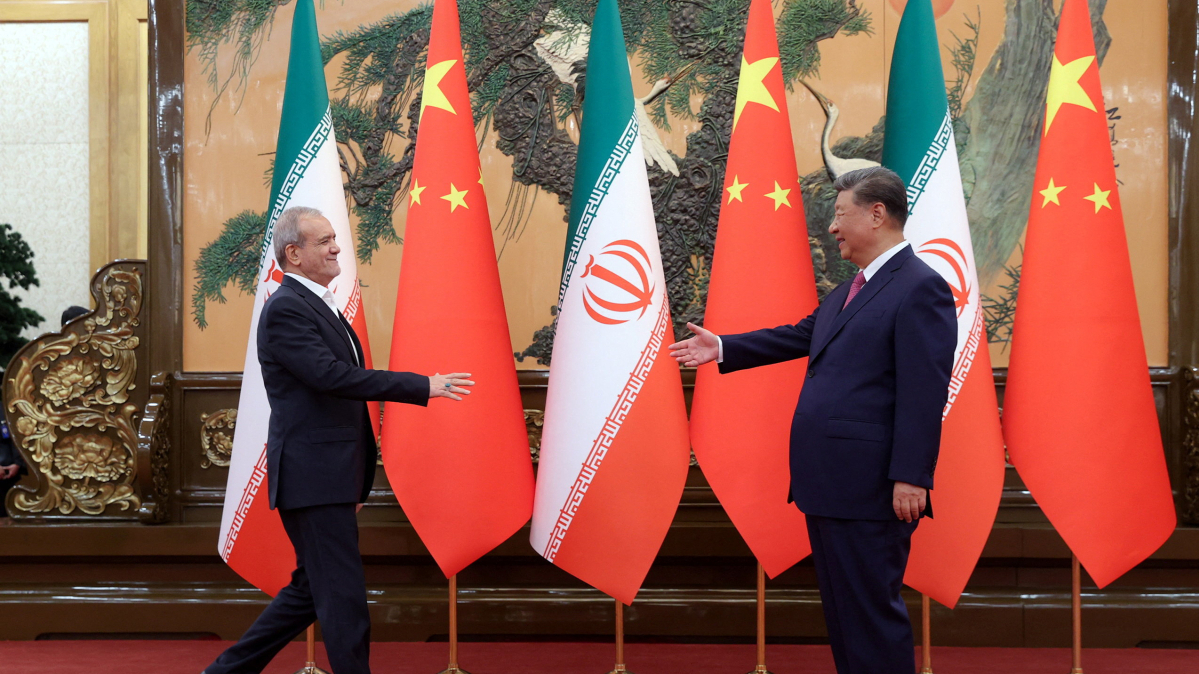
From there, relations deepened in stages. Xi Jinping’s visit to Tehran in 2016 marked a high point, with both sides announcing a “comprehensive strategic partnership,” followed by a long-term co-operation plan in 2021.
Yet the relationship remains uneven. “Iran depends on China far more than China depends on Iran,” he says, pointing to a fundamental asymmetry.
Different path from Russia
That imbalance sets China apart from Russia. Moscow’s ties with Tehran are more direct and security-driven. “Russia’s ties… are more explicitly security-centric and operational, visible in arms transfers [and] military co-ordination,” Messingschlager explains.
China, by contrast, offers “economic oxygen, diplomatic cover, and selective security co-operation,” while avoiding anything resembling a formal alliance.
There is also a deeper historical dimension. Hong Kong-based strategist Andrew Leung notes that links between China and Persia date back centuries. “Caravan trade routes [linked] Persia with the early Tang dynasty,” he says.
In modern times, he argues, China, Russia and Iran form a loose alignment - one that the late strategist Zbigniew Brzezinski once saw as a potential challenge to U.S. dominance.
Why China avoids military involvement
Despite growing ties with Iran, Beijing has drawn a clear line on military support. Its stated principles - non-use of force and respect for sovereignty - are more than rhetorical.
Messingschlager is unequivocal: “No serious analyst should expect overt Chinese military assistance at this stage.” China “has no defence treaty with Iran” and has consistently “avoided formal security guarantees.”
There are also practical constraints. “The PLA does not maintain a Middle East force posture remotely comparable to that of the United States,” he notes. Beijing’s focus remains closer to home, particularly around Taiwan and the western Pacific.
The risks of intervention are high. Direct military aid would “jeopardise China’s ties with Saudi Arabia [and] the UAE” and risk retaliation from Washington, potentially drawing China into “precisely the kind of distant, open-ended conflict it has long criticised.”
Leung puts it bluntly: “All three are the world’s largest nuclear powers with intercontinental missile delivery systems,” referring to China, the U.S. and Russia. “Hence, Beijing’s peace posture.”
For China, restraint is not just policy - it is necessity.
Reading China’s response to recent strikes
China’s response to recent strikes has been sharp but carefully calibrated. It has condemned violations of sovereignty, called for a ceasefire and intensified diplomatic engagement.
“China has not treated the strikes as a regrettable misunderstanding,” Messingschlager says. Instead, it has framed them as a breach of international law, backed by “emergency multilateral diplomacy… high-level calls, shuttle diplomacy, and Xi Jinping’s subsequent peace proposal.”
This offers Iran “political validation and some diplomatic shielding,” but with clear limits. Beijing has focused on “ceasefire, negotiations, protection of shipping, and opposition to regime change,” while avoiding any move that might alter the military balance.
“The calibration is telling,” he adds. China seeks to signal that unilateral force is unacceptable while preserving ties with Saudi Arabia, the UAE and the United States.
Leung reinforces this caution. While China has historically supported aspects of Iran’s defence capacity, including “missiles and drone technology”, it is now “extremely careful in NOT supplying arms.” As he puts it: “This is not China’s war.”
Why Iran matters to China
At its core, China’s relationship with Iran is driven by economics. Oil, trade and infrastructure outweigh ideology or security ties.
Messingschlager describes Iran as “a discounted energy supplier and a useful geoeconomic corridor”. In 2025, China bought a significant share of Iran’s oil exports - though still only a portion of its overall imports. “That makes Iran important, but not indispensable,” he says.
The broader regional picture matters more. China’s trade with Saudi Arabia far exceeds that with Iran. “Beijing’s Middle East strategy is regional, not Iran-centric,” he adds.
Iran’s geography also enhances its value. It sits at the crossroads of key routes linking Asia, the Gulf and Europe, with infrastructure projects reinforcing this role.
Leung highlights Iran as “a key node” in the Belt and Road Initiative, providing overland routes that bypass maritime chokepoints such as the Strait of Malacca, reducing vulnerability and strengthening supply chains.
At the same time, China has diversified its energy mix. As Leung notes, a growing share of its electricity now comes from renewables, giving Beijing more flexibility in times of crisis.
China’s soft power ambitions
China’s ambitions in the Middle East are not limited to trade. China is also seeking to expand its diplomatic influence in the Middle East.
The 2023 Saudi–Iran rapprochement demonstrated Beijing’s ability to act as a mediator. It is now looking to build on that role.
Messingschlager sees a clear objective: China aims to “occupy a mediating and norm-setting space,” positioning itself as a “convening power rather than a combatant.”
This approach brings advantages. China maintains relations across the region and lacks a history of military intervention, giving it a degree of credibility.
However, limits remain. “Credibility should not be confused with decisive leverage,” he warns. China can “encourage, host, and politically bless talks,” but cannot easily enforce outcomes.
Leung agrees, noting that China seeks to “maintain good relations with all countries in the Middle East,” with influence rooted primarily in diplomacy and economics.
The bigger strategy: China’s long game in the Middle East
China’s broader regional strategy reflects a simple goal: maximise influence while minimising risk.
Messingschlager describes this as an effort to “expand influence while externalising security costs.” Beijing wants stable energy flows, secure shipping lanes and market access, without replacing the United States as the region’s security guarantor.
This creates a delicate balance. China “will not abandon Iran,” given its strategic utility, but it “will not side fully with Tehran either,” due to its wider regional interests.
The preferred outcome is a “contained settlement: Iran intact, shipping restored, Gulf ties preserved, and Washington left carrying the political and military costs..”
Leung places this within a broader global shift. China’s influence stems from economic reach. “Over 120 countries have China as their largest trading partner,” he notes.
Even amid rising tensions, Beijing’s approach remains consistent: prioritising stability, safeguarding access and steadily expanding its influence - without resorting to military intervention.












What is your opinion on this topic?
Leave the first comment