If Fars News Agency is to be believed, Iran's neighbours should be on alert. The agency, which reportedly mirrors the views of Iran's Islamic Revolutionary Guard Corps (IRGC), warned Azerbaijan and Türkiye that if the U.S. and Israel attack Iran, they will become "legitimate targets for Tehran."
Yet, overt diplomatic efforts are underway. Following talks with Iranian Foreign Minister Abbas Araghchi in Istanbul on Friday (30 January), Türkiye’s Foreign Minister, Hakan Fidan, accused Israel of trying to persuade the United States to launch a military strike on Iran. Fidan warned such efforts could “severely damage the already fragile stability.”
He added that “Israel must end its destabilising policies in the region” and stressed that Türkiye opposes any military intervention, while closely monitoring developments and hoping that Iran’s internal issues are resolved peacefully without external interference.
Fidan stressed that “we have consistently conveyed to all our counterparts that we oppose any military intervention against Iran,” saying continued conflict could “create fertile ground for all kinds of problems, paving the way for terrorism, mass migration and poverty.”
The visit came amid aggressive rhetoric from U.S. President Donald Trump, who has threatened military action against Iran over its nuclear ambitions and domestic crackdown on protests.
Turkish President Recep Tayyip Erdoğan has also emphasised Türkiye's opposition to foreign military intervention in Iran, telling his Iranian counterpart, Masoud Pezeshkian, in a phone call that Ankara does not support scenarios involving external intervention. He said resolving tensions was in Türkiye’s interest.
Iran's warning
Fars News Agency published a commentary on 23 January, titled “Iran’s Oil Cards and America’s War Equation,” outlining scenarios in which a potential conflict would extend beyond Iran’s immediate adversaries.
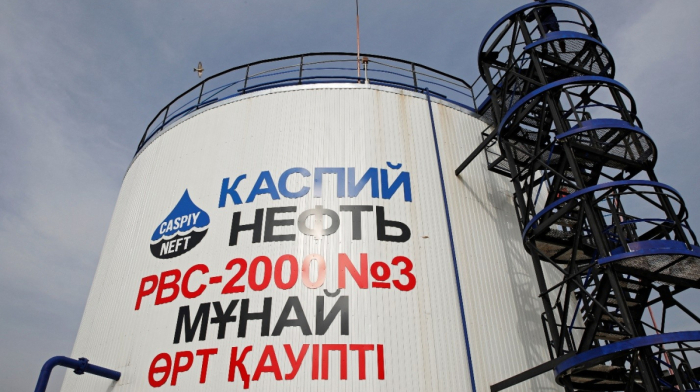
The article’s opening argues that any confrontation would result in the conflict “spreading the flames of war to all of Washington’s allies in West Asia,” pointing in particular to what it described as Israel’s growing dependence on Azerbaijani oil supplies.
The commentary also alleges that Israel’s access to facilities near Iran’s borders, described as being used for “espionage and surveillance operations” and potentially for attack scenarios, could further elevate Azerbaijan’s exposure in a conflict scenario.
According to the report, Tehran’s message to Baku, Ankara and other regional capitals was that any future confrontation would blur the distinction between direct participants and regional intermediaries. It warned that crossing what it described as red lines would carry significant costs.
Azerbaijan’s stance
In Azerbaijan, Foreign Minister Jeyhun Bayramov has underscored Baku's position on the crisis.
Following a 29 January phone call with Araghchi, Bayramov stated that Azerbaijan will not permit its airspace or territory to be used by any state for military operations against Iran.
He described the recent escalation of tensions as a cause for concern, reaffirming Azerbaijan’s commitment to sovereignty, territorial integrity and non-interference.
Azerbaijan has consistently emphasised diplomatic solutions and restraint over confrontation.
In June 2025, Bayramov similarly told Iranian counterparts that Azerbaijan’s territory would not be used for third-party strikes amid the prior Israel-Iran conflict, extending condolences over Iranian casualties and stressing dialogue in line with international law.
Broader regional context
The backdrop to these diplomatic exchanges is a wider period of tension between Iran and Israel that flared into direct hostilities in June 2025, when Iran launched missile strikes on Israel and exchanges of attacks during 12 days, prompting fears of a broader conflict.
During that period, Pezeshkian said Tehran did not seek to “expand the circle of war” but would respond “in proportion” to attacks.
In late January 2026, the diplomatic push in Ankara emphasised compromise and de-escalation, with Turkish officials urging Iran to make concessions on its nuclear programme to ease the crisis.
The region now faces a complex mix of hard rhetoric and active diplomacy. Iranian state-linked media warnings to Azerbaijan and Türkiye underline Tehran’s sensitivity to external threats against its sovereignty.
At the same time, Türkiye is actively mediating to prevent escalation and has publicly opposed a U.S.-led military strike, while Azerbaijan has sought to reassure Tehran it will not be drawn into a conflict.










What is your opinion on this topic?
Leave the first comment