Baku has once again become a focal point for international energy diplomacy, investment and strategic cooperation, as Baku Energy Week brings together policymakers, industry leaders and investors from around the world.
More than 600 delegates from over 20 countries have gathered at the Baku Convention Centre and Baku Expo Centre, including representatives from the U.S., United Kingdom, Germany, France, China, Saudi Arabia, Türkiye, Japan and the United Arab Emirates. Nearly 60 speakers are taking part in discussions on energy security, diversification, sustainability and regional connectivity.
AnewZ was on the ground in Baku, covering developments from the Baku Energy Forum and the wider Baku Energy Week as global energy leaders, policymakers and investors gathered to discuss the future of energy, investment and regional cooperation.
Energy transition and international cooperation in focus
Recognised as the flagship platform of Baku Energy Week, the Baku Energy Forum opened with a ministerial plenary session on "International Cooperation for a Resilient and Diversified Energy Future", chaired by Azerbaijan's Minister of Energy, Parviz Shahbazov.
The forum is addressing a broad range of issues, including the future of sustainable energy systems, long-term energy transition strategies, green energy development, export opportunities and regional cooperation.
A key session examining leadership perspectives on the energy transition and future strategies featured a keynote address by SOCAR President Rovshan Najaf.
The event has also become a venue for major international organisations to hold dedicated discussions. These include the International Renewable Energy Agency's Investment Forum, a ministerial dialogue on renewable energy-driven transition in Central Asia, and specialised sessions on energy efficiency, clean energy innovation and regional cooperation.
Another notable development was the first meeting of energy ministers from D-8 member states, held on the opening day of the forum.
Supported by Azerbaijan's Ministry of Energy, with SOCAR serving as General Partner, the forum continues to strengthen its position as one of the region's leading platforms for global energy dialogue.
$7.5 billion in agreements signed
Alongside policy discussions, Baku Energy Week has delivered a significant package of commercial agreements.
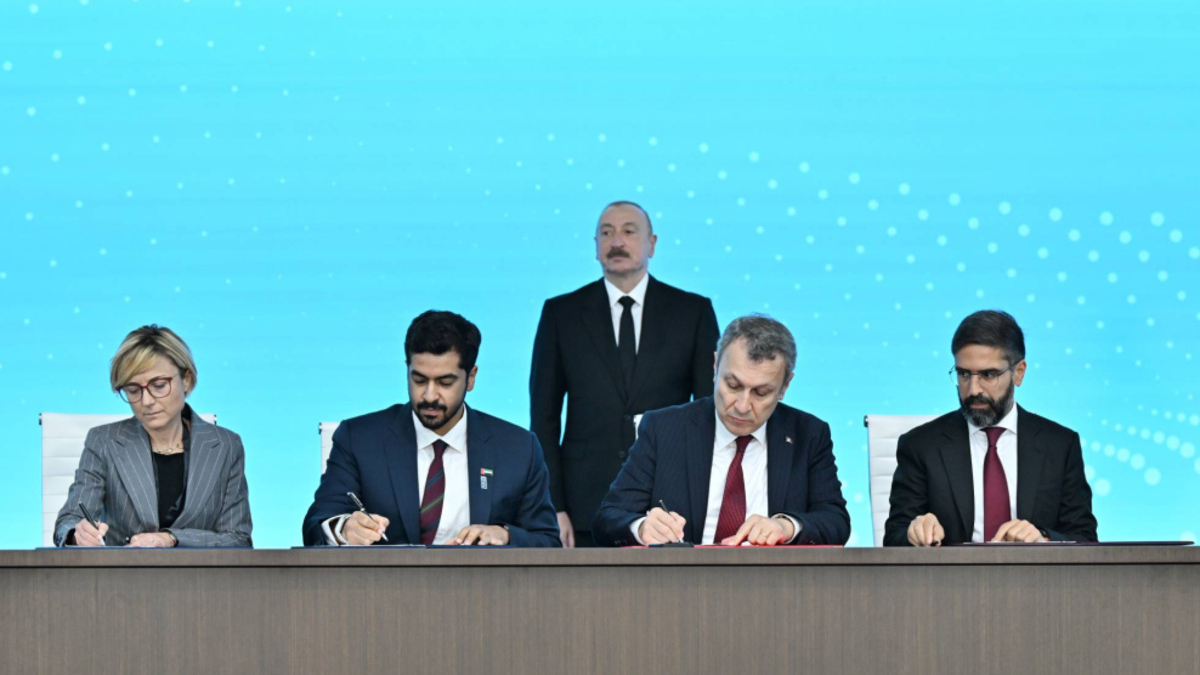
During the event and the first Azerbaijan–U.S. Economic Dialogue, Azerbaijan's Ministry of Economy and SOCAR signed agreements and memoranda worth approximately $7.5 billion with partners from the U.S., Türkiye, Serbia, San Marino and France.
Officials described the agreements as evidence that economic cooperation between Azerbaijan and the U.S. has reached a more institutional and strategic level.
One of the most significant documents was the "Azerbaijan–United States Framework for Securing Supply in the Mining and Processing of Critical Minerals and Rare Earths", signed by Economy Minister Mikayil Jabbarov and U.S. Assistant Secretary of State for Economic, Energy and Business Affairs Caleb Orr.
A major energy agreement was also concluded between SOCAR, TotalEnergies, XRG and BOTAŞ for the sale of 30 billion cubic metres of natural gas from the Absheron gas-condensate field to the Turkish market over a 15-year period.
Additional agreements covered the development of a gas-fired power plant in the Serbian city of Niš, potential cooperation between SOCAR and Shell across upstream and downstream energy projects, gas exports to San Marino, and joint studies with Chevron to assess hydrocarbon potential in the Middle Caspian Basin.
Several financing agreements were also signed, including strategic cooperation with Apollo Global Management on the TANAP pipeline project, expanded financing arrangements with JP Morgan, and new opportunities for cooperation with U.S. energy producer Comstock Resources.
The growing role of technology in the energy sector was reflected in agreements involving artificial intelligence, cloud infrastructure and digital transformation, including partnerships with Haimaker.ai, Oracle and George Washington University.
Energy security and connectivity dominate discussions
As the event moved into its second day, attention shifted towards energy security, investment opportunities and infrastructure development.
At the Baku Expo Centre, companies participating in the Caspian Oil & Gas and Caspian Power exhibitions showcased innovations in oil and gas production, low-carbon technologies and energy infrastructure.
Industry discussions focused on the Southern Gas Corridor and its contribution to regional energy security and supply diversification. Experts also examined how digital technologies, automation and advanced engineering can improve efficiency across energy projects.
Connectivity emerged as another major theme. Participants discussed the strategic importance of the North–South and Middle Corridor transport routes and their growing role in trade, logistics and energy flows across Eurasia.
Beyond the formal sessions, business-to-business and business-to-government meetings continued throughout the week, providing opportunities for governments, investors and international companies to explore new partnerships and projects.
With deal-making, energy security and regional cooperation at the centre of discussions, Baku Energy Week is reinforcing Azerbaijan's position as a key hub for energy policy, investment and connectivity between Europe, Central Asia and the wider region.















What is your opinion on this topic?
Leave the first comment