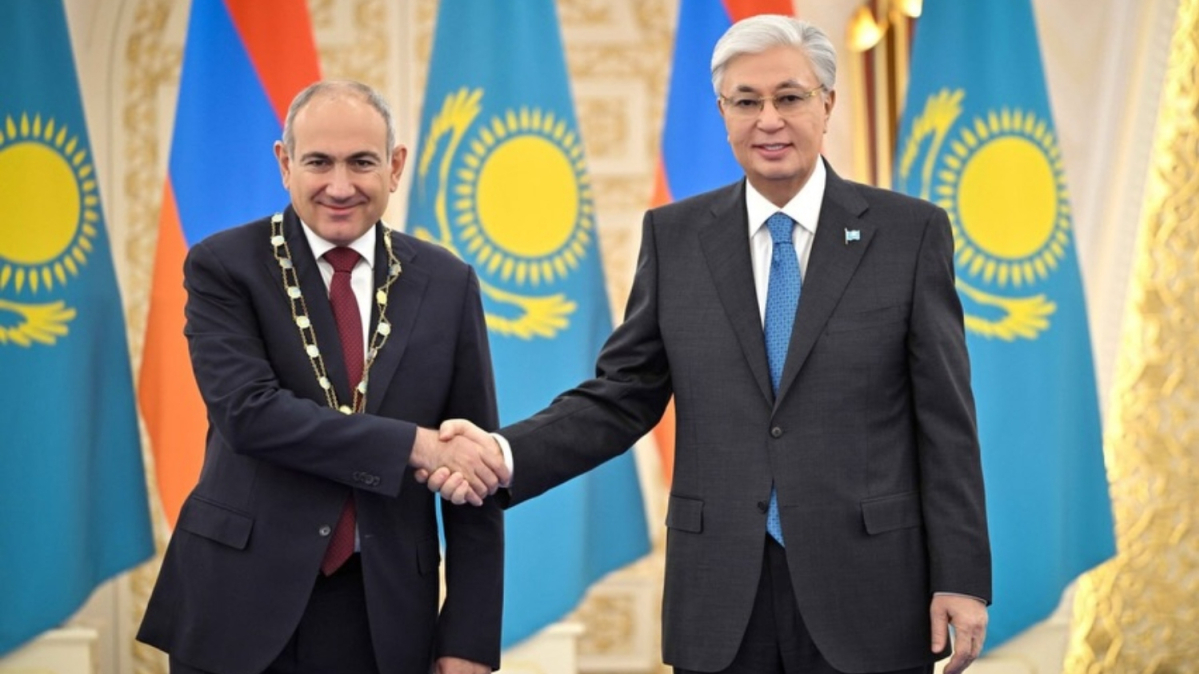
Armenian Prime Minister Nikol Pashinyan made his first official visit to Astana, marking a significant event in bilateral relations.
Following talks with Kazakhstan’s President Kassym-Jomart Tokayev, a joint statement was issued and 15 documents were signed, covering a broad range of areas of cooperation.
The parties discussed trade and economic relations, transit and transport logistics, investment cooperation, subsoil use, agriculture, digitalisation, the implementation of artificial intelligence, and healthcare.
Tokayev emphasised that Armenia is one of Kazakhstan’s key political and economic partners in the South Caucasus.
Pashinyan, in turn, noted that changes in the region open new opportunities for economic collaboration and the strengthening of transport links.
The economic potential of the partnership is evident, although the structure of trade requires adjustment. Over the first eight months of 2024, bilateral trade amounted to $57 million.
In this context, the possibility of resuming direct flights between Kazakhstan and Armenia was also discussed, which, according to Deputy Prime Minister and Minister of National Economy Serik Zhumangarin, could boost business and tourism contacts.
Against the backdrop of the peace agreement signed on 8 August in Washington between Armenia and Azerbaijan, new transport and economic opportunities are emerging, potentially giving momentum to cooperation between Astana and Yerevan.
The President of Kazakhstan described the agreement as a “historically important achievement.” Just two months after its signing, Azerbaijan lifted transit restrictions for Armenia, and the first shipment of Kazakh wheat, totalling 1000 tonnes, was delivered via Azerbaijani territory to Armenia, establishing a promising transport corridor in the South Caucasus.
The new geopolitical situation creates favourable conditions for expanding bilateral and regional contacts.
Kazakhstan supports Armenia’s “Crossroads of Peace” initiative in the transport and transit sector and has expressed interest in the “International Route of Peace and Prosperity (TRIPP)” project.
Kazakhstan has also indicated its readiness to supply Armenia regularly with grain and other goods, enhancing the economic potential of the partnership.
Pashinyan’s visit to Astana and the signed documents reflect the current dynamics of Kazakh-Armenian relations against the evolving backdrop of the South Caucasus.
The two countries have agreed on measures to expand economic cooperation, strengthen transport links, and participate in regional infrastructure projects, including new logistics corridors through Azerbaijan.
These steps provide a foundation for more active engagement between the countries and may have implications for trade and transport routes in the region.
















What is your opinion on this topic?
Leave the first comment