Venezuela Oil Exports Rise, Output Cuts Continue
Venezuela’s oil exports under a flagship $2bn supply deal with the U.S. reached around 7.8 million barrels on Wednesday, vessel-tracking data and st...
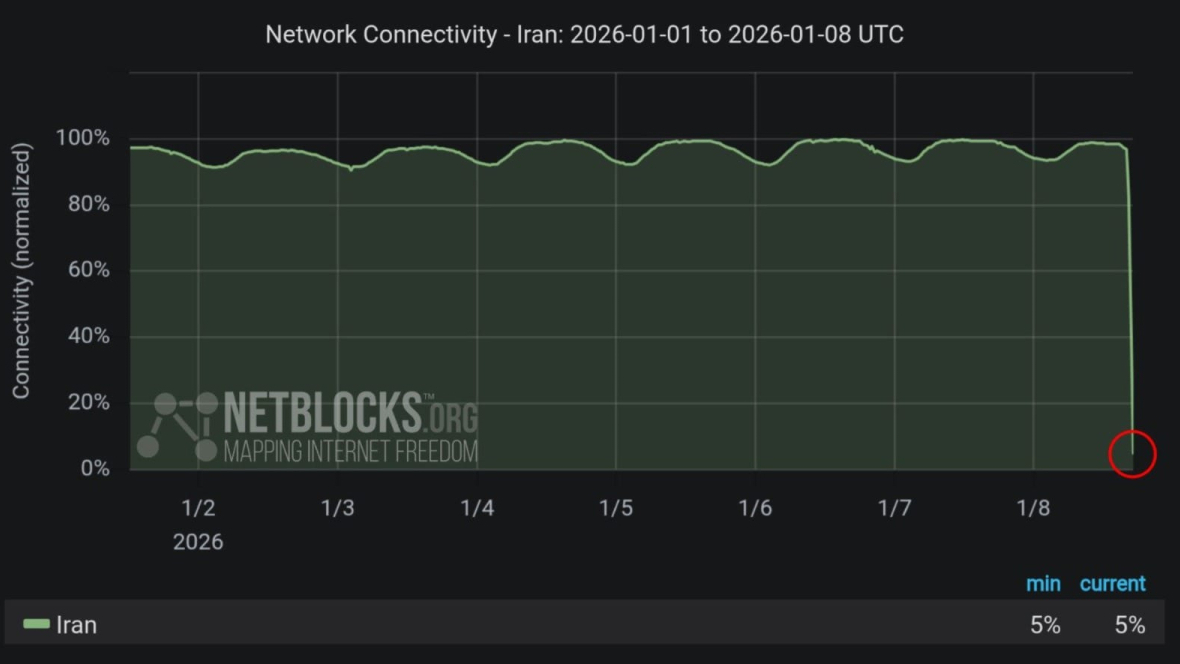
Iran is now facing a near‑total internet blackout as anti-government protests sweep the country. Major cities including Tehran have seen connectivity drop sharply, leaving millions of residents isolated from online communication.
NetBlocks, a digital rights monitor, reported widespread loss of access to online services on Thursday, with connectivity falling sharply across multiple providers at the height of demonstrations that have entered their second week.
By Friday (9 January), latest independent reports claim, Iran’s internet has been down for 12 hours, with connectivity dropping to around 1% of normal levels.
The shutdown comes amid an escalation in unrest, with demonstrators clashing with security forces and targeting symbols of the Islamic Republic. Authorities appear to be restricting internet access to limit coordination among protesters and control the flow of information.
Human rights observers warn that internet blackouts during periods of unrest can conceal violent crackdowns and prevent independent reporting. With online communication cut, it is difficult to confirm events on the ground, raising concerns about civilian safety.
No official statement has been issued by Iranian authorities regarding the scope or duration of the outage. Residents report that access to social media, messaging apps, and other online services has been severely restricted, intensifying fears about what may be happening amid the ongoing demonstrations.

Several locally-developed instant messaging applications were reportedly restored in Iran on Tuesday (20 January), partially easing communications restrictions imposed after recent unrest.
There was a common theme in speeches at the World Economic Forum on Tuesday (20 January). China’s Vice-Premier, He Lifeng, warned that "tariffs and trade wars have no winners," while France's Emmanuel Macron, labelled "endless accumulation of new tariffs" from the U.S. "fundamentally unacceptable."
Dozens of beaches along Australia's east coast, including in Sydney, closed on Tuesday (20 January) after four shark attacks in two days, as heavy rains left waters murky and more likely to attract the animals.
U.S. President Donald Trump said Washington would “work something out” with NATO allies on Tuesday, defending his approach to the alliance while renewing his push for U.S. control of Greenland amid rising tensions with Europe.
At the World Economic Forum’s “Defining Eurasia’s Economic Identity” panel on 20 January 2026, leaders from Azerbaijan, Armenia and Serbia discussed how the South Caucasus and wider Eurasian region can strengthen economic ties, peace and geopolitical stability amid shifting global influence.
Armenia and Azerbaijan will interconnect their energy systems, enabling mutual electricity imports and exports as part of a wider regional transit initiative, Armenian Prime Minister Nikol Pashinyan said.
Mine-clearing machines produced in Azerbaijan by ImProtex are being used to support demining operations across the country, as efforts continue to address landmine contamination left by past conflicts.
As part of the Frontline episodes, this AnewZ documentary investigates Libya fifteen years after the revolution and the fall of Gaddafi — a state caught between militias, foreign powers, energy interests and diplomatic manoeuvring.
Armenia's Prime Minister, Nikol Pashinyan, wants former Armenian ambassador to the U.S., Lilit Makunts, to become the next Speaker of the National Assembly.
Türkiye and Uzbekistan have established a new institutional framework for security and foreign policy coordination. Held in Ankara on Tuesday (20 January), the first meeting in the “4+4” format assembled the Turkish and Uzbek ministers for foreign affairs, defense, the interior, and intelligence.
You can download the AnewZ application from Play Store and the App Store.
What is your opinion on this topic?
Leave the first comment